

Bank statement loans can help people who work for themselves qualify for a mortgage. This is when their tax return income does not show how money they really make. Many business owners, freelancers and independent workers earn an income but deduct business expenses on their tax returns. This can make it harder for them to qualify for a mortgage because their taxable income is lower.
Many business owners, freelancers, independent contractors, consultants, real estate agents, truck drivers and gig workers make income but legally deduct business expenses on their tax returns. Those deductions may reduce income and make it harder to qualify for a traditional mortgage.
They can use bank statement loans to show they can afford mortgage payments. Self-employed borrowers can use these loans to qualify.
What Are Bank Statement Loans?
Bank statement loans are programs for mortgages that let people get a loan using their bank statements of the usual papers that show their income. The lender looks at the money that is deposited into the person’s bank account, or just looks at their tax returns, to figure out how much money they make.
These bank statement loans are really helpful for people who work for themselves and do not get a paycheck. Sometimes these people have tax returns that show they do not make a lot of money because they can write off business expenses.. They might actually have a lot of money coming in every month. The problem is that they might still have a time getting a regular mortgage because their tax return does not show that they have enough income.
Bank statement loans can be used for the house you live in, a home or a property that you are going to rent out to someone else it just depends on what the lender and the people who invest in the loan are okay, with.
How Do Bank Statement Loans Work
When you get a bank statement loan, the lender looks at your bank statements to figure out how much money you make. They usually look at 12 or 24 months of statements. It really depends on the lender.
The lender checks a lot of things like how much money’s going into your account what your business is doing, how you spend your money if you have overdrafted and if you have gotten any big deposits. They also want to know if your account is stable. If you use your business bank statements the lender might use a number to guess how much money you really make after expenses. If you use your statements they look at how much money you get regularly and decide how much of that can actually be counted as income.
So the amount of money the lender says you make which is called your qualifying income depends on how the lender does their math, what kind of bank account you have what kind of business you have and how consistent your deposits are. The bank statement loan is based on this qualifying income and the lender uses bank statements to determine it.
Bank Statement Loans for Self-Employed Borrowers
Though certain qualifications differ from one lender to the next, there are common criteria for most bank statement loan programs.
- Self-employment history: Many lenders prefer a two-year self-employment history. Some programs may consider one year if the borrower has related prior work experience, education, or a strong overall file.
- Credit score: Credit score requirements vary by lender. Borrowers with lower credit scores may need stronger compensating factors, such as a larger down payment, more reserves, lower loan-to-value ratio, or consistent deposits.
- Down payment: Bank statement loans often require a larger down payment than traditional agency loans. The exact amount depends on credit score, loan amount, occupancy, property type, and lender guidelines.
- Cash reserves: Some lenders may require reserves after closing. Reserves are extra funds available after the down payment and closing costs are paid.
- Debt-to-income ratio: Some non-QM bank statement loan programs may allow higher debt-to-income ratios, but approval depends on the full borrower profile, including credit, reserves, income stability, and loan-to-value ratio.
Paperwork Required For Bank Statement Loans
In the event one wants to apply for a bank statement loan, one should be fully equipped to offer the following papers:
- 12-24 months’ worth of personal or business bank statements.
- Some programs may accept profit-and-loss statements in lieu of bank statements.
- Self-employment proof, also known as a business license
- Credit Profile Review
- The documentation for assets
- A photo ID and the Social Security number (or the ITIN for foreign nationals)
Why Self-Employed Borrowers Use Bank Statement Loans
The gig and self-employment economy is booming like never before in history. Over 16 million Americans classify themselves as self-employed people and have their businesses. These entrepreneurs and business owners create a need for flexible mortgage options.
Self-employed borrowers often do not have enough qualified income to be eligible for conventional loans. The government offers many income tax loopholes for entrepreneurs who consider themselves self-employed or business owners.
Many self-employed borrowers legally deduct business expenses, which can reduce the net income shown on tax returns. This may make it harder to qualify for a traditional mortgage, even when the borrower has strong cash flow.
Bank Statement Loan Program Categories
Different lenders have different bank statement loan programs designed to fit different types of borrowers:
Programs For Personal Bank Statements
With this type of program, lenders want personal bank statements for the last 12 to 24 months to verify income. Most lenders will calculate income based on a certain percentage of deposits. That percentage is usually between 50% and 100%, depending on the lender’s methodology.
Business Bank Statement Programs
These programs look at the owner’s business bank statements to assess income. Depending on the lender, they may analyze a proportion of overall deposits, or examine only deposits related to the business.
1099 Income Programs
Some lenders have programs that use 1099 earnings statements to qualify borrowers, in lieu of bank statements or in addition to them.
P&L Only Programs
These programs enable self-employed borrowers to qualify with a profit and loss statement from a CPA, and usually with a cover for the last two years plus year-to-date.
Case Scenario of Self-Employed Borrowers
In this section, we will review some case scenarios of self-employed wage earners who may have difficulty qualifying for a traditional conventional mortgage but will be eligible for bank statement loans for self-employed borrowers.
- Freelancers: Freelancers may get paid irregular incomes at different times.
- Small business owners might reinvest profits into their companies, shrinking the figure subject to tax.
- Real estate investors may have depreciation write-offs that distort their true financial picture.
- Bank statement loans can solve these problems because they offer a different approach, allowing even those who do not fit the traditional criteria to become homeowners.
What Is the Procedure for Acquiring Bank Statement Loans?
Unlike traditional mortgage applications, obtaining a bank statement loan is easy, though the steps are slightly different. Here is how to do it.
Step 1: Submit Required Bank Statement Documents
According to the lender, borrowers must submit either 12 or 24 months’ worth of bank statements (personal, business, or a combination). These statements must demonstrate the borrower’s stable income through consistent deposits.
Step 2: Income Evaluation
The income calculation step is straightforward and uncomplicated. Lenders tend to compute income based on the minimum deposits made over the specified month. Some lenders may use a multiplier (10-50 percent) to cover business expenses, while others utilize gross deposits.
Step 3: Credit and Asset Verification
Lenders also evaluate credit score assessments (often requiring a minimum of 620-660), DTI ratios, and liquid reserve requirements (often 6-12 mortgage payments worth). The business must be personally owned for the mortgage account to be opened.
Step 4: Property Evaluation
Depending on which lender offers the best deal, primary residences, second homes, or investment properties can be utilized under set terms that vary for different lenders.
Step5: Approval and Closing
After approval, the loan is processed like any other mortgage, with competitive interest rates and funding timelines. Bank statement loans, unlike stated income loans in the past, require verified documentation, allowing the lender a degree of flexibility and security.
Discover How Bank Statement Loans Work – The Solution for Self-Employed Borrowers!
Apply Now And Get Recommendations From Loan Experts
Benefits of Bank Statement Loans for Self-Employed Borrowers
Bank statement loans have numerous benefits that appeal to self-employed individuals. Here’s what makes them different:
Income Verification Is More Flexible
This is because with mortgages the lender looks at your tax returns and it can hurt you if you have a lot of tax write-offs. With bank statement loans the lender looks at your cash flow. So what really matters is how money you actually have, not just what you put on your tax return. This means that bank statement loans look at your earning potential.
Increased Loan Amounts
This is because the lender looks at the amount of money that is deposited into your bank account. Self-employed borrowers can get bigger loans with bank statement loans than they could with other types of loans. This is really helpful when you are buying a property.
Fast Approval Process
This is because bank statement loans do not require as paperwork. So they can be. Closed much faster than other loans. This is really good for borrowers who need to act in a competitive market.
Accessibility for Non-Traditional Income Sources
This means that people who work on their own like freelancers or gig workers can use their bank statements to show that they are financially stable. This helps them get loans that they might not be able to get So bank statement loans are really helpful, for self-employed borrowers who have income streams. Bank statement loans can really help self-employed borrowers get the money they need to buy a property.
Tips for Securing Bank Statement Loans
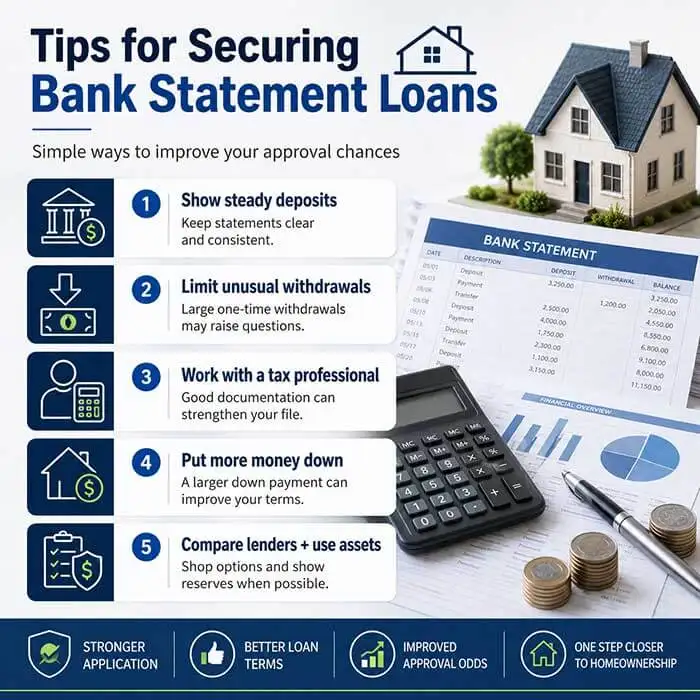
These strategies are among the most effective in increasing your chances of getting better offers:
- Streamline Your Bank Accounts: Ensure your bank statements show deposits.
- Too many large one-off withdrawals can be concerning.
- Use a Tax Professional: A tax professional can provide the necessary documentation that substantiates the healthier expense-income ratio he intends to portray.
- Increase Your Down Payment: A bigger down payment can offset increased interest rates and showcase greater financial commitment.
- Check Multiple Options: Look for multiple lenders to get favorable rates, terms, and reserve requirements that suit your needs.
- Use Your Assets: Invest in your savings and investments, as they will improve your application.
Bank Statement Mortgage Loans vs. Traditional Mortgages
Traditional mortgages usually verify income with W-2s, pay stubs, tax returns, and written employment verification. These loans may work well for salaried employees or self-employed borrowers whose tax returns show enough income.
Bank statement loans use bank deposits to evaluate income. They may work better for borrowers with strong cash flow but lower taxable income due to business deductions.
Traditional mortgages may offer lower rates and more standard terms, but they usually have stricter income documentation rules. Bank statement loans may offer more flexibility, but borrowers should expect different pricing, down payment, reserve, and documentation requirements.
Advantages of Bank Statement Loans
Bank Statement Loans are really helpful for people who’re self employed. They have a few things about them.
- Bank Statement Loans look at how much money’s coming in and, out of your account not just what you say you make on your taxes.
- You do not have to give them your tax returns.
- Bank Statement Loans also understand that sometimes you make money and sometimes you make less.
- Some people who give out Bank Statement Loans can make a decision really fast.
- You can also get a Bank Statement Loan even if you have a lot of debt compared to how money you make.
Bank Statement Loans Drawbacks
Bank Statement Loans are not perfect they have some downsides.
- The interest rates for Bank Statement Loans are really high even higher than the rates for loans.
- You need to pay an amount of money when you first get a Bank Statement Loan.
- Not many lenders give out Bank Statement Loans there are lenders, for regular mortgages.
- To get a Bank Statement Loan you have to meet some rules.
- Sometimes the costs to close a Bank Statement Loan can be very high.
Bank Statement Loans: Other Options
If a bank statement loan does not meet your needs, consider these alternatives:
- Asset-based loans for self-employed individuals, where collateral is used instead of income^1
- Investment property DSCR loans
- Foreign national ITIN loans that do not require a Social Security Number.
- Traditional loans with complete income doc collection
- FHA loans that accept alternative credit documentation
Tips To Improve Your Chances Of Mortgage Approval
To get a mortgage you need to do a things.
- Have a bank account for your business and a separate one for yourself.
- Do not put a lot of money in your account that you did not have before because this can look suspicious when you apply for a mortgage.
- You should also keep all your business papers in order. Make sure you have all your financial statements.
- Pay off the money you owe to get a debt to income ratio.
- A lower debt, to income ratio is better when you want to get a mortgage. So try to make your debt to income ratio
This will make it easier for you to get a mortgage. You should also talk to a mortgage broker who knows about Non-QM loans they can help you with your mortgage application.
FAQs On Bank Statement Loans
How Do My Credit Scores Have To Be To Get Approved For Bank Statement Loans?
My credit score is important. Some lenders will accept a credit score low as 500. Others want a credit score of 620 or higher. If I have a credit score I can get better terms.
What Are Bank Statement Loans Down Payment Requirements?
The down payment for a bank statement loan is usually between 10% to 20%. Some lenders may want down payment. It depends on my credit and other things.
Can I Buy An Investment Property With Bank Statement Loans?
I can buy an investment property with a bank statement loan. I can also use it to buy a home or my main home. Most programs let me do all these things.
Is It True Bank Statement Loans Are More Expensive Than Loans?
Bank statement loans cost more than loans. They have interest rates and maybe higher closing costs. Lenders charge more because these loans are riskier.
Can I Use Bank Statement Loans To Refinance Investment Properties?
I can refinance an investment property with a bank statement loan. Most lenders let me use these loans for refinancing and buying.
What If I’ve Only Been Self-Employed For One Year?
Most lenders want me to have two years of self-employment history.. Some lenders may consider me if I have one year of self-employment and relevant experience or education.
Do I Need To Provide Tax Returns For Bank Statement Loans?
Most bank statement loan programs do not need my tax returns. This is good for self-employed borrowers like me.
Are There Income Limits For Bank Statement Loans?
Bank statement loans do not have income limits like some government-backed programs. This makes them good for self-employed people, with incomes who may not qualify for other programs.
Unlock The Power Of Your Bank Statements To Secure Your Mortgage Today!
Apply Now And Get recommendations From Loan Experts