
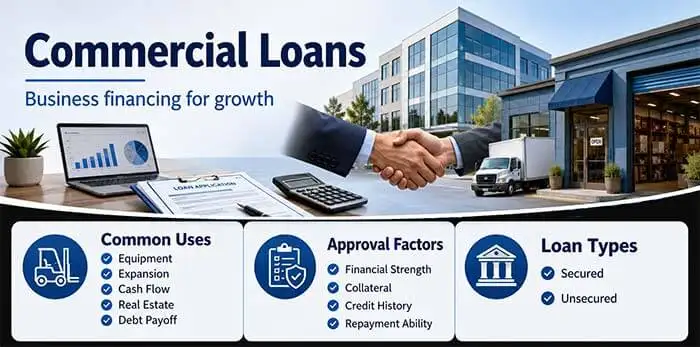
Commercial loans are a way for businesses to get the money they need to buy things like equipment or to help with everyday expenses. The right loan for a business depends on how much money the business makes, how much cash it has, what kind of collateral it has, its credit history, how long it has been in business, and what the money will be used for.
What Are Commercial Loans?
Commercial loans are a type of credit that banks, credit unions, and other lenders give to businesses to help them with their operations or to help them grow. Businesses use loans to buy equipment, expand their operations, manage their cash flow, buy real estate, or pay off other debts. Dale Elenteny, a mortgage loan originator at GCA Forums Mortgage Group, says that
Commercial loans can be tailored to meet the needs of a business, but the business must be able to show that it is financially strong, has good collateral, a good credit history, and can pay back the loan.
Commercial loans help businesses do the things they need to do to make money, be profitable and grow. These loans can be. Unsecured, depending on the lender and the creditworthiness of the business. Secured loans are backed by collateral, like estate or equipment, while unsecured loans are based on the business’s credit history and financial stability.
How Do Commercial Loans Work?
Commercial loans work like loans, where the business gets the money and then pays it back over time with interest. However, commercial loans are looked at closely to make sure the business can pay back the loan, and the lender considers things like the business’s revenue, cash flow, collateral, credit history, and what the loan will be used for.
Here is how it works:
- Step 1: The business applies for the loan by giving the lender an application that includes information about the business’s financial health, plans, and what it will use the money for. The application includes statements, tax returns, and business credit reports.
- Step 2: The lender looks at the business’s application. Evaluates its revenue, profitability, and cash flow to make sure it can pay back the loan. The lender also looks at the business’s credit history and the value of any collateral.
- Step 3: If the lender approves the loan, it will offer the business a loan with an interest rate and repayment terms. The interest rate and loan amount will have a repayment schedule that can be fixed or variable and can last from one to twenty-five years.
- Step 4: Once the business agrees to the terms, the lender gives the business the money, either all at or in payments.
- Step 5: The business then pays back the loan on a regular schedule, like monthly or quarterly. Some loans have a payment at the end called a balloon payment.
- Step 6: The lender keeps an eye on the business to make sure it is making its payments and meeting its obligations.
Requirements for Commercial Loans
If a business cannot pay back a loan, it can face penalties, damage to its credit rating, or even lose the collateral it used to secure the loan.
To get a loan, a business must meet certain requirements, which can vary depending on the lender and the type of loan.
Some common requirements include:
- Business Credit Score: The business must have a credit score to show that it can pay its debts on time.
- Time in Business: Most lenders want to see that a business has been in operation for at least one to two years.
- Profitability, Revenue and Cash Flow: The lender will look at the business’s revenue, profitability, and cash flow to make sure it can pay back the loan.
- Debt-to-Income Ratio: The business must have a debt-to-income ratio to show that it can afford to take on more debt.
- Collateral: For loans, the business must have collateral that is worth enough to cover the loan amount.
- Financial Documents: The business must provide documents, like balance sheets and income statements, to show its financial health.
- Personal Guarantees: In some cases, the business owner may have to guarantee the loan, which means they will be responsible for paying it back if the business cannot.
Type Of Commercial Loans
Commercial loans come in different types, including:
- Term Loans: Term Loans are a type of loan that provides a business with an amount of money. This money is used for a purpose, such as buying new equipment. Sometimes a business will use Term Loans to expand its operations. The money from Term Loans can be really helpful for a business that needs to grow or buy things. Term Loans are an option, for businesses that need a set amount of money for a specific reason.
- Commercial Real Estate Loans: These loans are used to buy or renovate property like office buildings or retail space.
- Lines of Credit: These loans give a business a line of credit that it can use to borrow money, pay it back, and borrow again as needed.
- Equipment Financing: These loans are used to buy or lease equipment, like machines or vehicles.
- SBA Loans: These loans are guaranteed by the U.S. Small Business Administration. They are designed to help small businesses get the funding they need.
- Invoice Financing: This type of loan allows a business to borrow money against its invoices.
- Merchant Cash Advances: These loans give a business a lump sum of money in exchange for a percentage of its credit or debit card sales.
- Bridge Loans: These loans are short-term loans that are used to cover expenses until a business can get a loan or permanent funding.
- Microloans: These loans are designed to help businesses get the funding they need to start or grow their operations. Microloans are business loans that people use to start a business or to help a small business. They use these loans to buy things like inventory, equipment, or to pay for expenses when they are just starting out. Use Cases: You can use microloans to set up a business, buy the things you need to get started, and pay for things that you need to run your business. Features: If you are a business and you do not have a credit history, the interest rate on your loan might be higher. This means you will have to pay money back when you borrow money. Example: Let’s say someone starts a bakery from their house and they want to buy an oven to make more bread. They can get a microloan of 10,000 dollars to buy that oven.
Commercial loans are a way that businesses can get money to achieve their goals. These goals can be things like getting bigger, buying equipment, or making sure they have enough cash to pay their bills. To make decisions about borrowing money, businesses need to know about the different types of commercial loans and what they need to be eligible for these loans. They also need to know how these loans work.
Before a business applies for a loan they should look at lenders and compare the terms of the loans and the interest rate. They should also talk to experts to make sure they are not paying too much money for the loan. If a business can get a commercial loan they can use that money to help it succeed in a competitive market. Businesses need to think about what they need and what they can afford before they borrow money. Microloans and commercial loans are both types of loans that businesses can use to help them grow and succeed. Commercial loans can be very helpful for businesses that are trying to achieve their goals.
Commercial Loans—Get the Right Financing for Your Business
Whether you need to purchase, refinance, build, or expand, we’ll match you with the right commercial loan based on your property type, cash flow, and timeline.
Commercial Loans vs Residential Mortgages
When you get a loan, it is very different from getting a residential mortgage. With a mortgage, the people who lend you the money look at your personal income and your credit. They also look at the house you are buying.
With a loan, the lender looks at the business and how it makes money. They want to know if the business can pay back the loan. They also look at the business’s cash flow and the property that is being used for the loan.
Commercial loans can be paid back faster than mortgages. Sometimes you have to make a payment at the end of the loan. The interest rate on a loan can change and the lender may ask you to personally guarantee the loan.
What Lenders Check To Approve A Business Loan
To get a loan approved, the lender looks at a lot of things. They look at how much money the business makes and if it makes a profit. They also look at how the business has been around and what kind of business it is. The lender looks at your credit and the business’s credit. They want to know what you are using the loan for and if you can pay it back. If you are getting a loan for a building, the lender looks at how much money the building makes. They look at who’s renting the building and how much they pay. The lender also looks at the building’s value. If it is safe for the environment. If you have a business with a steady income and good credit, you can usually get a loan. You also need to have something of value to use as collateral, for the loan. This means you have options to get a commercial loan.
Documents Needed for a Commercial Loan
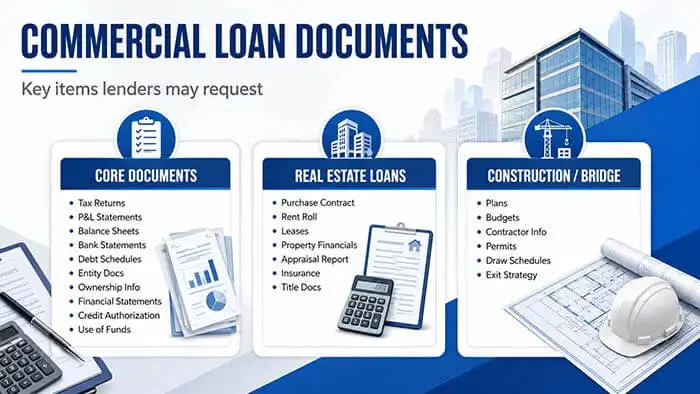
To get a loan, you will need to provide some documents. The documents you need may vary depending on the type of loan you are applying for. Usually you will need to provide business and financial records.
Here are some common documents you may need:
- * Business tax returns
- * Personal tax returns
- * Profit and loss statements
- * Balance sheets
- * Business bank statements
- * Business debt schedules
- * Entity documents
- * Operating agreements
- * Ownership information
- * Personal financial statements
- * Credit authorization
- * A clear explanation of how you will use the loan money
If you are applying for a real estate loan you may also need to provide:
- * A purchase contract
- * Rent roll
- * Leases
- * Property financials
- * Appraisal
- * report
- * Insurance information
- * Title documentation
If you are applying for a construction or bridge loan you may need to provide:
- * Plans
- * Budgets
- * Contractor information
- * Permits
- * Draw schedules
- * An exit strategy
How To Choose the Right Commercial Loan
The best commercial loan for you will depend on what you need the money for. A commercial real estate loan may be best if you want to buy or refinance a property. A business line of credit may be better if you need money for short-term cash flow. Equipment financing may be best if you need to buy machinery or vehicles. An SBA loan may help if you have a business and need longer terms. A bridge loan may work if you have a short-term project with a plan for repayment. Before you choose a loan you should compare:
- * The loan amount
- * The interest rate
- * The repayment term
- * The monthly payment
- * The total cost
- * The collateral requirement
- * The prepayment rules
- * The closing costs
- * How the payment will affect your business cash flow
Commercial Loan Rates and Terms
Commercial loan rates and terms can vary a lot. The price you pay will depend on the type of loan the lender, the collateral your credit profile, your business revenue, the industry risk, the loan amount, the property type, the market conditions and the repayment structure. Some commercial loans have fixed rates while others have rates. Some loans are fully amortizing while others have balloon payments after a term.
You should review the loan structure, not just the interest rate. A loan with a rate may still have fees, short repayment terms or a balloon payment that affects your long-term planning.
Risks of Commercial Loans
Loans can help your business grow but they also carry risk. You should understand the repayment obligation before you accept financing.
Some common risks include:
- * Payment pressure
- * Collateral loss
- * Personal guarantees
- * Variable rate increases
- * Balloon payments
- * Prepayment penalties
- * repayment terms
- * Cash-flow strain
Merchant cash advances and short-term business loans can be especially expensive if you do not understand the total repayment cost. Your business should borrow based on cash flow, not best-case projections.
How To Improve Your Chances of Getting Approved
You can improve your chances of getting approved by preparing your records before you apply. Clean bookkeeping, updated profit and loss statements, accurate tax returns organized bank statements and clear documentation can help the lender understand your business.
It also helps to:
- * Reduce debt
- * Maintain cash flow
- * Avoid overdrafts
- * Keep your business finances separate
- * Explain how you will use the loan
If you are applying for a real estate loan you should prepare:
- * Property financials
- * Leases
- * Rent rolls
- * A clear plan, for repayment or refinance.
When a Commercial Loan May Not Be the Option
A commercial loan may not work for your business if it can’t afford the payments. This is especially true if your revenue is over the place. You also need to have all your paperwork in order. Be cautious, with short-term loans that have a tight payment schedule. A loan should help your business grow not create a cash-flow mess. If your business is already having trouble paying its bills taking on new debt might make things worse. Unless you have a plan to get back on track that is. A commercial loan needs to help your business not hurt it. You should think carefully before getting a loan. A commercial loan should help you achieve your goals.
Need a Commercial Loan for Your Business Expansion?
Contact us today to discuss your needs and get pre-approved for your loan.