
In this blog, we will cover condominium loans. Are you considering buying a condo as your new home, vacation getaway, or investment property? If so, how can you finance your purchase? You can also use available online databases to search for approved condos. John Strange of GCA Forums advises reviewing the features and fees on condominium loans as follows:
Consider the interest rate, loan term, type, and fees when comparing condo loans. For example, consider whether you want a fixed-rate or adjustable-rate mortgage (ARM), how long you want to repay the loan (15 years or 30 years), and what closing costs and origination fees you must pay.
In the following paragraphs, we will explain condo loans, their differences from other types of mortgages, how to find the best condo loan for your needs, the benefits and drawbacks of buying a condo, and how to prepare for a condo loan application. Ultimately, you will better understand condo loans and how to achieve your homeownership goals.
What Are Condominium Loans and How Do They Differ From Regular Home Loans?
Condo loans are mortgages specifically designed to finance the purchase of condominium units. Condominiums, or condos for short, are buildings made up of individually owned units. Condo owners own only the interior of their units, while the exterior and common areas of the building are owned and managed by a condo or homeowners association (HOA). Condo loans differ from regular home loans in several ways. The mortgage lender may establish different or additional regulations for condo loans and charge slightly higher interest rates.
Complete Guide to Loans for Condominiums for Investors and Homebuyers
Financing a condominium often involves reduced maintenance responsibilities and opportunities for equity growth, but it also presents unique challenges. This guide details the mechanics of condo loans, criteria for selecting appropriate loan products, and lender evaluation processes for both borrowers and condominium projects.
Lenders consider condos riskier than single-family homes due to factors such as HOA fees, rules, and assessments that are out of the borrower’s control.
Condo loans may require more documentation and verification than regular home loans. Lenders must approve financing for the individual buyer and the condo project. Lenders will review the condo project’s financial health, legal status, insurance coverage, occupancy rate, and other criteria to determine eligibility.
Warrantable vs Non-Warrantable Condominium Loans
You can only purchase warrantable condominium loans with conventional and government-backed loans. Warrantable condos mean that 51% or more than the owners of the condo complex live in the condominium unit. Non-warrantable condos mean the reverse is true. 51% or more of the condo units are rented by condo owners. You can get financing on non-warrantable and condotel condominium units with portfolio or non-QM loans.
Obtaining a loan for a condominium shares similarities with securing a mortgage for a single-family home; however, several key differences may influence loan approval and interest rates.
Most banks and traditional lenders use Fannie Mae and Freddie Mac rules for ‘warrantable’ condos, which means the condo meets certain standards and can be sold to these agencies. A condo might be considered non-warrantable if there are too many investor-owned units, too much commercial space, low reserves, or ongoing lawsuits. Warrantable condos usually qualify for better rates and lower down payments, while non-warrantable condos may need higher down payments and special types of loans.
When Non-Warrantable Loans
Non-warrantable loans are often necessary for condominium projects with high investor ownership, significant commercial space, or ongoing litigation. These loans are also applicable to unique or boutique developments that do not conform to standard guidelines. Due to increased risk, lenders typically require higher credit scores, larger down payments, and may charge higher interest rates.
Pros and Cons of Portfolio Loans
Portfolio loans may offer greater flexibility but often impose stricter terms, such as higher down payments, increased cash reserve requirements, and potential interest rate adjustments. Portfolio financing can facilitate the purchase of specific non-warrantable condominiums, though it may involve certain trade-offs.
Another Review of the Condo Project
After you submit a loan application, the condo project’s lender usually has to complete a condo questionnaire and evaluate some HOA documents to determine what the project qualifies for and if there are any risks. They check owner occupancy rates, HOA delinquency, budget reserves, pending litigation, and if any one owner has too many units.
If the project does not meet these benchmarks, the condo may be labeled non-warrantable, which significantly restricts loan options and increases costs.
Some lenders may only lend to condo projects approved by Fannie Mae, Freddie Mac, FHA, or VA. Condominium loans may have different down payment and loan-to-value (LTV) requirements than regular home loans. Your loan type and property use may affect how much you must pay upfront and how much you can borrow for a condo. If you aim to buy a condo as an investment property with a conventional loan, you may need to make a 25% down payment and have an LTV of 75% or less.
FHA Condo Loan? Confirm FHA Approval First
FHA condo loans often require the project to meet FHA guidelines. We’ll verify approval status and outline the fastest path to move forward
Ready to Buy Your Dream Condo?
Condo loans are mortgages that let you buy a single condo unit. You own your unit, but you also share ownership of common areas with the Homeowners Association (HOA). Lenders look at both your finances and the condo project’s financial and physical health. Since your collateral is part of the entire building, this extra review sets condo loans apart from single-family home loans.
Conventional loans are among the most common and popular methods of financing condos, and they are especially suited for borrowers with a strong credit profile and stable income.
This guide explains how condo loans differ from traditional home mortgages, outlines qualification criteria for various condo mortgage types, and describes typical loan terms. It also addresses common approval challenges, required documentation, and frequently asked questions. Contact us today to learn about your options for securing a condominium loan and take the first step toward homeownership.
How Do You Find The Best Condo Loans For Your Needs?
Finding the best condo loan for your needs can be challenging, but it is possible. Here’s how you can shop for the best condo loan. Could you compare different lenders? Not all lenders offer condo loans with different rates, fees, terms, and guidelines. You should compare at least three lenders to find the best deal. Affordability. In some markets, a condo can be more affordable than a single-family home. Condos tend to be smaller and cheaper than single-family homes in terms of purchase price and property taxes. They can also help you build equity and wealth over time.
Financing Options for Condominiums
Borrowers seeking condominium financing must select from a range of loan programs, each with distinct requirements, benefits, and limitations. The suitability of these programs depends on factors such as credit score, income, down payment, and intended use of the condominium.
You can use various online tools to estimate your monthly payments and interest rates. Could you check the condo’s approval status? Before you apply for a condo loan, you should check if the condo project is approved by Fannie Mae,
Freddie Mac, FHA, or VA. These agencies have their lists of approved condos that meet their standards. If any of these agencies support the condo project, getting financing from lenders that follow their guidelines may be more manageable.
What Are The Benefits And Downsides Of Buying A Condo?
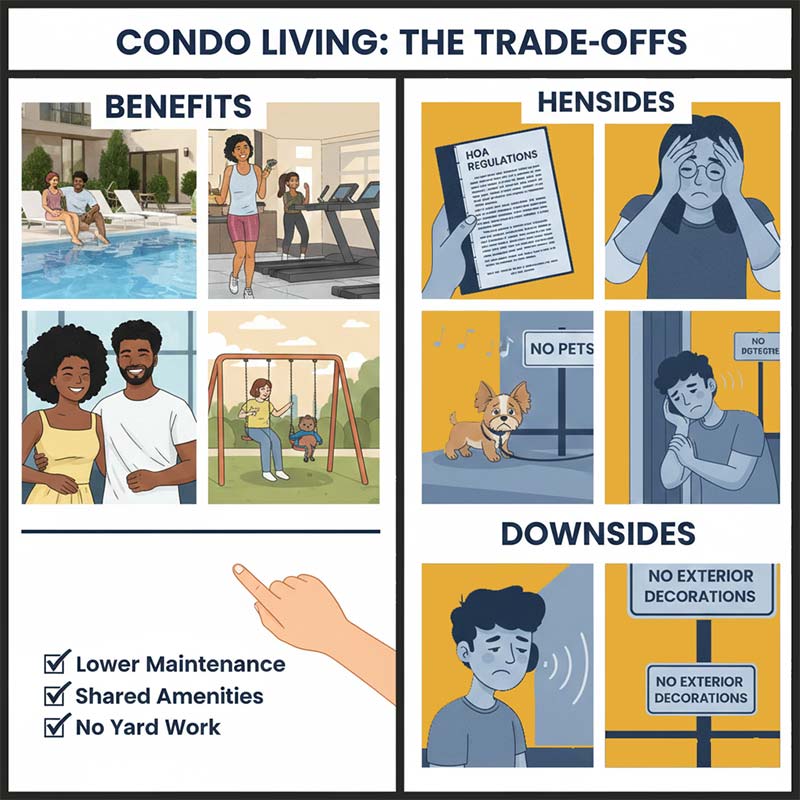
Buying a condo can be an excellent option for many home buyers, but it also has some trade-offs. We listed the benefits and downsides of purchasing a condo. Here are the benefits: Lower maintenance costs. The HOA takes care of the outside and shared spaces of the building. You may also face noise issues or neighbor disputes—stricter rules.
Buying a condo also means following the rules the HOA sets for living in the building. These rules can limit your freedom and flexibility in decorating your unit, renting it out, having pets, hosting guests, or making changes or improvements.
You do not need to worry about spending time or money on landscaping, snow removal, trash collection, and repairs. Shared amenities. Another benefit is that you can enjoy shared amenities such as pools, gyms, clubhouses, playgrounds, and security systems. These amenities can enhance your quality of life and add value to your property.
Downsides of Condominium Ownership
Higher association fees. One of the downsides of buying a condo is paying regular association fees to the HOA to maintain and manage the building. These fees depend on the size and quality of the building and its amenities. Condominium HOA fees can also increase over time due to inflation or unexpected expenses.
Another drawback of buying a condo is that you have less privacy than living in a single-family home. You have to share walls, floors, ceilings, and common areas with other residents who may have different lifestyles and preferences from yours.
You may also face fines or penalties for violating these rules, and there are potential risks. Buying a condo also involves potential risks that can affect your investment value or enjoyment of your property. For example, you may face issues such as poor management by the HOA and low occupancy rates by other owners or tenants.
How HOA Fees Affect Your Debt-to-Income Ratio
Lenders include HOA dues in the calculation of total housing expenses, which may reduce the maximum loan amount a borrower qualifies for. Although condominiums may have lower purchase prices than single-family homes, elevated HOA fees can increase the debt-to-income ratio and potentially hinder loan approval. All housing-related costs, such as taxes, HOA dues, principal, interest, and insurance, are considered when determining the maximum allowable payment. um payment.
How to Prepare for a Mortgage on Condominium Loans?
Applying for a condo loan can be complex and lengthy, but preparing beforehand can make it easier. This section will discuss the steps and documents needed to get approved for condominium loans. The first step is to check your credit score. Lenders know your credit score to decide if you can get a good condo loan.
A higher credit score is vital to better terms and lower rates. You should check and fix your credit score six months before applying for a condo loan. The three credit bureaus, Equifax, Experian, and TransUnion, provide a free credit report every year.
Save for a down payment. As mentioned earlier, you may need to make a larger down payment for a condo loan than a regular home loan, depending on the type of loan and the property. Save money to cover at least 10% to 20% of the purchase price, including the closing costs and reserves. You can also look for down payment assistance programs or gifts from family or friends to help you with the upfront costs.
How to Get Qualified and Pre-approved for Condominium Loans
Getting prequalified or pre-approved for a condo loan lets you know the amount you can borrow and will attest that you are a serious and qualified buyer. Dale Elenteny of GCA Forums Mortgage Group explains what you need to get qualified and pre-approved for condominium loans as follows:
To get prequalified, you must tell a lender some basic facts about your finances, such as your debts, income, assets, and credit. Afterward, they will show you how much you can borrow from them.
To get pre-approved, you must provide more detailed documentation and verification of your financial situation. Documents required to qualify for condominium loans include pay stubs, bank statements, tax returns, and W-2 forms. The lender will then give you a conditional commitment letter stating the exact amount and terms of the loan being offered.
Important Aspects of Traditional Condo Loans
Traditional condominium loans may be used for primary residences, secondary homes, or investment properties. Primary residences often qualify for lower down payments, whereas secondary and investment properties typically require higher down payments. Down payments below 20% generally necessitate mortgage insurance, which can be removed once sufficient equity is established.
Eligibility for Standard Loans
For a condo to meet standard conventional loan rules, it must have enough owner-occupied units and limits on investor and commercial ownership. Lenders also review the HOA’s finances, insurance, and any lawsuits to ensure the project is stable. If the condo doesn’t meet these standards, your loan may be classified as non-warrantable or become a portfolio loan.
FHA loans offer more flexible credit and down payment requirements; however, the eligibility criteria for condominiums are more stringent than those for single-family homes. stricter than for single-family homes.
Gather Income and Assets
When you apply for a condo loan, you must prove your income and assets to the lender. You must provide copies of your pay stubs, bank statements, tax returns, W-2 forms, 1099 forms, and any other sources of income or assets. John Strange, a senior mortgage loan originator at GCA Forums Mortgage Group, explains condominium loans:
You must also provide information about your debts, such as credit card balances, alimony or child support payments, car loans, and student loans. Find an approved condo project.
Like we discussed earlier, lenders must also approve the condo project you want to buy into. It would be best to look for condos approved by Fannie Mae, Freddie Mac, FHA, or VA that meet their standards.
What Are Some Of The Best Condominium Loans In The US?
Several US condo loan options are available for buyers and properties. Here are the most common options: conventional loans. Conventional loans are mortgages that follow the rules of Fannie Mae and Freddie Mac. Dale Elenteny of GCA Forums Mortgage Group shares the loan terms of condominium loans as follows:
Ask about any prepayment penalties or balloon payments that may apply to your loan. Condo loans help buyers purchase a condominium unit but differ from traditional home loans.
Conventional condominium loans require a 3% or more down payment for primary residences and a credit score of at least 620. However, for condos not approved by Fannie Mae or Freddie Mac, you may need a better credit score and a bigger down payment. Conventional loans can have fixed or adjustable rates and loan terms from 10 to 30 years.
HUD Guidelines on Condominium Loans
FHA loans are mortgages backed by the FHA, a government agency that helps low-to-moderate-income buyers with lower credit scores and down payments. FHA condominium loans need a down payment of 3.5% for primary residences and a credit score of at least 580. But you may need a better credit score and a bigger down payment for condos not approved by FHA. FHA loans can have fixed or adjustable rates and 15—to 30-year loan terms. Borrowers must also pay an upfront and an annual mortgage insurance fee.
FHA Approved Condominium Projects
You can only get an FHA loan for a condo if it’s on the FHA-approved list and has passed their review process. The FHA considers factors such as the number of owner-occupied units, the HOA’s finances, and the mix of commercial and residential space. There are also limits on how many units in a project can use FHA loans.
Ready to Buy a Condo? Let’s Get Your File Cleared Early
Send the condo address and (if available) HOA contact info. We’ll confirm project eligibility early so your appraisal and underwriting stay on track.
FHA Loans: Down Payment And Credit Requirements
FHA loans typically require a minimum down payment of 3.5% for qualified applicants, making them accessible to first-time buyers with limited savings. However, both upfront and monthly mortgage insurance premiums are required, and the condominium must comply with FHA safety and structural standards.
VA Guidelines On Condominium Loans
VA loans are mortgages supported by the VA, a government agency that helps eligible veterans, service members, and surviving spouses buy homes. VA loans usually do not require a credit score or a down payment for primary residences.
VA loans are also available for condominium purchases and are accessible to active duty service members and certain surviving spouses. These loans often do not require a down payment.
For condos not approved by VA, you may need a better credit score and a bigger down payment. VA loans can have fixed or adjustable rates and 15 to 30-year loan terms. They also need borrowers to pay a one-time VA funding fee unless exempt. You can use their online databases or ask your real estate agent or lender for help finding approved condos. You should also review the condo project’s financial statements, budget, reserve fund, insurance policy, bylaws, rules, and regulations to ensure they are in good shape and suit your needs.
VA-Approved Condo Projects
The condo project must be VA-approved before you can use a VA loan. The Department of Veterans Affairs reviews the project’s legal documents, HOA rules, and finances to make sure it qualifies. If the project isn’t already approved, your lender can try VA condominium loans, which provide several advantages, including competitive interest rates, no down payment requirement for qualified borrowers, and no mortgage insurance.
The only insurance-related cost is the VA funding fee, from which some individuals are exempt. These features can enhance affordability, particularly in markets with rising property values, and make owning a condo much more affordable.
Certain condominium projects do not satisfy the criteria for conventional, FHA, or VA loans. In such instances, non-warrantable or portfolio loans are required; these loans are retained by the lender rather than sold on the secondary market. need a non-warrantable or portfolio loan, which the lender retains rather than sells.
Jumbo Condominium Loans
Jumbo loans are mortgages bigger than the regular loan limits. They are usually used to buy luxury or expensive condos that regular loans cannot afford. They typically need a credit score of at least 700 and a down payment of 10% to 20% or more for primary residences. Angie Torres of GCA Forums Mortgage Group explains the convenience of owning a condo versus a house as follows:
Convenience. Buying a condo can also offer convenience in terms of location and transportation. Many condos are located in urban areas close to shops, restaurants, entertainment venues, and public transit, which allows you to access your daily needs and activities.
You may need a better credit score and a bigger down payment for condos that Fannie Mae or Freddie Mac do not approve. Jumbo loans can have fixed or adjustable rates and 15 to 30-year loan terms. They usually have higher rates and fees than regular loans.
What Are Your Options on Condominium Loans
Condominium loans are popular for many people who want to enjoy the convenience, comfort, and community of condo living. But remember, buying a condo is different from buying a regular house. Alex Carlucci of GCA Forums Mortgage Group explains home versus condominium loans:
You need a special type of mortgage called a condo loan, which may have different rules and requirements than other home loans. That’s why it is crucial to know everything about condominium loans before you apply for one.
Do you have questions or need more help with condominium loans? Please reach out to us today and let GCA Forums Mortgage Group help you. We are a team of professional mortgage brokers who can help you get the perfect condo loan for your situation. Our mortgage experts will walk you through the loan process and ensure you get the best deal possible. Please don’t hesitate to let me know. Contact the team at GCA Forums Mortgage Group today and let us make your condo dream come true.
Common Condo Project Requirements That Lenders Check
In addition to evaluating the borrower’s financial profile, lenders assess the stability of the condominium association and the project as a whole. A minimum percentage of owner-occupied units is typically required, especially for financing primary and secondary residences. High investor concentration increases project risk and sensitivity to market fluctuations. Certain guidelines also limit the number of units that any single individual or entity may own within a project.
HOA Delinquencies, Budget, and Reserves
If many owners are behind on HOA dues, it could mean the association is having money problems or may struggle to maintain the property. Lenders review the HOA’s budget, reserves, and insurance to assess whether the property is well-managed and prepared for future repairs or improvements.
Litigation, Insurance, and Physical Condition
If the HOA or developer is involved in lawsuits, especially those involving structural or safety issues, lenders may see this as a significant risk. They also check whether the HOA has the proper insurance and may order an appraisal or inspection to ensure the building is in good condition.
Steps to Getting a Loan for a Condominium
Securing a condominium loan requires demonstrating the ability to repay and ensuring that the condominium project satisfies the lender’s standards.
Requirements for Each Person’s Finances Usually, you’ll need to show proof of income, a decent credit score, and a manageable debt-to-income ratio for a condo loan. Lenders check your job, tax returns or W-2s, and bank statements to make sure you can pay the mortgage and HOA fees. They’ll also look at your savings to see if you can cover the down payment, closing costs, and keep some money in reserve if needed.
Expectations for the Down Payment
The required down payment varies based on the loan program and intended use of the condominium. Primary residence loans, including FHA and certain conventional options, often require lower down payments, while loans for secondary homes or investment properties typically necessitate higher amounts. Larger down payments may facilitate loan approval and result in more favorable interest rates.
Condo Questionnaires and Documentation
Alongside standard borrower documentation, lenders obtain a condominium questionnaire from the HOA or management company. This form addresses owner-occupancy rates, unpaid dues, insurance coverage, litigation, reserves, and other project-specific details. Lenders may also request the HOA’s budget, financial statements, and governing rules as part of the loan evaluation process.
Your Expenses When Financing a Condo
Condominium ownership involves expenses beyond the monthly mortgage payment. Developing a comprehensive budget that accounts for all associated costs is essential.
Assessments and HOA Fees
Condo owners pay regular HOA fees to cover things like maintenance, amenities, insurance, and reserve funds. The amount you pay depends on the services and the building’s location. If major repairs or improvements are needed, you might also have to pay special assessments, which can be a high extra cost.
FHA and other low-down-payment loans require mortgage insurance, increasing monthly payments. VA loans do not require monthly mortgage insurance, but a one-time funding fee may apply and can often be financed.
Awareness of these costs is important when comparing loan options. Closing costs for condominium loans typically encompass lender fees, appraisals, title fees, and prepaid insurance and taxes. Some lenders require borrowers to maintain post-closing reserves to address unforeseen expenses. Additionally, prepayment of several months’ HOA dues may be necessary, depending on local practices and HOA policies and HOA rules.
The Good and Bad About Owning a Condo
It is important to consider both the advantages and disadvantages of condominium ownership prior to pursuing a condominium loan.
Good Things About Buying a Condo
It’s often easier to buy a condo because they usually cost less than single-family homes nearby. The HOA handles exterior maintenance and common areas, so you have less to worry about. Many condos also offer amenities like gyms, pools, and extra security, which would be too expensive for most people to have in a single home.
Possible Drawbacks
HOA fees represent an additional monthly expense beyond the mortgage payment and may increase over time. Community rules and policies may restrict rental activity or exterior modifications to units. Operational issues within the community, such as litigation or mismanagement, can negatively impact refinancing options, resale potential, and property values.
Frequently Asked Questions On Condominium Loans
Interest Rates For Condominium Loans Vary Based On Loan Type And Lender.
- Loans not backed by government agencies, such as those from FNMA or FHLMC, generally require strong credit.
- Some government-backed loans, such as FHA, may accept lower credit scores if eligibility criteria are met.
- However, certain condominium projects may impose stricter requirements.
Some Loan Programs Allow You To Buy A Condo As A Rental Property.
- Yes, you can buy a condo as a rental property with some loan programs, but you might need a bigger down payment and more savings.
- Lenders also consider how many units are rented in the building and any HOA rules regarding rentals.
- If you may have been pre-approved for the loan, there may have been underlying issues with the condo development itself that could have led to a denial, including a high percentage of homeowners’ associations (HOA) lien delinquencies, insufficient reserves, ongoing litigation, or high ratios of investor and commercial ownership in the condo building.
Are Condominium Loans More Expensive Than Single-Family Homes?
- Condominium loans may be more expensive in certain situations, often due to increased risk factors such as low owner-occupancy rates.
- Total costs are influenced by interest rates, purchase price, HOA fees, loan type, and the borrower’s financial profile.
- Condominium owners may refinance to secure lower rates, modify loan terms, or access equity.
- However, lenders will reassess both borrower finances and the condominium project.
- New issues arising within the project may impact refinancing eligibility.
Non-Warrantable Condo? You May Still Have Options
Contact us today to get started on your condo loan application.