
-
Florida Home Buying Guide and Mortgage Options
Buying a House in Florida: Mortgage Options and Market Insights for 2026
Florida’s real estate market is active and attracts a wide range of buyers, from first-timers to retirees. Cities like Miami, St. Augustine, and the Gulf Coast each have their own character. Learning about these differences will help you choose the right mortgage for your new home.
Buying A House in Florida
Before diving into mortgage choices, take a moment to explore the economic and social forces that make Florida such a hot spot for homebuyers.
One major perk: Florida doesn’t have a state income tax, letting residents keep more of their hard-earned money. This extra cash can make it easier to qualify for a loan and boost your homebuying budget.
Florida’s housing market offers a wide range of options, from affordable starter homes in the Panhandle to luxury oceanfront estates in Palm Beach.
Cities like Tampa, Miami, Jacksonville, and Orlando are booming, thanks to thriving industries in healthcare, technology, tourism, and finance. This growth is transforming neighborhoods and creating new opportunities across the state. Retirees can breathe a little easier in Florida, where no state estate tax means more savings stay in your pocket for the years ahead.
Understanding the Florida Housing Market in 2026
Florida’s real estate market changes often. This guide shares the latest information, but trends may change as new data becomes available.
South Florida has expensive homes, while North Florida and the Panhandle offer more affordable neighborhoods. Central Florida, especially near Orlando, is growing quickly as more jobs and people move in. Most people look for homes in Florida between January and March, but you may find better deals during the slower summer months.
Florida Homeowner’s Insurance
Windstorm and flood insurance are important considerations in Florida. Even when not required, prospective buyers—especially first-time homeowners—should budget for these insurance costs. Many Florida homes, especially in new developments and condos, have homeowners’ association fees. Be sure to include these monthly or yearly costs in your homebuying budget.
The Florida Home Buying Process
Start by checking your credit score, saving for a down payment, and gathering financial documents. In Florida’s competitive market, sellers often prefer buyers with a pre-approval letter.
Choose The Home In A Suitable Location
When selecting a location, consider your daily commute, local schools, storm risks, nearby amenities, and transportation options. Each area, whether on the coast or inland, has its own unique challenges. A pre-approval letter shows sellers you are a serious buyer. At this stage, set your budget and look at mortgage options that match your needs.
Work with a local real estateagent who understands Florida’s market, including flood zones, sinkhole risks, and required disclosures. Florida’s market varies by neighborhood, and competition can be strong.
A good agent can help you make strong offers and negotiate favorable terms. Inspections should cover the roof (important for insurance), HVAC systems, foundation, and check for mold or termites. Homes in flood zones need an elevation certificate.
Closing and Final Walkthrough
In Florida, a title company or real estate attorney usually handles the closing. Expect closing costs to range from 2% to 5% of your home’s price.
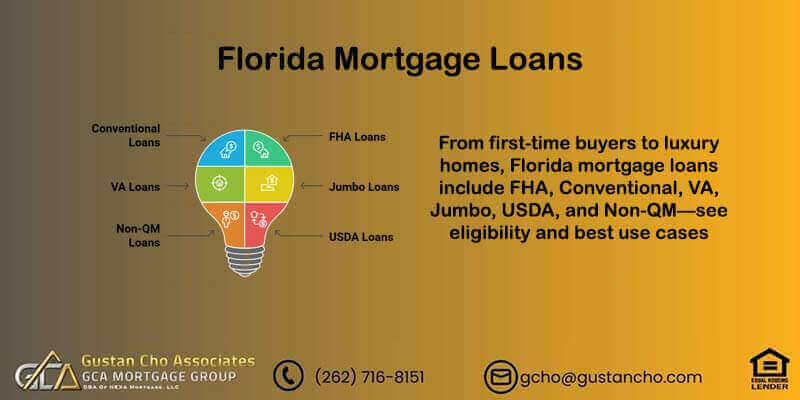
Florida Mortgage Loans: Finding the Right Fit
Florida buyers can tap into a variety of specialized mortgage programs, each with its own perks. Your eligibility will depend on your finances, down payment, and what you want for the long haul.
Conventional Loans In Florida
Conventional loans are not supported by the federal government and must follow rules set by Fannie Mae and Freddie Mac.
FHA Loans (Federal Housing Administration) In Florida
First-time buyers and those with lower credit scores often use FHA loans. These government-backed loans are designed to help qualifying buyers. FHA loans may require as little as 3% down. Applicants with credit scores of 620 or higher may qualify for better interest rates.
- FHA loan recipients who make a down payment of less than 20% are required to purchase Private Mortgage Insurance (PMI).
- Loans are Regionally Limited: Each county has its own loan limits, which will be updated in 2026.
- Check the limits for your area.
- FHA loans have stricter requirements than some other government-backed loans.
- Buyers with stable employment and strong credit histories may benefit from the lowest interest rates and greater flexibility.
- Keep in mind: Florida’s property values are all over the map, so loan limits change by county.
- High-priced spots like Miami-Dade and Monroe have bigger limits, while rural areas have lower ones.
Key Features:
- If your credit score is 580 or higher, you can get a loan with just 3.5% down.
- Some people with a credit score of 500 can qualify if they put down 10%.
- For the insurance you need with the loan, you pay a one-time fee before it starts and a yearly fee as long as you have the insurance.
- Every county in Florida has its own maximum loan limit.
- Sellers may contribute up to 6% of the buyer’s closing costs.
Best For:
- First-time buyers, people with limited savings, or those with credit scores under 680 who might not qualify for a conventional loan.
- FHA loans are popular with younger buyers in Florida’s affordable housing market.
- Including closing costs in your loan can help if you do not have enough cash at the start.
VA Loans (Department of Veterans Affairs)
Veterans, active-duty service members, and certain qualified surviving spouses are eligible for VA loans that do not require a down payment. Mortgage insurance is not mandatory for these loans.
- Interest rates are usually competitive.
- Closing costs are generally lower.
- A funding fee is required, but you can include it in your loan.
- There is no maximum loan amount, but the VA only guarantees part of the loan.
Best For:
- Military members, veterans, and eligible surviving spouses.
- Because Florida has many veterans and military bases, VA loans are a common choice.
- The zero-down-payment feature is especially helpful in expensive coastal areas.
Even though Florida is famous for its cities and beaches, many parts of the state qualify for USDA rural development loans.
Key Features:
- In certain rural areas, you can get a loan without a down payment.
- Your income must be below a set percentage of the area’s average income.
- Interest rates are competitive.
- You’ll need to pay annual mortgage insurance.
- The home must be in a USDA-eligible area and be your main residence.
Best For:
- Buyers with low to moderate incomes who want to avoid a down payment in eligible rural or suburban areas.
- Some larger cities also qualify as “rural” for USDA loans, so check the map to see if your preferred neighborhood is eligible.
Jumbo Loans
In Florida’s luxurIn Florida’s luxury markets, where home prices are higher than standard loan limits, jumbo loans are available to cover the difference.gger down payment, usually 10-20% or more.
- It’s harder to qualify for these loans.
- You usually need a credit score of 700 or higher.
- Interest rates are a bit higher.
- You may also need to show more assets. Best For: Buyers of high-value homes in Florida. Jumbo loans are often used for luxury and waterfront properties. Work with lenders who understand Florida’s upscale markets, including high-rise condominiums.
- Interest rates below the market interest rates for homebuyers
- Programs for essential workers, like teachers and healthcare professionals
- There are limits on income and home prices.
- You’ll need to complete a homebuyer education class.
Best For:
- First-time buyers, essential workers, and anyone who needs help with a down payment or closing costs.
- Considerations for Florida: These programs may change based on available funding.
- Visit the Florida Housing Finance Corporation website for current details and a list of approved lenders.
Reverse Mortgages (HECM)
Home Equity Conversion Mortgages let homeowners age 62 and older turn their home equity into cash.
Key Features:
- You do not have to make a monthly mortgage payment, but you still have to pay property taxes, insurance, and take care of the home. You can get the money as a line of credit or in monthly payments.
- The amount you owe on the mortgage goes up over time.
- The home must be the primary residence.
Best For:
- Older homeowners with substantial equity seeking additional retirement income.
- Considerations for Florida: Reverse mortgages are common among retirees, especially in communities such as The Villages and Sarasota.
Construction and Renovation Loans
- Construction and Renovation Loans are for buyers building new homes or making major renovations to existing properties.
- You can get loans for buying and renovating homes, like FHA 203(k) and Fannie Mae HomeStyle loans.
- Interest rates are higher while the home is being built.
- You’ll need to provide detailed construction plans and information about your contractor.
Best For:
- People buying fixer-uppers or building custom homes.
- In Florida, construction and renovation loans are essential for buyers in flood-prone areas who want to raise their homes or strengthen their hurricane defenses.
Special Considerations for Florida Homebuyers
- Flood insurance is required for many Florida homeowners, especially in Special Flood Hazard Areas.
- It is not included in standard homeowner’s insurance and can increase your monthly costs.
- Due to hurricane risks, premiums are among the highest in the country.
- Get quotes early, as some homes are difficult or expensive to insure.
- Features such as impact-resistant windows, strong garage doors, and special roof designs can help protect your home from hurricanes and may lower your insurance costs.
- Always review HOA or condo documents for reserves, special fees, and legal requirements.
Homestead Exemption:
- Florida residents can apply for a homestead exemption to reduce property taxes on their primary residence.
- File promptly after closing to maximize savings.
Pests:
- Florida’s year-round climate leads to ongoing concerns about termites and other pests.
- Most lenders require a termite inspection and ongoing pest control.
Water Quality:
- If the home has a well, test the water, as some areas have water quality issues.
Don’t Skip Pre-Approval:
- In a competitive market, sellers often disregard offers without a pre-approval letter.
Budget for All Costs:
- In addition to your mortgage, plan for insurance, maintenance, property taxes (which vary by county), HOA fees, and utilities such as air conditioning.
Consider Resale Value:
- Regardless of how long you plan to stay, evaluate factors such as school district quality, neighborhood development, and proximity to employment centers.
Flood Zones:
- Review FEMA flood maps before making an offer.
- Properties in high-risk zones (A or V) require flood insurance, which can impact resale value.
Visit Properties Multiple Times:
- Inspect homes on different days and times to assess traffic patterns, noise levels, and neighborhood activity.
Complete Homebuyer Education.
- Take a homebuyer class, even if it is not required, to learn helpful tips.
- Build an emergency fund, as living in Florida can bring unexpected costs like hurricane repairs or air conditioning issues.
- Try to save three to six months of living expenses in addition to your down payment.
- With careful planning, a clear understanding of your finances, and help from local experts, you can achieve your goal of owning a home in Florida.
- For information on Florida mortgage programs and current rates, visit the GCA Mortgage Group’s Florida Mortgage Loans page or contact a loan officer with experience in Florida financing.
Discussion Questions
Are you eyeing the Gulf Coast, the bustling cities, or a quiet inland retreat for your Florida home? What surprises or hurdles have you faced along the way? Which mortgage option feels like the best fit for you? Join the conversation by sharing your stories, questions, and tips to help other Florida homebuyers. Remember, this guide is only a starting point. Loans, rates, and rules can change quickly, so always check with mortgage professionals and real estate attorneys for the latest advice.
gcamortgage.com
Florida Mortgage Loans - GCA Mortgage
Explore comprehensive Florida mortgage loans, including FHA, VA, USDA, Conventional, Non-QM, and Jumbo options and DPA programs.
Sorry, there were no replies found.
Log in to reply.