
FHA Case Number: Understanding Your FHA Loan Identifier

FHA Case Number: Understanding Your FHA Loan Identifier
FHA case number is a key part of the Federal Housing Administration process, acting as your loan’s unique ID. Knowing how they work helps both first-time buyers and lenders move through loan approval with confidence.
FHA case numbers are associated with your home loan. Learn how to get, confirm, and utilize your FHA case number. A complete guide for homebuyers and lenders.
Your FHA case number shows that your loan is registered with the Department of Housing and Urban Development and indicates where your application is in the approval process. This guide answers the most common questions about getting and using your FHA case number as you work toward buying a home.
What Is an FHA Case Number and Why Is It Important?
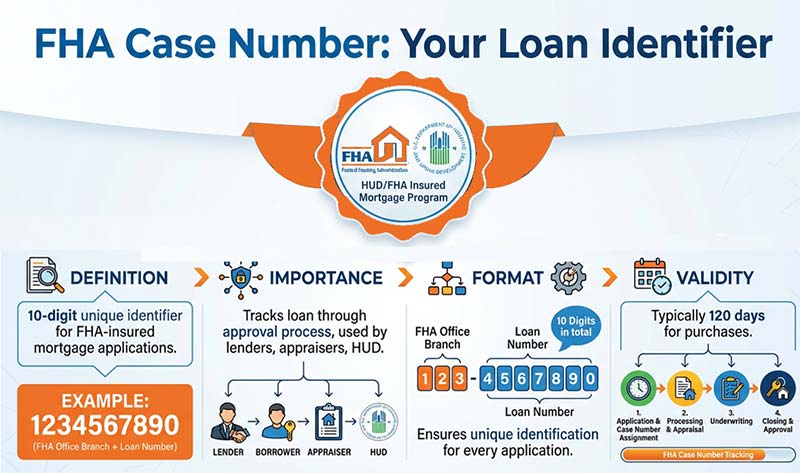
Each FHA-insured mortgage application gets a unique 10-digit case number when you apply. The FHA uses this number to track your loan through the paperwork, appraisal, and approval steps. All parties involved, including your lender, appraiser, underwriter, and HUD, use the case number to reference and update information related to your FHA home mortgage.
Sometimes technical problems can prevent lenders from obtaining or finding case numbers. These issues are usually fixed quickly, but they can be stressful when you are on a tight loan schedule.
If credit or eligibility problems arise after your case number is issued, your loan will be paused until those issues are resolved. Early reviews might miss something, but a closer look can bring surprises, even though your case number stays valid. For lenders, an FHA case number is the official go-ahead to start reviewing your loan for a specific borrower and property. Without it, the process stops—no FHA review or appraisal can happen. The case number also marks the date of your application, setting the rules and insurance rates that will apply. For borrowers, the FHA case number works like a tracking number for your mortgage. It lets you follow your loan’s progress, confirm it is registered with HUD, and keep up with important updates. Once you get your case number, it remains active for a period while your lender completes your loan.
How to Get Your FHA Case Number
While your lender obtains the FHA case number for you, understanding the process can help things go smoothly. It all starts when you submit your full loan application and receive pre-approval for FHA financing. ur loan officer will create a case number in the FHA Connection system, HUD’s online system for tracking FHA-insured loans. The loan officer must provide information about you and the mortgage loan, including your identity, loan amount, and property address.
The FHA Connection system usually gives out case numbers right away or within a few business days. But if there are duplicate or still-active case numbers linked to the property, you might have a short delay.
Once your case number is ready, your lender should give it to you right away—sometimes it shows up in your loan estimate, other times in a confirmation email. You can always ask for it, and good lenders will respond quickly. Since FHA appraisals can only be ordered after you get your case number, you can expect to get your number early in the process.
Get Your FHA Case Number Started Today
Submit your full application and we’ll request your FHA case number in HUD’s FHA Connection system, confirm there are no duplicate/active case issues, and keep your file moving so the appraisal can be ordered on time
FHA Case Numbers – How to Decode the Structure and Format
FHA case numbers show the date and place your loan was filed. Every case number is 10 digits long, with certain digits showing registration details and the office location. The first part of your case number indicates which FHA office branch issued your loan, with each number corresponding to a different region. This helps HUD keep track of loans. The remaining digits indicate how many loans that branch has handled so far.
Most borrowers never need to figure out what their case numbers mean. The format is primarily for HUD and lenders to track loan status and ensure everything is correct.
Once assigned, a case number is locked to a specific borrower and property. It cannot be reused for a different combination. If your purchase falls through and you find a new home, you will receive a brand-new case number—even if you stick with the same lender. Case numbers have an expiration date—usually 120 days for purchases, though this can change. If your loan does not close on time, your lender will need to request more time or obtain a new case number.
How FHA Case Numbers Work With Home Appraisals
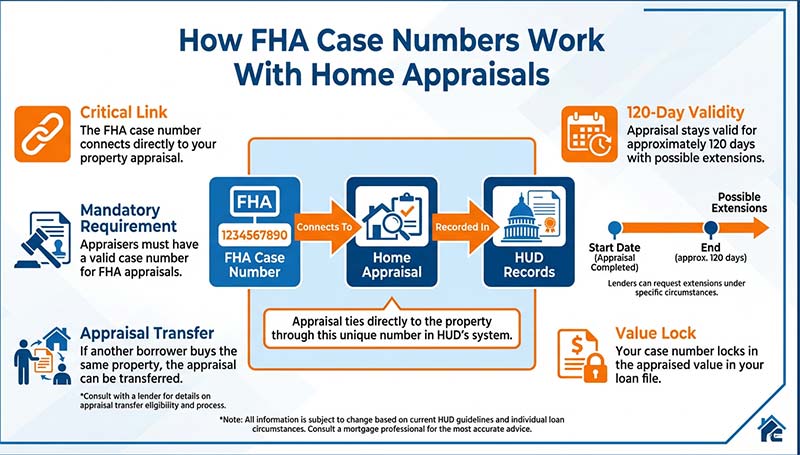
The FHA case number is very important for your property appraisal, which is required for every FHA-insured loan. It connects directly to the appraisal, ensuring it meets FHA requirements and is recorded in your loan file. An appraiser must get a valid case number for an FHA appraisal. Each case number matches an FHA appraisal and is linked to HUD records. This system lets review staff track and check FHA appraisals. The number connects an appraisal to a property in the FHA system.
The appraisal stays valid for about 120 days, with possible extensions. If another borrower wants FHA financing for the same property during this time, the appraisal can be given to that borrower.
This can save time and money. However, rules set the conditions for appraisal transfers. Your lender can help you determine whether an appraisal can be transferred to your case and whether it is a good idea for you. Your case number locks in the appraised value in your loan file, which is important if the market changes while your loan is being processed. This value sets your loan amount compared to the home’s value and your down payment, giving you peace of mind as you get closer to closing.
How to Verify Your FHA Case Number
To protect yourself against fraud and ensure your loan is registered with HUD, it is important to verify your FHA case number. There are several ways to confirm your number is valid and active in the FHA system. The easiest way is to contact your lender. Your lender can use the FHA Connection System to quickly confirm whether your case number is valid, active, and linked to your loan application. Good lenders are open about giving this information and will provide case number paperwork if you ask for it. Borrowers can check details linked to their FHA case number using HUD resources, but they cannot access the full FHA Connection system due to privacy rules.
You can check with HUD’s FHA Resource Center to see if a case number exists for you and to get the address linked to it, though staff may not be able to give you all the details.
You can double-check your loan documents, like the Loan Estimate and appraisal, to make sure they all show the same case number. This shows that everything is correctly linked to your file. Be careful with any lender who will not share your case number or gives you different details. This could mean problems with your loan or, in rare cases, even fraud. If you have doubts, talk to another licensed mortgage expert or contact HUD for peace of mind. Avoid third-party websites that claim to look up FHA case numbers, as these details are securely stored at HUD and access is limited. Use your lender or HUD to check your case number.
Common Issues Getting FHA Case Number
Problems getting your FHA case number can slow down your loan and may mean your lender has to do extra work. Knowing the usual problems helps you know what to expect. One issue is that case numbers are tied to specific properties. If a property you want to buy has an active case number from a past deal that did not close, you cannot get a new case number until the old one is cleared up. This can happen if a previous buyer backed out and their case number is still active. In this case, the lender may transfer or cancel the old case number, but doing so will slow things down and require additional paperwork.
FHA case number expirations can be a hassle. Since these numbers are only good for a set time, a slow loan process could mean your case number expires before you close.
If that happens, your lender will need to get a new number or request more time, which costs money and adds paperwork, pushing your timeline out. another common pitfall. If your lender enters incorrect info when requesting your case number, the error might not surface until much later, causing delays in underwriting or closing. Double-checking all details before submission can save you from these setbacks.
Differences in FHA Case Numbers for Purchases versus Refinances
FHA case numbers work a little differently for home purchases and refinances. Knowing these differences helps you know what to expect. For purchases, a case number cannot be given until you have a purchase agreement or have picked a property. This ensures the case number is linked to the property from the start and that the required appraisal is completed for the home you are buying.
The timing for purchases depends on your contract deadlines. Usually, your lender will ask for the case number right after you sign the purchase agreement and turn in your loan application.
The case number is needed to start the appraisal, which is often the longest step in getting your loan approved. nances follow a similar process, but with a twist. Since you already own the property, all the details are ready up front, so your lender can request the case number sooner than with a purchase. The FHA system also handles refinance case numbers a bit differently, depending on whether you are doing a streamlined or full-documentation refinance.
FHA Case Numbers On FHA Streamline Refinance
FHA streamline refinances, which are meant to be easier for borrowers, have the simplest case number process. These loans require less paperwork and fewer checks, even for the case number request. Even simple refinances need a case number that follows the same format as others. The validity period for a case number may differ for purchases and refinances, and the rules for extensions may also change.
Your lender can explain the time frames for your situation and help ensure your case number stays active throughout your loan process. This can affect your loan’s closing timeline and the smoothness of the mortgage process.
Knowing its role helps you plan and work with your lender to reach your closing goals. Getting your case number is a big step—it means your application is officially moving forward. Most lenders cannot order the FHA appraisal until you have your case number, so any delay here can push back your closing date.
How FHA Case Numbers Affect The Mortgage Process On FHA Loans
An active case number lets your lender start several steps at once, such as title work, loan review, and appraisal ordering. Doing these at the same time helps keep your closing on schedule. The time limit on your case number can affect your closing date. If your loan takes too long, you will need more time, which can add days or even weeks.
Work closely with your lender to complete everything before time runs out. After closing, your lender uses your case number to obtain FHA insurance, completing the process that began when your number was assigned.
A frequent closing hiccup is mismatched case number information. If your case number does not match across all documents, you could face last-minute delays. Double-checking that everything lines up. A common closing problem is mismatched case number information. If your case number does not match across all documents, you may experience last-minute delays. Double-checking that everything matches will help you avoid these problems. What to expect based on your property type.
How FHA Case Number Affect Type Of Property
Single-family homes have the simplest FHA case number process, with no special considerations. As long as the property and borrower meet FHA requirements, the process proceeds as usual. If you are buying a condo, the whole project must be FHA-approved before your unit can get a case number. If this approval is not done early, it can delay your loan.
Multi-unit properties like duplexes, triplexes, and fourplexes can get FHA case numbers, but expect more paperwork and a more detailed appraisal, which can stretch out the process.
Manufactured homes have their own set of rules—the home must meet specific standards, be anchored to a permanent foundation, and pass a special appraisal to qualify for a case number. For new construction, you might need separate case numbers for the construction loan and for permanent financing. Your lender can tell you whether your situation needs one or more case numbers. Renovation loans require additional case number steps, including both current-condition and post-renovation appraisals, making the process more complicated than for standard loans.
Your FHA Case Number and Privacy
Handle your FHA case number with care. It may not be as private as your Social Security or bank account number, but it still has important details and should be kept safe.
Ready for FHA Pre-Approval? Let’s Get You Moving
Once you’re pre-approved, we’ll create your FHA case number and help you understand what happens next—so your appraisal and underwriting can start without unnecessary delays








Responses