
NEXA Lending vs Loan Factory: P and L Mortgage Net Branch

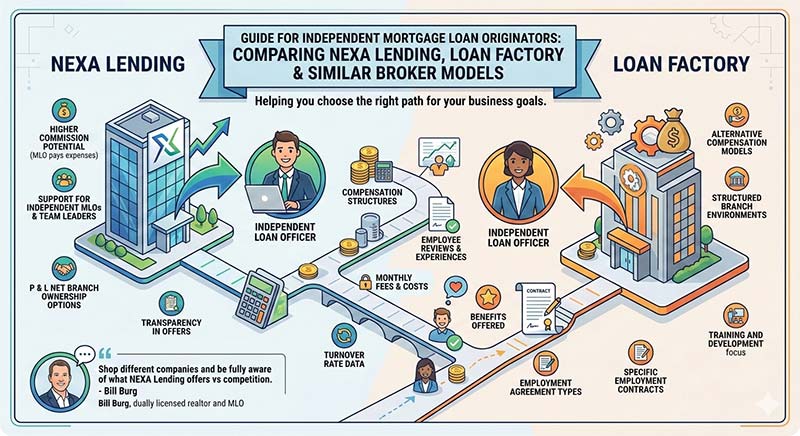
In this guide, we will cover career opportunities becoming an independent mortgage loan originator, team leader, sales manager, or branch/sales/area/regional manager at NEXA Lending vs Loan Factory. This guide is based on transparency, the pros and cons of NEXA Lending vs Loan Factory, and which company is or will be the best fit for you and your team. Bill Burg, a dually licensed mortgage loan originator and realtor at NEXA Lending and an associate contributing editor at GCA Forums and one of the top recruiters at NEXA Lending says the following:
There is no other industry with so many so-called liars than in the mortgage industry. Recruiters in the mortgage industry will promise just about about anything to recruit you to their company. After you transfer your NMLS license, things are not close to what was promised.
It is no secret that NEXA Lending has grown from a one office brick and mortar mom and pop mortgage broker company launched in July 2017 to a 3,000 plus NMLS licensed MLO giant national mortgage broker licensed in 48 states (MA and NY pending) including Washington, DC, Puerto Rico, and the U.S. Virgin Islands.
Type Of Loan Originators Who Benefit From NEXA Lending vs Loan Factory
The business model of NEXA Lending vs Loan Factory as well as similar mortgage broker companies is not for all licensed mortgage loan originators. This guide is one of several guides that is being created and developed to help loan originators who want to start their own business by becoming independent mortgage loan originators, team leaders, or P and L mortgage net branch owners and manager. We will cover not just NEXA Lending vs Loan Factory, but will try to cover every mortgage broker similar to NEXA Lending with the mission and goal to help loan originators interested in becoming independent loan officers. Bill Burg, a dually licensed realtor and MLO says the following:
The reason I am an associate contributing editor on this guide on NEXA Lending vs Loan Factory is to help any mortgage loan originator who wants to join NEXA Lending, I believe in full transparency and NEXA Lending and I want potential MLO recruits to shop other similar and comparable companies to be aware what NEXA Lending offers vs the competiion.
Independent mortgage loan originators get a substantially higher commission but pay all of their expenses. Loan officers can be a totally independent MLO, a loan officer who works under an existing branch, work as an LOA, or have a hybrid employment agreement with a senior loan officer. In this guide, viewers will learn how NEXA Lending works and similar companies offering similar programs like NEXA work, their business model, compensation, employment contract agreements, monthly fees and costs, turn over rate, and type of benefits offered. We will also cover what current and former employees say about their experience.
Comparison Of NEXA Lending To Other Mortgage Companies Like NEXA Lending.
Similar and like companies like NEXA Lending are Loan Factory, Barrett Financial, C2 Financial, Edge Home Finance, or any other local, regional, or national mortgage broker company become independent mortgage loan originators. Independent mortgage loan originators get a substantially higher commission but pay all of their expenses.
Loan officers can be a totally independent MLO, a loan officer who works under an existing branch, work as an LOA, or have a hybrid employment agreement with a senior loan officer.
In this guide, viewers will learn how NEXA Lending works and similar companies offering similar programs like NEXA work, their business model, compensation, employment contract agreements, monthly fees and costs, turn over rate, and type of benefits offered. We will also cover what current and former employees say about their experience.
Overview of NEXA Lending and Similar Mortgage Broker Companies
NEXA Lending (formerly NEXA Mortgage) is one of the largest mortgage brokers in the U.S., with over 3,200 loan officers as of 2025. It operates primarily as a broker but has evolved into a hybrid model, funding over 50% of loans through correspondent lending, which allows it to offer wholesale rates while sharing purchase advice on transactions. This shift emphasizes “wholesale” over traditional brokering.
Similar companies like Loan Factory, Barrett Financial, C2 Financial, and Edge Home Finance are also mortgage brokers that enable independent mortgage loan originators (MLOs) to access multiple lenders, competitive pricing, and flexible operations.
These firms cater to independent MLOs who handle their own marketing and client acquisition, often paying higher commissions but covering their own expenses. Independent MLOs in this space can operate fully independently, under a branch, as a loan officer assistant (LOA), or in hybrid setups. Commissions are typically higher (e.g., 100-275 basis points) than traditional retail lending, but MLOs bear costs like marketing, licensing, and fees.
Business Models of Mortgage Brokers Offering Independent MLO P and L Mortgage Branch Opportunities
Business models focus on volume through large networks of LOs, with revenue from flat fees, commission splits, or per-loan charges. Turnover varies but is often tied to market conditions; benefits are minimal since most roles are commission-based, with health insurance sometimes offered but not always comprehensive.
Below is a comparison table based on available data from company reviews, industry rankings, and employee feedback. Note: Data on turnover rates is sparse and inferred from review sentiment (e.g., high praise suggests lower turnover); exact figures aren’t publicly detailed. Employee experiences are summarized from aggregated reviews on sites like Glassdoor and Indeed.
Compare NEXA Lending vs Loan Factory for a P&L Net Branch
Thinking about relocating your mortgage net branch? Get a side-by-side breakdown of comp, deductions, fees, and what actually hits your bottom line—so you can decide with real numbers
NEXA Lending Review 2026: Is It the Best Mortgage Broker for Independent Loan Officers?
NEXA Lending or NEXA Mortgage ranks among the largest mortgage broker networks in the country. NEXA has over 3,200 loan officers and uses a hybrid model that combines traditional brokering with correspondent lending for just over 50% of its loans. This gives them the ability to offer competitive wholesale pricing and to also aid independent mortgage loan originators (MLOs) in several ways. This can be through fully independent setups, branch affiliations, loan officer assistant (LOA) roles, or hybrid models. For high-volume-producing mortgage professionals, compensation can be quite significant, ranging from 220 to 275 basis points on closed loans.
Mortgage professionals can choose from several pricing options, including more than 100% commission splits, under programs like NEXA100 (to avoid per-file fees), daily pay, and various pay structures (base, bonuses, partnership/revenue share).
They also have the option to choose whether they want to be a W2 or 1099 employee. For someone closing an average of one loan a month, they can expect to earn roughly $79,000 a year. Most contracts place strong emphasis on flexibility and a degree of autonomy. However, some reviews have indicated that high monthly fees or operational costs, such as overhead, profit, and tax splits, can take a significant share of take-home pay, particularly for newer or lower-volume MLOs. Since the roles are commission-based, MLOs are largely funded by focusing on training and coaching, as well as on access to lenders and tools. There are a few benefits.
Best Mortgage Companies for Loan Officers in 2026: Key Factors for Independent MLOs
Feedback from employees on sites like Glassdoor and Indeed show \*3.8 to 4.0 out of 5 star ratings\* in regards to their independent MLO positions. Positive comments involve working independently and following their own MLO paths. Negative comments involve excessive micromanagement and fee structures, leading to higher turnover in MLO part-time positions.
Comparing Top Independent Mortgage Brokers: NEXA Lending vs Loan Factory vs Barrett Financial vs C2 Financial vs Edge Home Finance
Loan Factory uses software-as-a-service to provide MLOs with quick processing and high closing ratios, and maintains a consistent position in the top tier of the industry. MLOs who become branch managers receive leads and bonuses along with the ability to run their own businesses.
How Independent Mortgage Loan Originators Earn More: Compensation and Business Models at NEXA and Similar Brokers
As a branch manager, compensation is pay-per-close, which can create a gap between advertised and actual compensation. Many MLO part-time employees or newer originators experience management control over contracts, monthly fees, and operational expenses, which reduces net compensation. Healthcare, bonuses, and additional management pressure are described in the reviews as part of the benefits package.
The average rating is falling just under 3.5 stars out of 5, and based on the number of employees recommending the position, their rating is around 48%.
The reviews are negative, with many examples of toxic work cultures and unfulfilled promises of training, while the positive reviews support the theory of tech-supported MLO training.
Barrett Financial Group
Barrett Financial Group is a conventional mortgage broker with a community-focused approach that still emphasizes loan officers. They also use a flat-fee system of about $695 per transaction. This means that MLOs get to keep most of their commission after that fee. They also offer great compensation for independents, including good splits and no significant hidden fees.
Contracts with minimal restrictions allow for significant autonomy, which is true for self-sufficient individuals. Another true statement is that people set their own pricing and processing. Compensation is true and great, which is likely the main reason for the great reviews.
Benefits are geared toward flexible community support and work-life balance, and it is likely the reason for the great reviews. Employee reviews on Glassdoor average 4.6 out of 5 and have a high recommendation rate. It is often rated among the best broker options because it has strong leadership, competitive rates, and a strong emphasis on LO success.
C2 Financial Corporation
The C2 Financial Corporation describes itself as a leading mortgage service broker with one of the largest lender partnerships, the ability to process loans via the National Mortgage Licensing System (NMLS), and a history as a top producer in terms of volume. Independent MLOs (Mortgage Loan Originators) benefit because they can receive higher commission splits and payouts are paid quickly, while maintaining the flexibility to choose their own plan without being overly managed.
MLOs receiving less support from their broker can manage a larger share of their operational support. MLOs can manage their marketing and client support while maintaining competitive pricing and structure, with costs and pricing kept low.
MLOs can enjoy a flexible work-life balance and the independence it offers. Employees rate C2 Financial Corporation around 4.3 out of 5 on Glassdoor, and the company is well regarded. Employees often comment on the company’s flexibility and honesty and describe it as good for the self-employed.
Edge Home Finance
Edge Home Finance focuses on independent MLOs’ autonomy, growth, and transparency, with self-sourced leads and rapid payouts post-closing, offering greater earning potential. Their business model prioritizes high margins and low operational costs with collaborative, competitive pricing. Pay structure fosters a greater sense of control and compensation for initiative.
Contracts provide a clear, supportive structure that empowers ownership. Monthly costs are presented as low or balanced and include development and a healthy workplace culture (health options noted lightly).
Employee feedback is consistently strong. Glassdoor ratings consistently above average (4.6-4.8) with high recommendations. They have proven leadership, culture, and retention. They are often praised for their support and transparency, and are among the best large brokers.
NEXA Lending vs Competitors: Which Broker Offers the Best Payouts, Fees, and Support in 2026?
NEXA Lending offers independent MLOs massive scale and tools, but potentially higher costs. Loan Factory offers technology, though it has mixed reviews. Barrett and Edge have a nice culture and simple economics. C2 offers decent flexibility to self-starters.
If choosing options as an independent originator, better to review current contracts with active LOs as terms adjust with the market. Other similar regional or national brokers may also suit your area and needs.
If you’re considering becoming an independent MLO, these companies suit experienced professionals with self-generated business. NEXA offers scale but higher costs; Barrett and Edge stand out for culture; Loan Factory has tech edge but mixed reviews. Research current contracts directly, as terms evolve. For other options, consider local brokers or nationals like UMortgage for varied cultures.
Comparing NEXA Lending vs Loan Factory The Nation’s Two Mortgage Giants For Independent Loan Officers And P and L Mortgage Net Branch
Here’s an overview that covers your questions. Some details, such as employee numbers or future projections, aren’t public, so I’ll share the most accurate information available and add insights based on industry best practices.
NEXA Lending and Loan Factory are two of the largest and fastest-growing national mortgage brokers in the wholesale market. Both focus heavily on recruiting and have become major players in the industry.
Loan Factory – Overview
General Description
- A nationwide mortgage brokerage started by CEO Thuan Nguyen
- This brokerage is known for its very low pricing margins and high-volume operations.
- It relies heavily on automation, generates its own leads, and uses online workflows.
Formation and Growth
- Founded around 2006-2007 (public records vary slightly depending on the entity).
- Since 2019, the company has expanded more across the country.
- Post aggressive pricing, online presence, and scalable tech, there has been rapid growth.
Aggressive Pricing, A Strong Online Presence, And Scalable Technology Have Fueled Rapid Growth. Often Several Hundred)
– The operations team is small, thanks to automation and centralized processing.
- Staff counts fluctuate a lot because the brokerage model is volume-sensitive.
- Support comes mainly from advanced technology and automation.
- Centralized branch-oriented support, and
- Operational support is less personalized than that offered by traditional retail lenders.
Forecast
- Low overhead and a digital approach are expected to keep driving growth.
- Automated, low-fee models could attract more brokers to compete.
- For long-term success, the company needs to keep its edge in pricing, technology, and compliance.
NEXA Mortgage (NEXA Lending) – Overview
General Description
- One of the largest mortgage brokerages in the U.S.
- Centered: The company focuses on recruiting, revenue sharing, and building branch and team structures. and growth:
- Established in 2017
- Very Fast. It grew quickly by recruiting nationwide. the leading mortgage brokerage firms in the last 5–7 years
Staff:
The company has thousands of licensed MLOs, usually between 1,500 and 2,500, depending on the time of year. Its internal support team is larger than most other brokers.
- They offer training, mentoring, marketing support, and help with team growth.:
- The company puts more emphasis on training than most brokerages.
- They offer branch P&L, different levels of team leadership, and revenue-sharing recruiting models.
- Operational support varies by the branch model and internal processes.
- Continue to be one of the largest brokers due to scale and recruiting engine
- Its growth will depend on market conditions and how well it manages compliance.
- Revenue-sharing models are more likely to face regulatory scrutiny.
Loan Factory vs. NEXA Lending – Indicative Comparison
Business Model:
- Loan Factory: pricing‑driven, tech‑driven, centralized.
- NEXA Lending: Recruiting‑driven, team-based, training-intensive
Support:
- Loan Factory: Streamlined operations, technology-focused, and fewer people providing services.
- NEXA Lending: Extensive support ecosystem and more onboarding/training
Pricing:
- Loan Factory: Frequently one of the lowest broker pricing due to very small margins.
- NEXA Lending: Competitive pricing, but usually not as low as Loan Factory’s model.
- MLO Experience. For those who value autonomy, want to maximize profits, and seek the most competitive pricing, Loan Factory is an ideal fit.
NEXA Lending: NEXA Lending is best for those who prefer coaching, a team environment, and a structured path for rapid growth.
Technology
- Loan Factory offers the best automation.
- TO NEXA’s technology is solid, but the company focuses more on training and scaling systems.
Independent LO (Broker Model)
Pros:
- Highest earning with lowest costs
- Most flexible with products through wholesale lenders
- Closings extremely quickly with very strong lenders
- Ability to brand yourself however you would like
Cons:
- Lead self-sourcing
- Variable compliance and licensing depending on brokerage
- Less handholding than at retail
- Must do your own marketing, pipeline, organization
Team Leader
Pros:
- Building leverage and scaling through agents or junior LOs
- Additional revenue potential from splits or overrides
- Better client support and more capacity overall
Cons:
- People management takes a lot of time
- More training and oversight responsibility
- Recruiting becomes a secondary job
P&L Mortgage Net Branch
Pros:
- Almost the highest control you can get (besides owning your own brokerage)
- Ability to manage your own processors, staff, and systems
- Bigger revenue share
- Achieves good scalability if you have existing volume or a team
Cons:
- You take on responsibility for P&L performance
- Higher operational expenses
- Greater exposure to regulatory risk
- Business management (beyond production) is needed
Summary
- Loan Factory is a good fit for experienced, independent LOs who value low pricing and minimal support.
- NEXA is better for LOs who want structure, training, and support to build a team.
- Independent LO roles offer flexibility, but you’re expected to generate your own business.
P&L branch operators and team leaders take on more business risk and responsibility, but they also have higher income potential.
NEXA Lending vs Loan Factory
Simplified Comparison for Relocating a P&L Mortgage Net Branch
This summary is based on the thread you provided. Some points are based on opinions or personal experiences, so it’s best to confirm details with each company before deciding.
Bottom-Line Overview
NEXA Lending
NEXA appears to offer a higher compensation plan at first, but company deductions lower the actual revenue for your branch. The thread gives this example:
- 275 bps lender-paid comp
- 25 bps kept by NEXA
- 30 bps allocated to revenue share
- Net to branch/originator before branch expenses: about 220 bps
- If you produce more than $3 million, your compensation might change. The “100%” figure only applies after NEXA takes its deductions.
Main Takeaway
NEXA Lending might work well if you want brand recognition, strong support, and a bigger platform. But for a true P&L branch, your margin can drop fast after paying loan officers, processors, rent, staff, compliance, and marketing.
Loan Factory
The thread says Loan Factory uses a simpler flat-fee model for each file.
- $500 in-house processing fee
- Total flat fee per loan: $1,095
- Remaining compensation goes to the independent MLO/branch.
Main Takeaway
- Loan Factory’s model is easier to follow because it’s more transparent for each loan.
- For larger loans, the flat-fee approach may yield more net revenue per loan than a bps-based model.
Best Fit by Decision Type
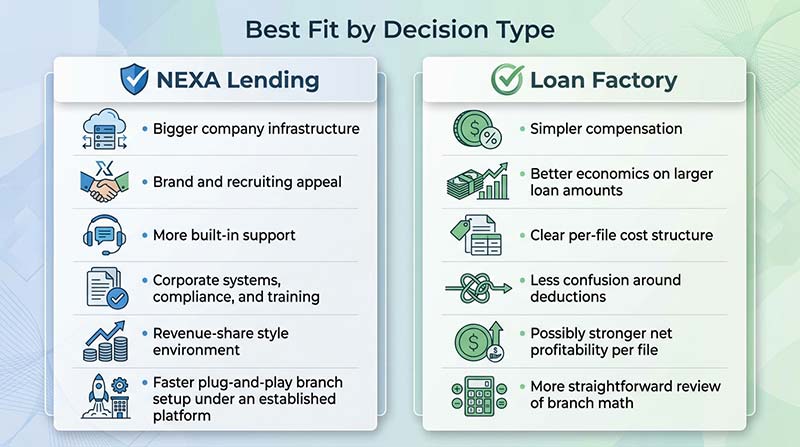
Choose NEXA Lending If Your Priority Is:
- Bigger company infrastructure
- Brand and recruiting appeal
- More built-in support
- Corporate systems, compliance, and training
- Revenue-share style environment
- Faster plug-and-play branch setup under an established platform
Choose Loan Factory If Your Priority Is:
- Simpler compensation
- Better economics on larger loan amounts
- Clear per-file cost structure
- Less confusion around deductions
- Possibly stronger net profitability per file
- More straightforward review of branch math
Compensation Comparison in Plain English
NEXA Lending
The thread points out that NEXA’s “100%” language can be confusing. In practice, it means:
- You do not truly keep the full 275 bps upfront.
- NEXA Lending first removes 55 bps total
- That leaves around 220 bps for the branch/originator side.
- Then you still have to pay your own branch expenses and staff from that amount.
Concern For A P&L Branch
If you pay your loan officers 100–160 bps, your leftover margin may become very small.
Example from thread:
- Start with 220 bps
- Pay an LO 140 bps
- Only 80 bps left for:
- rent
- payroll
- processors
- LO assistants
- compliance
- insurance
- technology
- marketing
- your own compensation
This is the main warning from the thread for anyone thinking about the branch manager model with NEXA Lending.
Loan Factory: The Thread Shows Loan Factory’s Model Is Simpler To Calculate:
- Start with 250 bps
- Subtract $1,095 per file.
- You keep the rest
Why This Matters
For larger loans, a flat fee may leave you with more take-home income than losing 55 bps right away.
For example, on a $350,000 loan:
- 250 bps = $8,750 gross compensation
- Less $1,095 fee
- Net = $7,655 before your internal branch payroll/overhead
Compared with NEXA Lending:
- 220 bps on $350,000 = $7,700 gross branch revenue
- But that is before paying your LOs and branch expenses.
So The Real Question Isn’t Just “Which Pays More?”
- Instead, consider asking yourself:
- Which leaves more money after I pay staff and operate the branch?
Not Sure Which Platform Is Better for You? Get a Second Opinion
Share your monthly volume, average loan size, and goals. We’ll give you a practical recommendation based on profitability—not hype.
Support and Operations Comparison
NEXA Lending
From the thread, NEXA Lending appears stronger in these areas:
- Larger-company support structure
- Established net branch environment
- Branding and recognition
- Training resources
- Compliance infrastructure
- Access to lender relationships and systems
- It may be a better fit for managers who want more corporate support.
However, that support isn’t free. The thread repeatedly warns that the economic trade-off can be significant for branch managers running full P&L operations.
Loan Factory
- The thread doesn’t provide much detail about Loan Factory’s support, but it does show Loan Factory as more favorable in terms of compensation.
Possible Strengths
- Cleaner economics
- Easier to model profitability
- Good for experienced operators who already know how to run a branch
Open Question
The biggest missing piece in the thread is whether Loan Factory provides the same level of:
- onboarding
- compliance help
- processing support
- branch manager support
- staff support
- recruiting support
- training
- tech support
It’s best to check this directly with the company.
Licensed Staff and Team Considerations
This is one of your main concerns, and the thread raises some important questions.
Issues You Should Compare Between Both Two Companies
- Can you hire your own processors?
- Can you hire your own LO assistants?
- Can you hire your own marketers?
- Can you use your own virtual assistant company?
- Do they allow overseas VAs?
- Do they require company approval for staff?
- Do staff work under your EIN or their EIN?
- Who handles payroll compliance?
- Who supervises licensing and renewals?
- Who is responsible for audit issues or staff mistakes?
- Can your existing team move with you?
- Are there restrictions on recruiting your own people?
What Matters Most
If your current licensed staff and operations team are key to your success, the better company is the one that gives you flexibility without adding compliance risk or slowing down operations.
Main Financial Warning For A P&L Branch
The thread makes one thing very clear:
A P&L Branch Might Look Profitable On Paper, But Can Get Tight In Reality.
Costs Mentioned In The Thread Include:
- office rent: $2,000 to $6,000 monthly
- receptionist: $3,000 to $4,500 monthly
- processors: $4,000 to $7,000 each monthly
- LO assistant: $3,000 to $4,500 monthly
- marketing: $1,000 to $5,000 monthly
- E&O insurance: $200 to $600 monthly
- licensing/compliance: $300 to $800 monthly
- utilities: $300 to $700 monthly
- accounting/bookkeeping: $300 to $800 monthly
- payroll taxes on W-2 staff
- tech/admin/compliance “junk fees.”
The Thread Conclusion Starts Lower After The BPS.
A branch doing only modest volume may struggle badly if compensation to LOs is too generous and overhead is high.
This warning is especially important for NEXA’s model because of the revenue deductions.
Risks and Red Flags Mentioned in the Thread
With NEXA Lending
- “100%” may be more of a marketing phrase than the actual gross compensation you receive
- Tight margin after deductions
- Harder to support a full branch team unless volume is strong
- Concerns in the thread about recent company changes and morale
- Some comments suggest that top-level people may have left, but this is unverified and should be independently verified.
With Loan Factory
- Less information in the thread about the depth of support
- You should confirm whether the flat-fee model includes less hands-on support.
- You should verify what’s included in processing, compliance, and branch operations support. Head seems to suggest
Based Strictly On The Thread:
If Your Main Priority Is Compensation And Branch Profitability:
Loan Factory appears stronger.
Why:
- simpler fee structure
- more transparent per-loan economics
- may leave more money on larger loans
- easier to model net branch profitability
If Your Main Priority Is Platform Support And Corporate Infrastructure:
NEXA may be stronger
Why:
- larger support environment
- established brand/platform
- broader built-in systems and resources
- may appeal more if you want company backing rather than maximum per-loan economics
Simplified Side-by-Side Comparison
| Category | NEXA Lending | Loan Factory |
| Compensation style | Basis-point split model | Flat-fee per file model |
| Headline comp | 275 bps | 250 bps |
| Actual usable comp | About 220 bps after company deductions | 250 bps less $1,095/file |
| Ease of understanding | More complex | Simpler |
| Branch margin clarity | Harder to model | Easier to model |
| Good for P&L math | Can be tight | Potentially better |
| Support infrastructure | Likely stronger | Needs verification |
| Training/compliance platform | Likely stronger | Needs verification |
| Best for experienced self-sufficient operator | Maybe, but costly | Likely yes |
| Best for built-in corporate support | Yes | Unclear from thread |
| Best for maximizing net revenue per file | Usually no | Possibly yes |
Best Questions to Ask Both Companies Before Deciding
Compensation
- Show me my exact net comp on a $300k, $400k, and $500k loan
- What deductions happen before I am paid?
- Are there production tiers or caps?
- Are there penalties, clawbacks, or early payoff reductions?
Support
- Who helps my branch daily?
- Do I get a dedicated operations or branch support contact?
- What is the turnaround time for compliance and scenario support?
- Is onboarding structured, and who trains my team?
Staffing
- Can I bring my current licensed staff?
- Can I hire my own processors and LOAs?
- Can I use contract processors?
- Can I use overseas VAs?
- Who supervises their compliance and permitted duties?
Operations
- Who processes files?
- Is in-house processing mandatory?
- Can I choose contract processing?
- What systems are required?
- Can I use my own CRM and marketing stack?
Legal/Exit
- Who owns the clients and database?
- Can I operate under a DBA?
- What happens if I leave?
- Are there non-solicit or non-compete clauses?
- What happens to loans in my pipeline after notice is issued?
Practical Decision Framework
NEXA Lending Is Probably Better If:
- You want more infrastructure.
- You want a recognized parent platform.
- You need more help with compliance, support, and systems.
- You are comfortable trading some margin for support
Loan Factory Is Probably Better If:
- You are highly experienced.
- You already know how to run staff and operations.
- You want stronger economics.
- You want a simpler, easier-to-audit model.
- You are focused on branch profitability first.
Plain-English Conclusion
Based on the thread, Loan Factory stands out for its simple compensation and likely better branch economics, while NEXA stands out for platform support and infrastructure. For a P&L mortgage net branch, the biggest issue isn’t the advertised split; it’s how much money is left after:
- company deductions
- LO comp
- processing
- payroll
- rent
- compliance
- technology
- support staff
This is where NEXA may be less attractive unless you have high volume and keep your expenses in check.
If your top concern is:
- profitability and cleaner compensation math → Loan Factory seems to have the edge
- support, systems, and corporate backing → NEXA may still be worth considering
Smart next step
Ask both companies for the same written side-by-side breakdown using your real branch model:
- monthly volume
- average loan size
- number of LOs
- LO comp
- processors
- assistants
- states
- support needs
Ready to Decide? Get a P&L Snapshot in One Call
In a quick review, we’ll map out comp, expenses, profit, and break-even—then confirm the best fit for your branch growth plan.








Responses