
 Dual-Licensed Mortgage and Real Estate Professionals
 Angela
Dual-Licensed Mortgage and Real Estate ProfessionalsForum Replies Created
-

Angela
MemberJuly 6, 2024 at 8:58 pm in reply to: How Do You Promote a FORUM in Going Viral by Building a Strong Online CommunityYes, please. I would you like you to elaborate on any of these points or discuss specific promotion strategies for GCA Mortgage Forums. GCA Mortgage Forums will cover niche for all things a homebuyer or real estate investor will need when buying or selling a property. When a homebuyer sells a home and buys another home in a different area, the homebuyer will need everything and get to know every business, shops, schools, medical professionals, stores, people, and friends. This is the purpose and mission of GCA Mortgage Forums, to create a one-stop go to resource online community for like minded consumers, businesses, and professionals. It is similar like its own community of its own where its members are the citizens and their goal is to help one another out.
-
Thank you for providing this comprehensive overview of two-to-four-unit multi-family homes. You’ve covered the key aspects well. Let me add some information specifically about VA loans for these types of properties, as your title mentioned, “VA Two-To-Four Unit Multi-Family Homes”:
VA Loans for Two-to-Four Unit Multi-Family Homes:
Eligibility: VA loans are available for eligible veterans, active-duty service members, and certain surviving spouses to purchase two- to four-unit multi-family homes.
Owner Occupancy Requirement: The borrower must intend to occupy one of the units as their primary residence.
Loan Limits: VA loans for multi-unit properties often have higher loan limits than single-family homes.
No Down Payment: Like other VA loans, these can often be obtained without a down payment, subject to the borrower’s entitlement.
Rental Income Consideration: Lenders may consider potential rental income from the other units when determining loan eligibility, which can help borrowers qualify for larger loans.
Property Condition: To be eligible for a VA loan, the property must meet the VA minimum property requirements (MPRs).
Interest Rates: VA loans typically offer competitive rates compared to conventional loans.
Funding Fee: A VA funding fee applies but can be rolled into the loan amount.
Assumability: VA loans are assumable, which can be an attractive feature for future buyers.
Investment Potential: This option allows veterans to build a real estate portfolio while securing housing.
These VA loan features make two-to-four-unit multi-family homes attractive for eligible borrowers looking to combine homeownership with investment potential. However, borrowers should carefully consider their ability to manage a multi-unit property and the responsibilities of being a landlord.
https://gustancho.com/va-loan-information/

gustancho.com
VA Loan Information UPDATES on Guidelines
VA Loan Information UPDATES on Guidelines show effective January 1st, 2020, the VA does no longer have the maximum loan limits on VA loans.
-
Thank you for sharing this information about Amanda Witthauer’s career transition. It’s great to hear about her success securing a new position as a commercial real estate agent in Tennessee. Here’s a summary of the key points you’ve mentioned:
- Amanda Witthauer is a dually licensed Realtor-MLO (Mortgage Loan Originator).
- She has recently moved from Washington to Tennessee.
- After a period of furlough due to relocation, she has secured a new commercial real estate agent job.
- She was one of ten experienced agents hired by a prestigious, highly reputable company.
- You have high confidence in her abilities and potential for success.
You’ve mentioned that Amanda needs some tools to support her success in her new role. However, you should have specified what these tools are. To provide the most helpful response, knowing what specific tools or resources Amanda might need would be beneficial. These could potentially include:
- Commercial real estate software or databases
- Market analysis tools
- Client relationship management (CRM) systems
- Property valuation tools
- Marketing and presentation software
- Networking resources or memberships in professional organizations
If you have specific tools in mind, please provide more details so I can offer more targeted information or suggestions to support Amanda in her new role.
-
Thank you for asking about No-Ratio DSCR Loans. You’re correct in your understanding. Let me expand on the No-Ratio Mortgage Loans concept:
DSCR (Debt Service Coverage Ratio):
- No-Ratio Mortgage Loans are typically a key metric in commercial real estate lending.
- It measures the property’s ability to cover debt payments with net operating income.
No-Ratio DSCR Loan:
- As you mentioned, No-Ratio DSCR Loans is a type of loan that doesn’t require the calculation or consideration of the DSCR.
- It’s often used for investment properties.
How No-Ratio Mortgage Loans Works:
- These loans do not focus on the borrower’s personal income or the property’s cash flow; instead, they primarily consider the value of the property itself.
- The lender may look at the property’s location, condition, and potential rental income.
Qualification of No-Ratio Mortgage Loans:
- Often based on the property’s potential income rather than the borrower’s income.
- Credit score and down payment requirements may be higher than traditional loans.
Benefits of No-Ratio Mortgage Loans:
- It can be easier to qualify for, especially for investors with multiple properties.
- This may allow for faster closing times.
Considerations of No-Ratio Mortgage Loans:
- Interest rates are typically higher than traditional loans.
- It may require larger down payments.
Common uses of No-Ratio Mortgage Loans:
- Often used for fix-and-flip properties or long-term rental investments.
No-Ratio Mortgage Loans can be useful for real estate investors. Still, it’s important to consider the terms and potential risks carefully. As with any financial product, it’s advisable to consult with a financial professional before proceeding.
https://gustancho.com/dscr-mortgage-loans/
gustancho.com
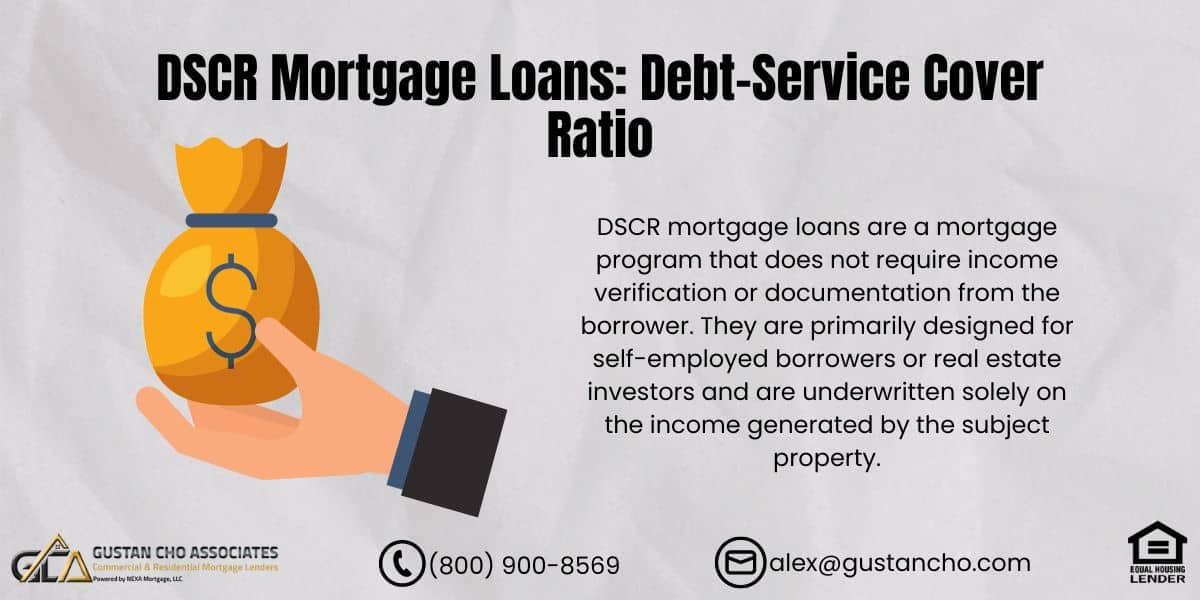
DSCR Mortgage Loans: Debt Service Cover Ratio
DSCR Mortgage Loans is underwritten based on the cash flow of the property. Borrower does not have to provide income docs or tax returns
-
Bank statement loans are a type of mortgage loan designed for self-employed borrowers, freelancers, and business owners who may need traditional forms of income documentation, such as W-2s or tax returns, to verify their income. Instead, these loans use the borrower’s bank statements to assess their income and ability to repay the loan. Here’s a detailed explanation of how bank statement loans work:
How Bank Statement Loans Work
Income Verification:
- Bank Statements: Lenders use personal or business bank statements instead of traditional income verification to determine the borrower’s income. Typically, lenders will look at 12 to 24 months of bank statements.
- Deposits Analysis: The lender reviews the deposits into the bank accounts to calculate the borrower’s monthly income. This helps establish a consistent income flow, demonstrating the ability to repay the loan.
Qualifying Criteria:
- Credit Score: While credit score requirements vary by lender, a minimum score of around 600-620 is often required.
- Down Payment: A larger down payment may be required compared to traditional loans, often ranging from 10% to 20%.
- Reserves: Lenders may require proof of reserves, such as savings or other liquid assets, to ensure the borrower can cover several months of mortgage payments if needed.
Types of Eligible Accounts:
- Personal Bank Statements: These are used for individuals who mix personal and business finances.
- Business Bank Statements: These are used for separate business accounts. Lenders may apply an expense ratio to account for business expenses, reducing the qualifying income.
Documentation:
- Bank Statements: 12 to 24 months of consecutive bank statements.
- Other Documents: Depending on the lender, additional documentation may include proof of business ownership, a profit and loss statement, and possibly a letter from an accountant.
Loan Terms of Bank Statement Loans:
- Interest Rates: Interest rates for bank statement loans are generally higher than those for conventional loans due to the higher risk associated with alternative income verification.
- Loan Amount: Loan amounts can vary but typically align with conventional loan limits.
- Repayment Period: Standard repayment periods (15, 20, 30 years) similar to conventional loans.
Benefits of Bank Statement Loans
Flexibility: Ideal for self-employed borrowers who may have difficulty documenting income through traditional means.
Accessibility: Provides an alternative for those with substantial cash flow but lack standard income documentation.
Quick Approval: This can sometimes be approved faster than traditional loans due to the streamlined documentation process.
Considerations and Potential Drawbacks
Higher Costs: Interest rates and fees may be higher than traditional mortgage loans.
Down Payment Requirements: Larger down payments might be necessary.
Complexity: The application process can be complex, requiring detailed bank statement analysis and possibly additional documentation. Bank statement loans offer a valuable solution for self-employed individuals and business owners who might not qualify for conventional loans due to a lack of traditional income documentation. By leveraging bank statements to verify income, these loans provide a pathway to homeownership for those with non-traditional income sources.
https://gustancho.com/non-qm-and-bank-statement-portfolio-loans/
gustancho.com
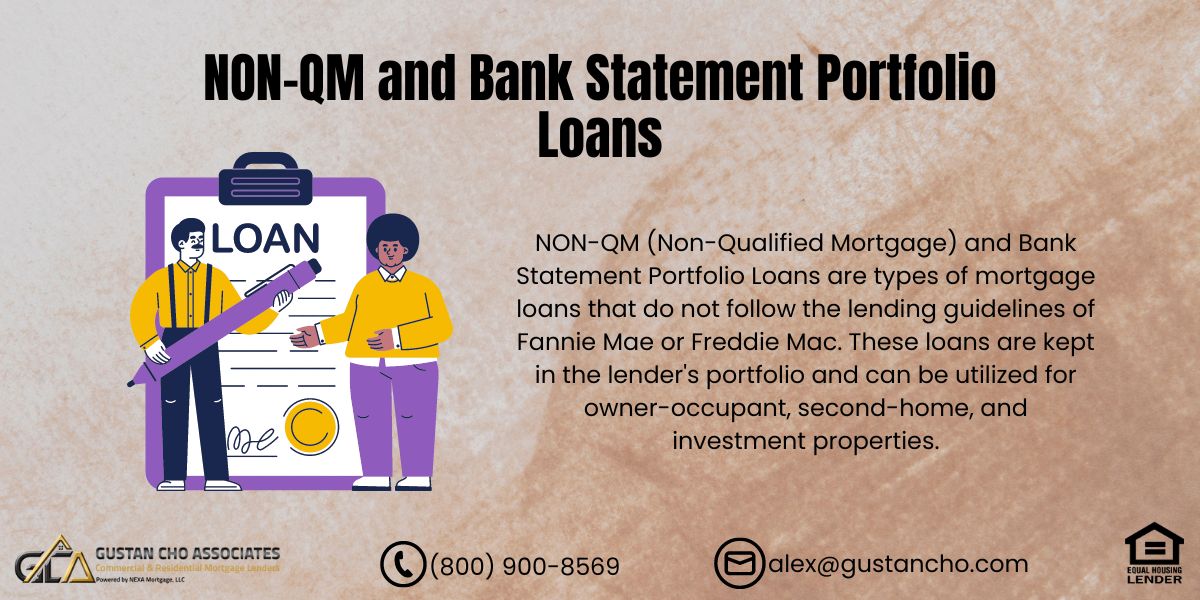
NON-QM and Bank Statement Portfolio Loans
NON-QM and bank statement portfolio loans allow non-QM loans one day out of BK and foreclosure, asset depletion, bank statement loans
-
Angela
MemberJune 23, 2024 at 2:49 am in reply to: What is the Reason GCA Mortgage Forums is Experiencing Explosing Growth and Going ViralGustan Cho Associates is the parent of the following subsidiaries:
- GCA Mortgage Forums | https://www.gcaforums.com/
- GCA Mortgage Group| https://www.gcamortgage.com/
- NON-QM Mortgage Brokers| https://www.non-qmmortgagebrokers.com/
- FHA Bad Credit Lenders| https://www.fhabadcreditlenders.com/
- Preferred Mortgage Rates| https://preferredmortgagerates.com/
- Lending Network|https://www.lendingnetwork.org/
- FHA Streamline Refinance Lenders| https://www.fhastreamlinerefinancelenders.com/
- VA Streamline Refinance Lenders| https://www.vastreamlinerefinancelenders.com/
- Viral Website Developers: https://www.viralwebsitedevelopers.com/
Great Community Authority (GCA) FORUMS is a wholly owned subsidiary of Gustan Cho Associates. It is a comprehensive, all-in-one, one-stop-shop informational resource center and portal where members can get answers to conflicting questions from fellow members, expert moderators, and five-star experienced professionals in their respective fields.
Gustan Cho Associates, operating under NEXA Mortgage LLC, is a prominent mortgage brokerage firm known for its ability to approve and close loans that other lenders often cannot. They are licensed in 48 states, including Washington DC, Puerto Rico, and the U.S. Virgin Islands. They offer various mortgage products, including government loans, conventional loans, non-QM, and alternative financing programs (Gustan Cho Associates Mortgage Brokers) (GCA Mortgage).
The firm is particularly notable for its no-overlay approach, which does not impose additional qualification requirements beyond those mandated by loan programs. This makes it a go-to option for borrowers whom other lenders have denied due to stricter internal policies (Gustan Cho Associates Mortgage Brokers).
Gustan Cho Associates also stands out for its customer service, with a team available seven days a week and a reputation for quick responses and personalized assistance. They cater to a diverse clientele, including first-time homebuyers, veterans, and those with unique financial situations (BBB) (GCA Mortgage).
For more information or to contact their team, visit their official website (Gustan Cho Associates Mortgage Brokers).
gcaforums.com
GCA Forums activities in an online community to share ideas, ask questions, and connect with like-minded individuals.
-
Angela
MemberJune 3, 2024 at 5:08 pm in reply to: Tips to detect AI Generated Content and make it humanizeGreat advice, Ravinder. Here are some tips to help you detect AI-generated content and make it sound more human:
- Look for repetitive phrases: AI tends to reuse certain phrases or sentence structures, especially when generating longer texts. Human writers vary their language more.
- Check for overly formal language: AI often uses formal, academic-style writing. Human writing is typically more conversational and includes colloquialisms.
- Assess emotional depth: AI struggles to convey genuine emotion or personal experiences. Human writing often includes anecdotes, feelings, and unique perspectives.
- Evaluate coherence: While AI has improved, it can still produce text that’s logically disjointed. Humans maintain better coherence throughout their writing.
- Look for generic information: AI often provides broad, Wikipedia-like information. Humans tend to offer more specific, insightful, or opinionated content.
- Use AI detectors: Tools like GPTZero or Writer’s AI Content Detector can help, although they’re not foolproof.
To humanize AI-generated text:
- Add personal anecdotes: Incorporate your own experiences to make the content more relatable.
- Use contractions and idioms: Replace “do not” with “don’t” or add phrases like “hit the nail on the head” to sound more natural.
- Vary sentence structure: Mix short and long sentences, and rephrase repetitive structures.
- Inject humor or emotion: Add jokes, empathy, or passionate language where appropriate.
- Include specific examples: Replace generic information with detailed, real-world examples.
- Read aloud: This helps you spot unnatural phrasing that you can then rework.
- Add transitions: Improve coherence by linking paragraphs with phrases like “On the other hand” or “Similarly.”
- Personalize tone: Adjust the language to match your usual writing style, making it uniquely yours.
Remember, the goal isn’t to deceive but to enhance AI-generated content, making it more engaging and authentic.
-
The debt-to-income (DTI) ratio is a key metric that lenders use to determine a borrower’s ability to manage monthly payments and repay debts. It’s especially crucial in the context of securing mortgage loans. The DTI ratio is expressed as a percentage and represents the ratio of a borrower’s total monthly debt payments to their gross monthly income.
How to Calculate DTI Ratio:
To calculate the DTI ratio, you sum up all your monthly debt payments and then divide this total by your gross monthly income (your income before taxes and other deductions are taken out). The formula looks like this:
https://gustancho.com/debt-to-income-ratio-mortgage-calculator/
- Front-End Ratio: This ratio considers only housing-related costs, such as monthly mortgage payments, property taxes, homeowner’s insurance, and homeowners association fees (if applicable). It’s also known as the housing ratio.
- Back-End Ratio: This includes all debt obligations per month, not just the housing costs. This would cover payments for car loans, student loans, credit card debt, personal loans, and other recurring debt payments in addition to the mortgage.
Importance in Mortgage Applications:
- Lender Assessment: Lenders use the DTI ratio to assess a borrower’s risk. A lower DTI ratio indicates a better balance between debt and income, suggesting that the borrower is more likely to manage monthly payments effectively.
- Loan Approval and Terms: The DTI ratio influences not only the approval of the loan but also its terms. It can affect the interest rate offered, the amount of the loan, and other conditions.
- Guidelines: Different lenders have varying thresholds, but generally, a DTI ratio of 36% or lower is viewed favorably for conventional loans. FHA loans might allow higher ratios, sometimes up to 43-50%.
Impact on Borrowing:
- Lower DTI Ratios: Typically result in more favorable loan conditions. Borrowers with lower DTI ratios are often eligible for larger loan amounts and better interest rates.
- Higher DTI Ratios: May lead to loan rejections or less favorable loan terms. It may signal to lenders that the borrower has too much debt relative to their income, increasing the risk of default.
For anyone considering a mortgage, it’s advisable to calculate their DTI ratio in advance to understand their standing and potentially take steps to improve it, such as paying down existing debts or increasing income before applying for the mortgage. This preparation can significantly enhance the chances of obtaining a favorable mortgage offer.
https://gustancho.com/debt-to-income-ratio-mortgage-calculator/
gustancho.com
Debt-To-Income Ratio Mortgage Calculator | PITI, PMI, HOA
No longer need to contact your loan officer when shopping for homes. Use the debt-to-income ratio mortgage calculator and get results ins seconds
-
Rosalynn Carter is a prominent figure known for her role as the First Lady of the United States from 1977 to 1981, during the presidency of her husband, Jimmy Carter. Here’s a brief overview of her contributions and achievements:
Early Life and Marriage
- Born: Eleanor Rosalynn Smith was born on August 18, 1927, in Plains, Georgia.
- Marriage: She married Jimmy Carter on July 7, 1946, and they have had a long and close partnership both during and after their time in the White House.
Contributions as First Lady
- Advocacy for Mental Health: Rosalynn Carter was an active advocate for mental health awareness. She worked to improve the lives of those with mental illnesses and played a critical role in the passage of the Mental Health Systems Act of 1980.
- Community Volunteering: She promoted community-based health systems and was involved in various volunteer programs.
- Diplomacy: Rosalynn also took on active diplomatic roles during her husband’s presidency, including solo goodwill trips to Latin America and other regions.
Post-White House Initiatives
- The Carter Center: Along with her husband, she co-founded The Carter Center in 1982, which is a non-profit organization that works to improve global human rights, public health, and democracy.
- Mental Health Advocacy: She continued her advocacy for mental health through the Rosalynn Carter Institute for Caregiving, which provides support for both professional and family caregivers.
- Public Speaking and Writing: Rosalynn has been an active speaker and author, working to advance the causes she supports.
Rosalynn Carter has been recognized for her humanitarian efforts and advocacy with numerous awards and honors, reflecting her significant impact on both national and global stages.