 Commercial Mortgage Lender
 Bailey
Commercial Mortgage LenderForum Replies Created
-

Bailey
MemberAugust 16, 2024 at 3:28 pm in reply to: How do non-QM loans differ from qualified mortgages?Non-QM loans (or non-qualified mortgages) have little in common with qualified mortgages (QM). The most significant differences between these two types of loans include the borrowers they serve, underwriting criteria, and flexibility in documentation. This article provides an overview of what sets them apart, as well as specific examples such as bank statement loans, DSCR loans, no-ratio loans, and no-doc loans.
What are Qualified Mortgages (QM)?
A QM loan is a type of mortgage that meets certain guidelines set forth by the Consumer Financial Protection Bureau (CFPB) under the Dodd-Frank Act. These rules were implemented to ensure consumers could repay their home loans while affording certain legal protections for lenders.
Key Features of QM Loans:
Ability-to-Repay (ATR) Rule: Lenders must verify income, assets, employment status, credit history, and other factors before approving any borrower.
Debt-to-Income Ratio (DTI): QM mortgages typically require a debt-to-income ratio below 43%.
No Risky Loan Features: A qualified mortgage may not contain any risky features like negative amortization or interest-only payments. Balloon payments are also prohibited.
Points & Fees Cap: For non-jumbo loans ($100k or more), points and fees charged at closing cannot exceed 3% of the loan amount.
Legal Protection: Lenders offering QMs are protected from lawsuits claiming they should have known the borrower couldn’t afford it.
What Are Non-QM Loans?
Non-qualified mortgage Loans are designed for individuals who don’t meet strict QM criteria. Therefore, these products allow more flexibility when underwriting them. However, they come with less legal protection for creditors and higher rates for borrowers because they represent riskier investments than their qualified counterparts.
Key Differences Between Non-QM & QM Mortgages:
Income Verification Flexibility: Non-QM mortgages may use alternative forms of income verification, such as bank statements or asset-based qualification, rather than rely solely on W2s/tax returns.
Higher DTI Ratios Allowed: Non-qualified loans can have higher debt-to-income ratios, making them available to people with more debt or lower income relative to their obligations.
Loan Features: Non-QMs can have loan features not allowed under QM guidelines, such as interest-only or balloon payments.
Borrower Profiles: Self-employed individuals and real estate investors often use non-conforming loans. These borrowers may have volatile incomes that do not qualify for regular conforming mortgage programs due to the variability in their earnings streams over time (e.g., salespeople who work on commission).
Types of Non-QM Loans
Bank Statement Loans:
Description: Bank statement loans are designed for self-employed borrowers who cannot provide traditional income documentation. Lenders review bank statements for 12-24 months to determine average monthly cash flow.
Differences from QM: Unlike qualified mortgages requiring W2s and tax returns. Non-QM mortgages use a borrower’s average monthly deposits shown on their bank statements as proof of income, allowing those with irregular earnings to qualify for home financing.
Use Case: This is ideal for self-employed individuals, freelancers, and small business owners who have strong cash flow but cannot prove it via conventional means such as pay stubs or tax returns.
No-Ratio Loans:
Explanation: In a no-ratio loan, the lender does not calculate or verify the DTI ratio. Instead, it relies on criteria such as credit score, assets, and down payment for approval.
Different from QM: While no-ratio loans look at a borrower’s overall financial situation, QM loans require a strict DTI calculation.
Use Case: No-ratio loans are helpful for people with high net worth who have many assets but get earnings irregularly, which would make their DTI ratios too high.
No-Doc Loans (No Documentation Loans):
Explanation: Income documentation is either optional or very limited with no-doc loans. The main factors considered during the approval process are credit score, down payment, and assets.
Different from QM: Unlike QM loans that need full income, employment, and asset documentation, no-doc loans allow borrowers to qualify without giving traditional documents.
Use Case: It is mostly used by individuals with large amounts of money in their accounts and good credit scores who want to keep their earnings private.
Summary of Differences:
Income Verification: Non-QM loans provide alternative ways of verifying income so that self-employed persons or those with non-traditional income can easily access them.
Flexibility: Non-QM loans have more flexible terms regarding DTI ratios, borrower qualifications, and loan features.
Risk and Cost: Due to their higher risk exposure, non-QMs might attract increased interest rates and lender fees.
Legal Protections: QMs offer certain protections for lenders that non-qualified mortgages lack, making them more suitable for individuals who fail to meet the standard criteria.
Non-qualified mortgages differ from bank statement loans, DSCR,no-ratio, and no-docs regarding income verification, borrower profiles, and loan flexibility. Nonetheless, they provide useful alternatives for borrowers whose needs are unmet by traditional qualified mortgages. However, this comes at an extra cost with stricter terms and conditions. Familiarity with these variations is essential for both borrowers and lenders in the mortgage industry.
-
Christian Sorenson seems like a great young man 👍
-
Bank statement loans is a form of non-qm loans for self employed borrowers with little to no income on their income tax returns. Self employed individuals who do not have adjusted gross income on their federal income tax returns can qualify for bank statement loans for self employed borrowers with credit scores down to 600 at Gustan Cho Associates. Here’s a article about bank statement loans for self employed borrowers.
https://fhabadcreditlenders.com/bank-statement-loans/

fhabadcreditlenders.com
Bank Statement Loans For Self-Employed Borrowers
Bank statement loans for self-employed borrowers with no income tax returns, 12 months deposit in bank statements are averaged for income.
-
Based on the scenario you’ve described, here’s an analysis of the situation and potential options for the borrower:
- Property Value: $1.5M
- Existing First Mortgage: $625K
- Desired Second Lien: $450K
- Location: California (94551 – Livermore area)
- Credit Score: 738 (Good)
Analysis: Combined Loan-to-Value (CLTV): First mortgage: $625K
Proposed second lien: $450K
Total proposed debt: $1,075,000
CLTV: 71.67% ($1,075,000 / $1,500,000)
Equity Position: Current equity: $875K (58.33% of property value).
Equity after proposed second lien: $425K (28.33% of property value)
Credit Score: 738 is considered a good credit score and should qualify for most loan products
Options for the $450K Second Lien:
Home Equity Loan: This is a fixed-rate, lump-sum loan. It typically has higher interest rates than first mortgages. Finding a lender willing to take a $450K second lien may be challenging.
Home Equity Line of Credit (HELOC): Variable rate, flexible draw period. It could be a good option if the full $450K is only needed after some time. More lenders may be willing to offer this product for larger amounts.
Cash-Out Refinance: Instead of a second lien, refinance the entire amount ($1,075,000). Likely to get a better interest rate than a second lien. It would require paying off the existing first mortgage.
Investment Property Loan: Specific products designed for investment properties May have higher interest rates than owner-occupied properties
Considerations to take under account in this case scenario:
Purpose of the Loan: The intended use of the funds could impact the loan options and terms.
Debt Service Coverage Ratio (DSCR): For investment properties, lenders often look at the property’s ability to generate income to cover the debt payments.
Borrower’s Income and DTI: While not mentioned, these factors will be important for loan qualification.
Investment Property Status: Loans for investment properties often have stricter requirements and higher interest rates than owner-occupied homes.
Prepayment Penalties: Check if the existing first mortgage has any prepayment penalties if considering a cash-out refinance.
Tax Implications: Interest on investment property loans may be tax-deductible, but consult a tax professional.
Next Steps: Shop with multiple lenders, including local banks, credit unions, and online lenders. Compare terms, rates, and fees for different loan products. Consider consulting a mortgage broker who specializes in investment properties. Prepare documentation on the property’s rental income and expenses. Be prepared to explain the purpose of the loan and provide a solid business plan if it’s for further investment. Given the good credit score and significant equity in the property, the borrower should have several options available. However, the large size of the desired second lien may limit some choices. A cash-out refinance might be the most straightforward option. However, it’s worth exploring all possibilities to find the best fit for the borrower’s needs and financial situation.
-
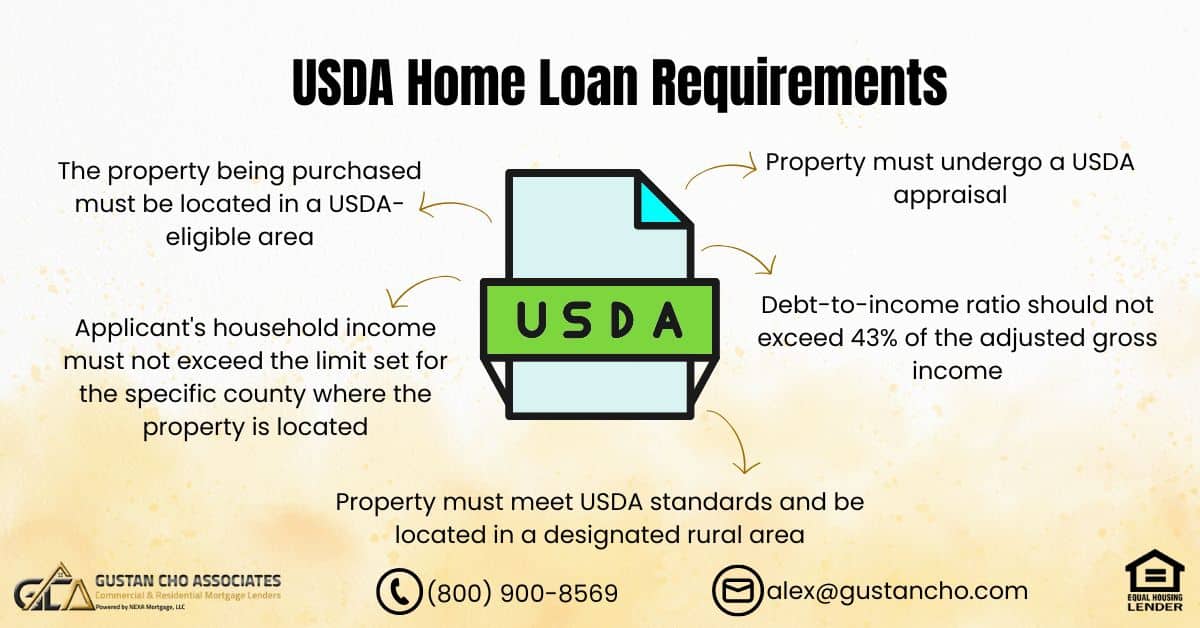
USDA Direct Mortgage Loans
USDA Direct Mortgage Loans, also known as Section 502 Direct Loan Program, help low- and very-low-income applicants obtain decent, safe, and sanitary housing in eligible rural areas. The USDA provides the loan directly, and there are specific income and property eligibility requirements.
Key Features of USDA Direct Loans
Eligibility:
Income: Applicants must meet income eligibility requirements determined by the area median income (AMI). Typically, applicants must have an income of less than 80% of the AMI.
Property Location: The property must be in a rural area defined by the USDA. Rural areas are typically defined as communities with populations of 35,000 or less.
Occupancy: The loan is only for the applicant’s primary residence.
Loan Terms:
Interest Rates: Interest rates can be as low as 1% with subsidies.
Loan Amount: The amount depends on the applicant’s income and the area where they purchase the home.
Repayment: Repayment terms can be up to 33 years (38 years for applicants with incomes below 60% of the AMI).
Benefits: No down payment is required. Subsidized interest rates based on income. Ability to finance some closing costs.
Role of USDA Loan Packagers
USDA loan packagers assist applicants in preparing and submitting their loan applications. They can provide valuable assistance in navigating the application process and ensuring all necessary documentation is provided.
Services Provided by Packagers:
Application Assistance: Help complete and submit the loan application.
Documentation: Assistance in gathering and organizing necessary financial documents.
Guidance: Provide advice on eligibility and loan terms.
Compensation: USDA loan packagers typically earn around $1,500 per file. The applicant often pays this fee, though some programs may incorporate these costs into the loan.
Steps to Apply for a USDA Direct Loan
Determine Eligibility: Check income eligibility using the USDA’s income eligibility calculator. Verify the property’s location using the USDA’s property eligibility tool.
Prepare Documentation: Gather income statements, tax returns, and other necessary financial documents. Ensure the property meets USDA guidelines.
Contact a USDA Loan Packager: Consider working with a USDA-approved loan packager to streamline the application process. Utilize their expertise to ensure a complete and accurate application.
Submit Application: Complete and apply along with all required documentation. Work with the USDA or your loan packager to address additional requirements or questions.
Loan Approval and Closing: Once approved, close the loan and purchase the property. Ensure all terms and conditions are understood before finalizing the loan.
USDA Approved Packagers: Contact local USDA offices for a list of approved loan packages. By understanding the requirements and benefits of USDA Direct Loans and utilizing the services of loan packagers, low- and very-low-income applicants can access affordable home financing options in rural areas.
https://gustancho.com/usda-home-loan-requirements/
gustancho.com
USDA Home Loan Requirements allow homebuyers to purchase homes in designated rural areas by the USDA with 100% financing no money down
-
Chicago, often called “The Windy City,” is a major metropolis known for its rich history, diverse culture, architectural marvels, and vibrant community life. Here’s an overview of Chicago and its people:
The City
Nickname Origin: “Windy City” is often believed to reference Chicago’s weather. However, it originated from its residents’ reputation for being full of “hot air” or boastful, particularly in the city’s bid to host the 1893 World’s Columbian Exposition.
Geography and Climate: Located on the southwestern shore of Lake Michigan, Chicago experiences a temperate climate with cold winters, warm summers, and significant wind due to its proximity to the lake.
Architecture and Landmarks: Renowned for its skyline, Chicago is home to masterpieces such as the Willis Tower (formerly Sears Tower), John Hancock Center, and innovative structures by architects like Frank Lloyd Wright.
The People
Diversity: Chicago is a melting pot of cultures and ethnicities, with significant African American, Hispanic, Irish, Italian, Polish, and Asian communities.
Cultural Contributions: The city has significantly contributed to music (especially blues, jazz, and house), theater, and art. Chicago is known for its vibrant arts scene with institutions like The Art Institute of Chicago and venues like the Chicago Theatre.
Sports: Chicagoans are passionate about sports, supporting teams like the Chicago Cubs and White Sox (MLB), Chicago Bears (NFL), Chicago Bulls (NBA), and Chicago Blackhawks (NHL).
Food: The city is famous for its culinary offerings, including deep-dish pizza, Chicago-style hot dogs, and Italian beef sandwiches. It’s also home to a burgeoning fine dining scene.
Community and Spirit
Resilience: Known for their resilience and community spirit, Chicagoans have a history of returning from challenges, exemplified by the city’s recovery after the Great Chicago Fire of 1871.
Neighborhoods: Chicago is a city of neighborhoods, each with a unique character and community. There’s a diverse range of living environments, from the historic Bronzeville to the artistic Wicker Park and the affluent Gold Coast. Chicago, “The Windy City,” is a dynamic and diverse metropolis with a rich cultural heritage and a strong sense of community. Its people are known for their resilience, pride, and passion for their city. Whether through its architecture, cuisine, music, or sports, Chicago leaves an indelible mark on anyone who experiences it.
-
Bailey
MemberJune 18, 2024 at 5:09 pm in reply to: What is the down payment for a first time investor?For first-time real estate investors, the typical down payment requirements can vary depending on the type of property and financing options used. Here are some common scenarios: Investment Property Loans: Most lenders require a higher down payment for investment properties compared to owner-occupied homes. The standard down payment is typically 20-25% of the purchase price for a single-unit investment property. For multi-unit properties (2-4 units), the down payment may range from 25-30%. Conventional Mortgage for Investment Property: If using a conventional mortgage for an investment property, lenders typically require at least a 20% down payment. A higher credit score and lower debt-to-income ratio may allow for a slightly lower down payment. FHA Loan for Investment Property: The FHA (Federal Housing Administration) loan program is primarily designed for owner-occupied properties. FHA loans are generally not available for investment properties purchased as a first home. Down Payment Assistance Programs: Most down payment assistance programs are geared toward first-time homebuyers for a primary residence, not investment properties. However, some local or state programs may offer assistance for investors in specific areas or with certain income limits. These are less common. It’s important to note that lenders view investment properties as higher risk, which is why they often require larger down payments. This helps mitigate their risk and ensures the investor has sufficient skin in the game. As a first-time investor, it’s generally recommended to have at least 20-25% of the purchase price saved up for a down payment, along with additional reserves for repairs, vacancies, and other expenses associated with owning an investment property.
https://gustancho.com/investment-property-loans/
gustancho.com
Investment Property Loans | Non-QM, DSCR, No-Doc Mortgages
There are dozens of investment property loans mortgage options such as non-QM loans, DSCR loans, no-doc mortgages, and bank statement loans
-
There are credible evidence to support the claim that the “missing link” in human evolution involves extraterrestrials interbreeding with early humans. This idea is grounded in scientific consensus. According to mainstream science and the theory of evolution through natural selection, humans evolved over millions of years from ape-like ancestors. The “missing links” refer to the gaps in the fossil record where transitional fossils between different human-like species have yet to be discovered and confirmed. While there are still many open questions in human evolutionary studies, the overwhelming evidence points to human origins being tied to ancient primate ancestors in Africa, not alien intervention. Credible theories are based on analysis of fossils, DNA evidence, comparative anatomy and other scientific data. Some key fossils representing human evolutionary ancestors that help fill gaps include: Ardipithecus ramidus (4.4 million years old): Australopithecus anamensis (4.2 million years old): Australopithecus afarensis (Lucy) (3.2 million years old): Homo habilis (2.4 million years old): Homo erectus (1.9 million years old): While ancient artwork across cultures suggests humans have long held questions about our origins, extraordinary claims about extraterrestrial ancestry require extraordinary evidence that has not been provided by the scientific community. I would caution against presenting unsubstantiated theories as facts regarding such a complex scientific matter.
-
Kevin DeLory is the Chief Lending Officer of Equity Prime Mortgage (EPM Mortgage) the number one wholesale lender of choice at Gustan Cho Associates. Kevin DeLory serves as the Chief Lending Officer at Equity Prime Mortgage (EPM). With over two decades of experience in the mortgage industry, DeLory has held significant positions at various institutions, including Carrington Mortgage Services, Mid-Island Mortgage, Barclays, New Century Mortgage, and Option One Mortgage.
DeLory joined EPM in August 2021 and is responsible for building and leading the company’s sales force as well as enhancing third-party and consumer experiences. Under his leadership, EPM has focused on supporting brokers and enhancing its wholesale mortgage operations.
His approach to leadership is characterized by a deep commitment to education and support for brokers, particularly during challenging times in the mortgage industry. This commitment is rooted in his own experiences of overcoming personal and professional adversities, including a cancer diagnosis.