
 Commercial Mortgage Lender
Bailey
Commercial Mortgage LenderForum Replies Created
-

Bailey
MemberSeptember 17, 2024 at 9:09 pm in reply to: How long does Commercial Loan Officer training usually take?I highly recommend Danny Vesokie, President and Chief Executive Officer at Affiliated Financial Partners, Inc. based in San Francisco. Learned so much in the intensive three day course. However, after the commercial loan training school course was over, I got a guaranteed job as both a residential mortgage loan originator at Gustan Cho Associates as well as a commercial loan officer at Lending Network. Danny Vesokie will not let you out and dry after the commercial loan officer training school. Mr. Vesokie is hands on and always calls me when I message him about a case scenario or am in need for extra wholesale lenders. Not only is the services of Danny Vesokie stellar and a five-star professional, being a graduate from Affiliated Financial Partners, Inc. comes with many benefits. I am a premium lifelong member of GCA Mortgage Forums and Sub-FORUMS where I have access to the underwriting help desk, teams of wholesale lenders, the case scenario desk, and other great resource centers of Great Community Authority (GCA) FORUMS. I can also post questions or case scenarios, reply to threads and posts, and participate in group discussions of GCA Mortgage Forums, the best all-in-one comprehensive online community. I am so grateful I was referred to Danny Vesokie of Affiliated Financial Partners, Inc. headquartered in Sacramento, California. Danny Vesokie is a Godsend and highly recommend Affiliated Financial Partners and Danny Vesokie.
https://www.affiliatedfinancialpartners.com/

-
This does not tell me anything. If I did not have a PFS form and had to type one up, can you please explain in detail the line items on how to prepare a personal financial statement from scratch? I really appreciate it if you can show me step by step on the type of information I need to put on a professional custom personal financial statement.
-
Bailey
MemberAugust 29, 2024 at 12:30 am in reply to: How Much Cash-Out Can I Get With Reverse MortgageThe cash you can get from a reverse mortgage or reverse loan proceeds is quite different from place to place and is controlled by some factors. Each case scenario is different. How much proceeds a borrower can get from a reverse mortgage cash-out depends on the home’s equity and the borrower’s age.
Borrower’s Age
In general, applicants’ age factor makes applying for such a loan more qualified. The justification for this is that the younger the homeowner is, the longer the longevity of the borrower. The minimum age limit for reverse mortgage companies is sixty-two years. At 62 years old, the homeowner is fairly young and has a life expectancy of a 72-year-old. However, the amount that will be advanced to you increases the older you get.
Home’s Value
The home valuation from a certified HUD-approved HUD appraiser also affects how much cash an individual can take out. The real estate that secures the reverse mortgage will largely determine the amount that can be advanced to you.
Interest Rates in the Market
With such lower interest rates, one is usually allowed a lesser amount than the maximum loan amount. The interest rate one can take on a loan usually dictates the loan qualification.
Amount of any Existing Mortgage
Any mortgage or lien on the property must be satisfied before any counts toward totals. What will be cash out for you is what is left after paying this.
Reverse Mortgage Type
For example, HECM and proprietary reverse mortgages are some of the examples of reverse mortgages that differ in the amount cashed out.
Option Connecting to Payout
It has been made easier for the loan receivable to be made in forms that include lump sum, distribution in monthly installments, the line of credit given by the lender, a mixture of such formats, or even combinations. The alternative payout format opted for, if any, features such that it may limit the amount of cash available for disbursement.
Cash-out Amount Evaluation
HECM: The most commonly applied kind of reverse mortgage, also an FHA-insured type. It has been stated that the cash-out amount is typically between 40%-60% of the house’s present value.
For instance, your available equity could be as low as $120,000 and as much as $180,000. That depends mostly on your age, current interest rates, and the amount of mortgages already paid and yet to be paid off.
Situational Analysis
Fees and Costs: Also note that reverse mortgages usually attract certain fees and closing costs, which are subtracted from the advance.
Mandatory Counselling: A policy rule has been that a borrower is counseled by an institution recommended by the HUD before obtaining a reverse mortgage.
Heirs—Inheritance interactions: The use of goods-inversion mortgage loans has major disadvantages. These include balance maximums and home equity limitations. Inheritance dramatically affects the inheritors. The people listed as the heirs or heirs of the property must repay the loan to keep the property.
Similarly, to enhance the estimation, it is advisable to consult a reverse mortgage provider who will help calculate what is necessary.
-
Bailey
MemberAugust 22, 2024 at 10:57 pm in reply to: Can i get a cash out refinance if i had a forclosure 6 years ago my score is 650Yes, even if you foreclosed on a property six years ago and your credit score is 650, you can refinance and get cash out. There are some points that you have to note:
Waiting period after foreclosure:
FHA Loans: HUD, the parent federal agency of FHA, requires three years of waiting time after foreclosure before applying for another mortgage. Examples include such as cash-out refinances. This means that, in this case, with a foreclosure that happened six years ago, we meet this requirement.
Conventional Loans: Conventional loans usually require seven years after foreclosure. However, if there are extenuating circumstances, the lender might reduce it to three years.
VA Loans: They would work for you if you qualify for a VA loan. To qualify and get approved for VA loans, you usually have a two-year waiting period after foreclosure.
Credit Score Considerations:
650 Credit Score: A credit score 650 is considered fair and may allow someone to qualify for a cash-out refinance. But not with terms as good as those available at higher scores. Expect higher interest rates or more rigorous qualification standards.
Loan-to-Value (LTV) Ratio:
LTV Requirement: Most lenders want 80% LTV on cash-out refinances. So, ensure you have at least 20% equity in your home. The better one’s equity position, the likelier it is that approval will be granted on favorable terms.
Debt-to-Income (DTI) Ratio:
DTI Consideration: The DTI ratio will be calculated to ensure new mortgage payment can be afforded, typically requiring 43% or less but sometimes higher with sufficient compensating factors allowed by certain underwriters
Lender Flexibility: Some lenders may have more lenient policies toward borrowers who have had foreclosures. This holds especially when reestablished credit is proven, along with other qualifying criteria being met. Hence, shopping around among different financial institutions becomes essential.
Final thoughts: Although having had a foreclosure might complicate matters. In your case, six years since then and a credit score of 650 do put you within reach of getting cash-out refinancing. As always with this type of loan, though, eligibility will be determined based on factors such as the LTV ratio, DTI ratio, and lender-specific requirements.
Let me know if there is anything else I can do for you!
-
Bailey
MemberAugust 16, 2024 at 3:28 pm in reply to: How do non-QM loans differ from qualified mortgages?Non-QM loans (or non-qualified mortgages) have little in common with qualified mortgages (QM). The most significant differences between these two types of loans include the borrowers they serve, underwriting criteria, and flexibility in documentation. This article provides an overview of what sets them apart, as well as specific examples such as bank statement loans, DSCR loans, no-ratio loans, and no-doc loans.
What are Qualified Mortgages (QM)?
A QM loan is a type of mortgage that meets certain guidelines set forth by the Consumer Financial Protection Bureau (CFPB) under the Dodd-Frank Act. These rules were implemented to ensure consumers could repay their home loans while affording certain legal protections for lenders.
Key Features of QM Loans:
Ability-to-Repay (ATR) Rule: Lenders must verify income, assets, employment status, credit history, and other factors before approving any borrower.
Debt-to-Income Ratio (DTI): QM mortgages typically require a debt-to-income ratio below 43%.
No Risky Loan Features: A qualified mortgage may not contain any risky features like negative amortization or interest-only payments. Balloon payments are also prohibited.
Points & Fees Cap: For non-jumbo loans ($100k or more), points and fees charged at closing cannot exceed 3% of the loan amount.
Legal Protection: Lenders offering QMs are protected from lawsuits claiming they should have known the borrower couldn’t afford it.
What Are Non-QM Loans?
Non-qualified mortgage Loans are designed for individuals who don’t meet strict QM criteria. Therefore, these products allow more flexibility when underwriting them. However, they come with less legal protection for creditors and higher rates for borrowers because they represent riskier investments than their qualified counterparts.
Key Differences Between Non-QM & QM Mortgages:
Income Verification Flexibility: Non-QM mortgages may use alternative forms of income verification, such as bank statements or asset-based qualification, rather than rely solely on W2s/tax returns.
Higher DTI Ratios Allowed: Non-qualified loans can have higher debt-to-income ratios, making them available to people with more debt or lower income relative to their obligations.
Loan Features: Non-QMs can have loan features not allowed under QM guidelines, such as interest-only or balloon payments.
Borrower Profiles: Self-employed individuals and real estate investors often use non-conforming loans. These borrowers may have volatile incomes that do not qualify for regular conforming mortgage programs due to the variability in their earnings streams over time (e.g., salespeople who work on commission).
Types of Non-QM Loans
Bank Statement Loans:
Description: Bank statement loans are designed for self-employed borrowers who cannot provide traditional income documentation. Lenders review bank statements for 12-24 months to determine average monthly cash flow.
Differences from QM: Unlike qualified mortgages requiring W2s and tax returns. Non-QM mortgages use a borrower’s average monthly deposits shown on their bank statements as proof of income, allowing those with irregular earnings to qualify for home financing.
Use Case: This is ideal for self-employed individuals, freelancers, and small business owners who have strong cash flow but cannot prove it via conventional means such as pay stubs or tax returns.
No-Ratio Loans:
Explanation: In a no-ratio loan, the lender does not calculate or verify the DTI ratio. Instead, it relies on criteria such as credit score, assets, and down payment for approval.
Different from QM: While no-ratio loans look at a borrower’s overall financial situation, QM loans require a strict DTI calculation.
Use Case: No-ratio loans are helpful for people with high net worth who have many assets but get earnings irregularly, which would make their DTI ratios too high.
No-Doc Loans (No Documentation Loans):
Explanation: Income documentation is either optional or very limited with no-doc loans. The main factors considered during the approval process are credit score, down payment, and assets.
Different from QM: Unlike QM loans that need full income, employment, and asset documentation, no-doc loans allow borrowers to qualify without giving traditional documents.
Use Case: It is mostly used by individuals with large amounts of money in their accounts and good credit scores who want to keep their earnings private.
Summary of Differences:
Income Verification: Non-QM loans provide alternative ways of verifying income so that self-employed persons or those with non-traditional income can easily access them.
Flexibility: Non-QM loans have more flexible terms regarding DTI ratios, borrower qualifications, and loan features.
Risk and Cost: Due to their higher risk exposure, non-QMs might attract increased interest rates and lender fees.
Legal Protections: QMs offer certain protections for lenders that non-qualified mortgages lack, making them more suitable for individuals who fail to meet the standard criteria.
Non-qualified mortgages differ from bank statement loans, DSCR,no-ratio, and no-docs regarding income verification, borrower profiles, and loan flexibility. Nonetheless, they provide useful alternatives for borrowers whose needs are unmet by traditional qualified mortgages. However, this comes at an extra cost with stricter terms and conditions. Familiarity with these variations is essential for both borrowers and lenders in the mortgage industry.
-
Bank statement loans is a form of non-qm loans for self employed borrowers with little to no income on their income tax returns. Self employed individuals who do not have adjusted gross income on their federal income tax returns can qualify for bank statement loans for self employed borrowers with credit scores down to 600 at Gustan Cho Associates. Here’s a article about bank statement loans for self employed borrowers.
https://fhabadcreditlenders.com/bank-statement-loans/
fhabadcreditlenders.com
Bank Statement Loans For Self-Employed Borrowers
Bank statement loans for self-employed borrowers with no income tax returns, 12 months deposit in bank statements are averaged for income.
-
Based on the scenario you’ve described, here’s an analysis of the situation and potential options for the borrower:
- Property Value: $1.5M
- Existing First Mortgage: $625K
- Desired Second Lien: $450K
- Location: California (94551 – Livermore area)
- Credit Score: 738 (Good)
Analysis: Combined Loan-to-Value (CLTV): First mortgage: $625K
Proposed second lien: $450K
Total proposed debt: $1,075,000
CLTV: 71.67% ($1,075,000 / $1,500,000)
Equity Position: Current equity: $875K (58.33% of property value).
Equity after proposed second lien: $425K (28.33% of property value)
Credit Score: 738 is considered a good credit score and should qualify for most loan products
Options for the $450K Second Lien:
Home Equity Loan: This is a fixed-rate, lump-sum loan. It typically has higher interest rates than first mortgages. Finding a lender willing to take a $450K second lien may be challenging.
Home Equity Line of Credit (HELOC): Variable rate, flexible draw period. It could be a good option if the full $450K is only needed after some time. More lenders may be willing to offer this product for larger amounts.
Cash-Out Refinance: Instead of a second lien, refinance the entire amount ($1,075,000). Likely to get a better interest rate than a second lien. It would require paying off the existing first mortgage.
Investment Property Loan: Specific products designed for investment properties May have higher interest rates than owner-occupied properties
Considerations to take under account in this case scenario:
Purpose of the Loan: The intended use of the funds could impact the loan options and terms.
Debt Service Coverage Ratio (DSCR): For investment properties, lenders often look at the property’s ability to generate income to cover the debt payments.
Borrower’s Income and DTI: While not mentioned, these factors will be important for loan qualification.
Investment Property Status: Loans for investment properties often have stricter requirements and higher interest rates than owner-occupied homes.
Prepayment Penalties: Check if the existing first mortgage has any prepayment penalties if considering a cash-out refinance.
Tax Implications: Interest on investment property loans may be tax-deductible, but consult a tax professional.
Next Steps: Shop with multiple lenders, including local banks, credit unions, and online lenders. Compare terms, rates, and fees for different loan products. Consider consulting a mortgage broker who specializes in investment properties. Prepare documentation on the property’s rental income and expenses. Be prepared to explain the purpose of the loan and provide a solid business plan if it’s for further investment. Given the good credit score and significant equity in the property, the borrower should have several options available. However, the large size of the desired second lien may limit some choices. A cash-out refinance might be the most straightforward option. However, it’s worth exploring all possibilities to find the best fit for the borrower’s needs and financial situation.
-
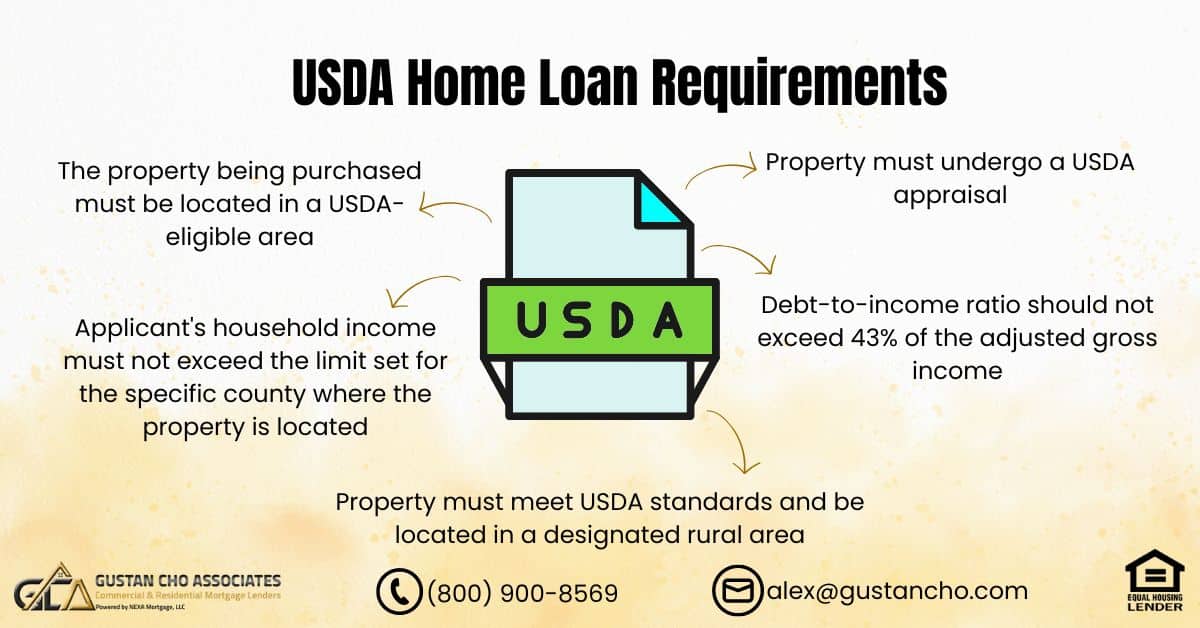
USDA Direct Mortgage Loans
USDA Direct Mortgage Loans, also known as Section 502 Direct Loan Program, help low- and very-low-income applicants obtain decent, safe, and sanitary housing in eligible rural areas. The USDA provides the loan directly, and there are specific income and property eligibility requirements.
Key Features of USDA Direct Loans
Eligibility:
Income: Applicants must meet income eligibility requirements determined by the area median income (AMI). Typically, applicants must have an income of less than 80% of the AMI.
Property Location: The property must be in a rural area defined by the USDA. Rural areas are typically defined as communities with populations of 35,000 or less.
Occupancy: The loan is only for the applicant’s primary residence.
Loan Terms:
Interest Rates: Interest rates can be as low as 1% with subsidies.
Loan Amount: The amount depends on the applicant’s income and the area where they purchase the home.
Repayment: Repayment terms can be up to 33 years (38 years for applicants with incomes below 60% of the AMI).
Benefits: No down payment is required. Subsidized interest rates based on income. Ability to finance some closing costs.
Role of USDA Loan Packagers
USDA loan packagers assist applicants in preparing and submitting their loan applications. They can provide valuable assistance in navigating the application process and ensuring all necessary documentation is provided.
Services Provided by Packagers:
Application Assistance: Help complete and submit the loan application.
Documentation: Assistance in gathering and organizing necessary financial documents.
Guidance: Provide advice on eligibility and loan terms.
Compensation: USDA loan packagers typically earn around $1,500 per file. The applicant often pays this fee, though some programs may incorporate these costs into the loan.
Steps to Apply for a USDA Direct Loan
Determine Eligibility: Check income eligibility using the USDA’s income eligibility calculator. Verify the property’s location using the USDA’s property eligibility tool.
Prepare Documentation: Gather income statements, tax returns, and other necessary financial documents. Ensure the property meets USDA guidelines.
Contact a USDA Loan Packager: Consider working with a USDA-approved loan packager to streamline the application process. Utilize their expertise to ensure a complete and accurate application.
Submit Application: Complete and apply along with all required documentation. Work with the USDA or your loan packager to address additional requirements or questions.
Loan Approval and Closing: Once approved, close the loan and purchase the property. Ensure all terms and conditions are understood before finalizing the loan.
USDA Approved Packagers: Contact local USDA offices for a list of approved loan packages. By understanding the requirements and benefits of USDA Direct Loans and utilizing the services of loan packagers, low- and very-low-income applicants can access affordable home financing options in rural areas.
https://gustancho.com/usda-home-loan-requirements/
gustancho.com
USDA Home Loan Requirements allow homebuyers to purchase homes in designated rural areas by the USDA with 100% financing no money down
-
Chicago, often called “The Windy City,” is a major metropolis known for its rich history, diverse culture, architectural marvels, and vibrant community life. Here’s an overview of Chicago and its people:
The City
Nickname Origin: “Windy City” is often believed to reference Chicago’s weather. However, it originated from its residents’ reputation for being full of “hot air” or boastful, particularly in the city’s bid to host the 1893 World’s Columbian Exposition.
Geography and Climate: Located on the southwestern shore of Lake Michigan, Chicago experiences a temperate climate with cold winters, warm summers, and significant wind due to its proximity to the lake.
Architecture and Landmarks: Renowned for its skyline, Chicago is home to masterpieces such as the Willis Tower (formerly Sears Tower), John Hancock Center, and innovative structures by architects like Frank Lloyd Wright.
The People
Diversity: Chicago is a melting pot of cultures and ethnicities, with significant African American, Hispanic, Irish, Italian, Polish, and Asian communities.
Cultural Contributions: The city has significantly contributed to music (especially blues, jazz, and house), theater, and art. Chicago is known for its vibrant arts scene with institutions like The Art Institute of Chicago and venues like the Chicago Theatre.
Sports: Chicagoans are passionate about sports, supporting teams like the Chicago Cubs and White Sox (MLB), Chicago Bears (NFL), Chicago Bulls (NBA), and Chicago Blackhawks (NHL).
Food: The city is famous for its culinary offerings, including deep-dish pizza, Chicago-style hot dogs, and Italian beef sandwiches. It’s also home to a burgeoning fine dining scene.
Community and Spirit
Resilience: Known for their resilience and community spirit, Chicagoans have a history of returning from challenges, exemplified by the city’s recovery after the Great Chicago Fire of 1871.
Neighborhoods: Chicago is a city of neighborhoods, each with a unique character and community. There’s a diverse range of living environments, from the historic Bronzeville to the artistic Wicker Park and the affluent Gold Coast. Chicago, “The Windy City,” is a dynamic and diverse metropolis with a rich cultural heritage and a strong sense of community. Its people are known for their resilience, pride, and passion for their city. Whether through its architecture, cuisine, music, or sports, Chicago leaves an indelible mark on anyone who experiences it.