
 Attorney
 George
AttorneyForum Replies Created
-

The answer differs for each divorce agreement and how the property is titled. The following is a breakdown:
Property Title
Joint Tenants with Right of Survivorship: If held as joint tenants with right of survivorship, your brother’s interest in the property would pass automatically to his ex-wife when he dies, even if he has other wishes stated in his will or doesn’t have kids.
Tenants in Common: However, if owned as tenants in common, then his portion would not pass directly to her but instead go into his estate, which is distributed according to intestate laws (if no will) or testamentary provisions (if there is one).
Divorce Decree
Sometimes, divorce settlements include language about what happens if one spouse dies before everything gets sorted out. So, depending on their agreement, she may still get half.
Will or Estate Plan
If there’s a will: If your brother has a will that says his share should be given to children. They hold it as tenants in common, and this means that upon death, all rights shall vest indefeasibly with them as tenants in common being co-owners without the right of survivorship, which means that each child becomes vested with an equal, undivided interest therein.
No will: On the other hand, if he doesn’t have one, then state law takes over – most likely resulting in everything going equally among offspring
-
George
MemberJuly 30, 2024 at 4:34 am in reply to: Population of Cities With High Property Taxes DecreaseWith increased home value comes higher property taxes. Most homeowners throughout the United States will see higher property taxes due to increased assessed value. Besides high rates, high home values, new home buyers can expect higher property taxes, and higher homeowners insurance premiums. The economy is not healthy unlike Joe Biden’s claim and the mainstream media network bragging how great our overall economy is. Expect a housing bubble, increased unemployment, high bankruptcy, higher foreclosures, and skyrocketing inflation numbers.
-
George
MemberJuly 14, 2024 at 9:54 pm in reply to: California Planning on Taxing 30 cents per mile you DriveMost wage earners in California with average salaries are priced out of the housing market. Homes in Los Angeles County and Orange County are $1,000,000. That’s a 1,000 square foot home with two bedrooms and one bath with a one car garage. With many employers turning workers to remote wage earners, you will be seeing more and more people Fleeing the state of California to lower tax states with lower housing prices and affordable cost of living. California is in major trouble. Again, it’s incompetent politicians like Gavin Newsom, Nancy Pelosi, Adam Schiff and the Democrats that are in power.
-
What exactly is a No-Doc Loan? A No-Doc (No Documentation) Loan is a mortgage which doesn’t require traditional income verification documents like pay stubs, W-2s or tax returns from the borrower. Instead, approval depends on credit score, assets and down payment. These loans were more common leading up to the 2008 financial crisis and have since become less prevalent because of more stringent lending regulations.
Qualify for No-Doc Loans: Do Business Owners and Self-Employed Homebuyers or Property Investors?
Yes, business owners and self-employed individuals can qualify for no-doc loans, especially if they have significant write-offs on their federal income tax returns that result in low or negative adjusted gross income. These loans can be helpful for people who need to prove their income but have trouble doing so through traditional means.
Features of No-Doc Loans
Minimal Documentation:
Borrowers may provide simple documentation.
Approval often based on credit score, assets and down payment.
No-Doc Loans Require Higher Down Payment:
No-doc loans usually require a higher down payment than conventional loans; this could be anywhere from 20% to 40% of the property’s value.
Interest Rates on No-Documentation Loans:
Because there’s greater risk to the lender when no-doc loan applicants don’t provide complete financial information about themselves upfront — such as where they work or how much money they make — interest rates are usually higher than those offered with conventional mortgages.
Asset Verification for No-Documentation Loans:
Lenders may look at the borrower’s assets and reserves as an indication of their ability to repay the loan.
Eligibility Requirements for No-Doc Loans
Good Credit Score: Having good credit is important, with most lenders requiring a minimum score around 680 – though higher scores will yield better terms.
Substantial Down Payment: As mentioned earlier, larger down payments are usually required because there’s minimal income documentation provided by the borrower.
Significant Assets: Borrowers should have substantial assets or savings that can be verified by the lender.
Alternative Income Verification: While traditional income verification is not required, lenders may use alternative methods to assess income stability such as bank statements or other records of deposit.
Special Considerations for Self-Employed Individuals and Business Owners
Write-offs and Tax Returns: Many self-employed people have significant write-offs that reduce their taxable income, which can make traditional income verification challenging. No-doc loans overcome this obstacle by not requiring tax returns.
Bank Statements: Some lenders offer what are known as bank statement loans, which are a variant of no-doc loans where the borrower provides bank statements (usually 12-24 months) instead of tax returns to prove income.
Stated Income Loans: Another variation is the stated income loan, in which borrowers state their income without providing any verification documents. The lender will assess the reasonableness of the stated income based on the borrower’s profession and overall financial profile.
Availability of Mortgage Loans with No Documentation: The collapse in 2008 of the housing market was associated with many risky lending practices which led to the decline in the number of no-doc loans. However, some lenders still offer them, especially nontraditional ones and private ones. For instance, during periods when credit availability has considerably tightened up elsewhere business owners or self-employed persons having substantial write-offs that lead to low or negative AGI might find these loans helpful. Credit scores are more important in such mortgages as well as assets and down payments than verifying stable income through traditional methods alone like pay stubs. Although not as common now as it used to be but still offered by few providers who need applicants may also show other evidences that can prove their financial soundness apart from relying solely on traditionally earned incomes.
https://non-qmmortgagebrokers.com/no-doc-loans/

non-qmmortgagebrokers.com
No-Doc Loans require one months of bank statements to show the source for the down payment and 12 months of reserves of the home purchase
-
Property tax prorations happen during the sale of a property to ensure both parties pay only for the time they own it. Normally at closing, sellers will give buyers credit for property taxes accrued but not yet due.
Using Property Tax Prorations for Down Payment
FHA Loans: There are specific rules from the Federal Housing Administration (FHA) about what can count towards your down payment; seller credits — including property tax prorations — generally cannot be used to meet their minimum requirement of 3.5%. Your down payment must come from your funds or approved sources such as gifts from family members.
Conventional Loans: Depending on the lender, conventional loan guidelines may be more flexible than FHA when it comes to using prorated taxes for closing costs vs. prepaids and/or down payment.
Practical Example
Scenario:
Home Purchase Price: $300,000
Annual Property Taxes: $6,000
Closing Date: June 30th
Property Taxes Due in Arrears: Seller owes taxes from January 1st through June 30th
Proration Calculation:
Daily Property Tax Rate : $6,000 / 365 days = $16.44 per day
Seller’s Portion: 180 days (January 1st through June 30th) x $16.44 = $2,959.20
At Closing:
Seller Credits Buyer : $2,959.20 for buyer’s portion of year’s property taxes.
Buyer’s Responsibility : From July 1st forward buyer is responsible for paying property taxes.
Note : The amount credited ($2,959.20) by the seller usually goes towards reducing buyer’s closing costs not down payment.Property tax proration is standard practice in many states’ real estate transactions especially where arrears are paid; while these can help reduce closing costs for buyers they typically cannot be used to meet down payment requirements especially with FHA loans. Loan officers need to know these differences well enough so they can guide clients through home buying process effectively in different situations.
-
Renovation vs. Trade-In: Evaluating Your Options Your Current RV Model: 2001 Tiffin Zephyr Length: 42 feet Mileage: 52,000 miles (relatively low for its age) Condition: Consider current condition and potential for upgrades Renovation Example David’s RV: 37-foot RV Renovation Cost: $150,000 Work Done: Two new slide-outs, interior and exterior renovation Outcome: Significant transformation, likely adding value and modern features Key Considerations for Renovation Pros to Renovate Existing RV Customization: Tailor the RV to your specific needs and preferences. Preserve Value: Maintain and increase the value of a well-loved and well-maintained RV. Avoid Depreciation: Unlike buying a new RV, where depreciation starts immediately, a renovated RV can hold its value better. Modern Features: Upgrade to include modern amenities and technologies. Cons Cost: Renovation can be expensive, as evidenced by David’s $150,000 investment. Time and Effort: Renovations require time, effort, and a reliable contractor. Unknown Issues: Potential for unexpected problems during renovation, leading to additional costs. Key Considerations for Trade-In Pros New Features: Access the latest models with updated technology and features. Warranty: Newer RVs often come with manufacturer warranties, reducing maintenance costs and concerns. Reliability: There is less likelihood of mechanical issues with a newer model.
Immediate Use: No waiting for renovations to be completed; you can use the RV immediately. Cons Depreciation: New RVs depreciate quickly, often losing a significant percentage of their value in the first few years. Cost: Higher upfront cost for a new or newer model. Trade-In Value: You may receive less for your current RV than its perceived value, especially considering depreciation. Steps to Take Evaluate Current Condition: Thoroughly assess the condition of your Tiffin Zephyr. Consider getting a professional appraisal. Compare Costs: Get estimates for a potential renovation similar to what David did. Compare these costs to the price of a newer RV you’re considering. Inspect David’s RV: Review the before and after pictures and visit David’s renovated RV to see the quality of work and get an idea of potential results. Depreciation Analysis: Research the depreciation rates for new RVs and renovated older models. This will help you understand long-term value retention. Consult Professionals: Talk to RV experts, including those at Collier RV, about the market trends and get their input on your situation. Both renovation and trading have their merits and drawbacks. Your decision will depend on your budget, preferences, and how much you value customization versus new features. By carefully evaluating your options and consulting with professionals, you can make an informed decision that best suits your needs and financial situation. 🙌.
-
George
MemberJune 25, 2024 at 6:46 am in reply to: HUD Chapter 13 Bankruptcy Dismissal Guidelines on FHA LoansHUD’s guidelines for obtaining FHA loans during and after a Chapter 13 bankruptcy are designed to help individuals who have demonstrated financial responsibility during the bankruptcy period. Here’s a detailed overview of these guidelines:
FHA Loan Eligibility During Chapter 13 Bankruptcy
Minimum Time Requirements:
- One Year of Payments: Borrowers must have made 12 months of on-time payments to their Chapter 13 bankruptcy plan.
- Court Approval: The bankruptcy court must approve the borrower’s request for a new mortgage loan.
Creditworthiness:
- No Late Payments: The borrower must have a history of timely payments on all obligations within the bankruptcy period.
- Credit Score: While the FHA does not set a minimum credit score, most lenders prefer a score of at least 580. Some lenders may have higher requirements.
Manual Underwriting:
- FHA loans for active Chapter 13 bankruptcy borrowers are subject to manual underwriting. This means a more detailed review of the borrower’s financial situation, including income stability, employment history, and overall credit profile.
Income and Employment Verification:
- Stable Income: Borrowers must demonstrate stable and sufficient income to cover mortgage payments, living expenses, and bankruptcy plan payments.
- Employment History: A steady employment history of at least two years is typically required.
FHA Loan Eligibility After Chapter 13 Discharge
Discharge Requirements:
- Seasoning Period: Typically, borrowers must wait at least two years from the discharge date of their Chapter 13 bankruptcy to qualify for an FHA loan without manual underwriting. However, borrowers can be eligible for an FHA loan one year after discharge if they have demonstrated strong credit and financial management during and after the bankruptcy.
Credit and Financial Stability:
- Credit Improvement: Borrowers should improve their credit score and maintain a positive credit history post-bankruptcy.
- Financial Management: Demonstrating sound financial management and having no additional delinquencies or defaults post-discharge is crucial.
Documentation:
- Discharge Papers: Borrowers must provide a copy of their bankruptcy discharge papers.
- Verification of Payment History: Documentation of timely payments throughout the bankruptcy period will be required.
Key Considerations
Debt-to-Income Ratio (DTI):
- The borrower’s DTI ratio must meet FHA guidelines, which typically allow for a maximum of 43% for front-end ratios and up to 56.9% for back-end ratios, depending on compensating factors.
Compensating Factors:
- Lenders may consider compensating factors such as significant cash reserves, a substantial down payment, or other positive financial attributes that can offset the risk associated with recent bankruptcy.
Counseling Requirements:
- Some lenders may require borrowers to complete homebuyer education or credit counseling courses to ensure they understand the responsibilities and implications of taking on a new mortgage.
These guidelines help ensure that borrowers who have undergone Chapter 13 bankruptcy and demonstrated financial responsibility can still achieve homeownership through FHA loans. Always consult with a mortgage professional or financial advisor for personalized advice and to navigate the specifics of your situation.
https://gustancho.com/qualifying-for-fha-loan-during-chapter-13-bankruptcy/
gustancho.com
Qualifying For FHA Loan During Chapter 13 Bankruptcy
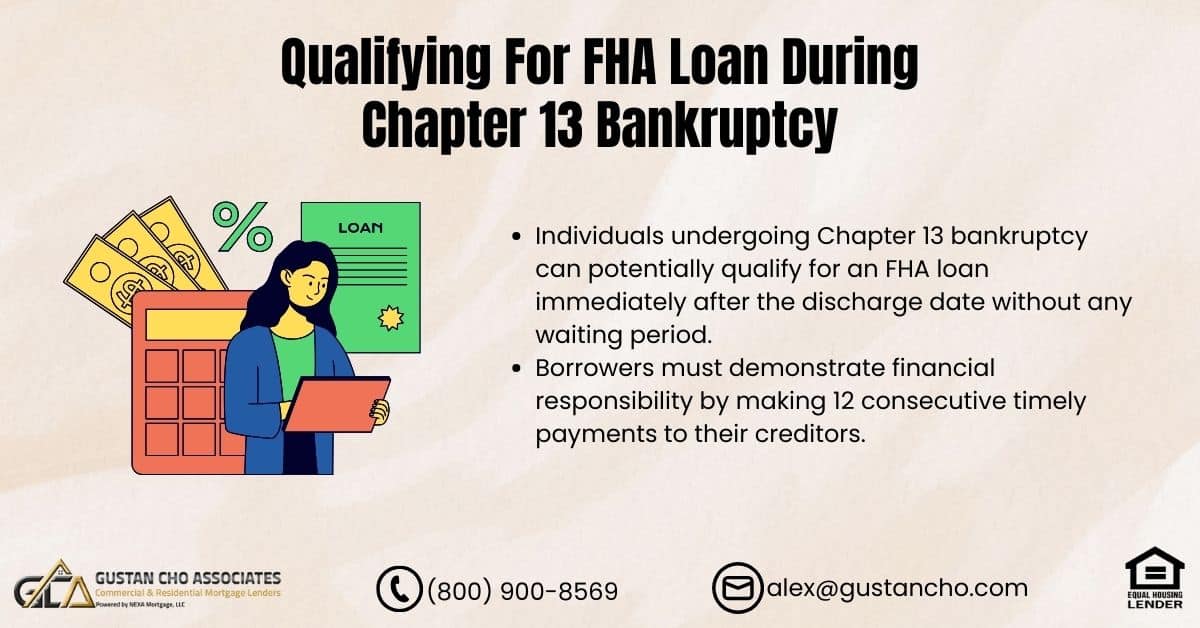
Qualifying For FHA Loan During Chapter 13 Bankruptcy: Borrowers can qualify for an FHA loan during Chapter 13 one year into the plan
-
Key Characteristics of Primary Owner-Occupant Homes
Primary owner-occupant homes, also known as owner-occupied homes or primary residences, are residential properties where the owner lives and resides as their main place of residence. These homes are distinguished from rental properties or investment properties. Here are the key characteristics of primary owner-occupant homes:
Primary Residence
- Definition: The home is the main residence where the owner lives most of the year.
- Usage: It is not used primarily for rental income or as an investment property.
- Tax Benefits: Homeowners can qualify for specific tax benefits, such as the mortgage interest deduction and the exclusion of capital gains tax on the sale of the property (subject to certain conditions) (Gustan Cho Associates Mortgage Brokers).
Occupancy Requirements
- Owner Occupancy: The owner must physically occupy the home. Lenders often require the owner to move in within a certain period (usually 60 days) after closing on the property.
- Verification: Lenders may ask for verification, such as utility bills or driver’s license address, to confirm that the home is the owner’s primary residence.
Mortgage Rates and Terms
- Favorable Rates: Mortgages for primary residences typically have lower interest rates than loans for second homes or investment properties because lenders consider them less risky.
- Loan Terms: More favorable loan terms are often available, including lower down payments and higher loan-to-value (LTV) ratios (Gustan Cho Associates Mortgage Brokers).
Insurance Requirements
- Homeowners Insurance: Owners must carry homeowners insurance covering the property and personal liability.
- Lower Premiums: Insurance premiums are often lower for primary residences than rental or vacation homes.
- Loan Eligibility
- First-Time Homebuyers: Special loan programs, including FHA, VA, and USDA loans, are often available for first-time homebuyers purchasing a primary residence.
- Down Payment Assistance: Various programs can assist with down payments and closing costs for owner-occupied properties (Better Business Bureau).
Homestead Exemption
- Property Tax Reduction: Many states offer a homestead exemption, which reduces property taxes for primary residences. Eligibility and benefits vary by state.
- Protection from Creditors: Some states provide homestead protection, shielding some of the home’s value from certain creditors (GCA Mortgage).
Property Use Restrictions
- Zoning Laws: The property is subject to local laws and ordinances that affect its use and modification.
- Homeowner Associations: If the property is within a community governed by a homeowner association (HOA), additional rules and regulations regarding property use and maintenance (GCA Mortgage)may exist.
Primary owner-occupant homes serve as the owner’s main residence and come with specific benefits and requirements, including favorable mortgage terms, tax advantages, and potential eligibility for special loan programs and property tax exemptions. Homeowners must meet occupancy requirements and understand the associated legal and financial implications.
gustancho.com
GCA Mortgage | Mortgage Experts With No Overlays
Whether you’ve gone through bankruptcy, divorce or you are a first-time homebuyer, Gustan Cho Associates are experts in difficult loans
-
Thank you for providing this detailed introduction to VA high-balance loans. You’ve explained their purpose and context very well. Let’s expand on this by discussing the key features of VA high-balance loans:
Higher Loan Limits:
- Allows borrowers to exceed standard conforming loan limits in high-cost areas.
No Down Payment Required:
- Like standard VA loans, high-balance VA loans often require no down payment, subject to the borrower’s entitlement.
No Private Mortgage Insurance (PMI):
- VA loans don’t require PMI, even with a high loan amount and no down payment.
Competitive Interest Rates:
- Despite the higher loan amounts, interest rates are often competitive with standard VA loans.
Flexible Credit Requirements:
- VA loans generally have more lenient credit score requirements than conventional jumbo loans.
VA Funding Fee:
- A funding fee is required, which can be financed into the loan. The fee amount varies based on factors like a down payment and whether it’s a first-time or subsequent use of the VA loan benefit.
Occupancy Requirement:
- The borrower must intend to occupy the property as their primary residence.
Debt-to-Income (DTI) Ratio Flexibility:
- VA loans often allow for higher DTI ratios compared to conventional loans.
Loan Assumption:
- VA loans, including high-balance loans, are assumable and can be attractive to future buyers.
Limited to Eligible Veterans and Service Members:
- Borrowers must meet VA eligibility requirements and obtain a Certificate of Eligibility.
Property Requirements:
- The property must meet VA minimum property requirements (MPRs).
Refinancing Options: This includes the ability to refinance with a VA Interest Rate Reduction Refinance Loan (IRRL). These features make VA high-balance loans attractive for eligible borrowers looking to purchase or refinance homes in high-cost areas. They offer many of the same benefits as standard VA loans but with higher loan limits to accommodate more expensive properties.
https://gustancho.com/high-balance-mortgage-loans/
gustancho.com
FHA and Conforming High-Balance Mortgage Loans
FHA and Conforming High-Balance mortgage loans have a loan limit ceiling cap at $1,089,300. VA loans has no maximum loan limit