 Real Estate Agent
LK1119 2004
Real Estate AgentForum Replies Created
-

LK1119 2004
MemberNovember 13, 2024 at 1:28 pm in reply to: FORMER PRESIDENT TRUMP WINS 2024 ELECTIONWhy does half the population in the United States hate former President Donald J. Trump? What is Trump Derangement Syndrome? Would you want a President that speaks their mind and is not two faced?
-
Some of the factors affecting veteran loans from the VA are income, debt, and credit scores. If you’re a veteran with around 675 credit and a ratio hovering around 50%, here is a guide that should make things easier in the state of California. But be advised: hope is not lost if DTI is still between the given ranges, as a strong set of tools can help.
A 41% DTI can also mean anything else.
A lot of honing in will require you to have a strong compensating factor since the DTI to loan terms ratio will be more lenient—according to VA loans. Nonetheless, having a strong payment history, amongst other things, will still be paramount.
Grow the Income in Residuals
Projected Budget: Residual income is almost always considered for a VA loan over the DTI ratio, as it can help the application get approved.
Additional Sources Of Income: If there are any freelance gigs that you can pull off or even side jobs that can help strengthen your financial profile, doing so is recommended.
Connect with Lenders who understand VA loans.
Look for Lenders: Consider them a boot camp, especially those who are already experienced and well aware of the process of getting funds through VA loans. This will save a lot of your time and have you connected in a dime.
Consider Paying Off or Reducing Debt
Debt Reduction: To reduce your DTI, start by focusing on existing debts that are most manageable. Paying a few debts will help your overall ratio.
Credit Card Balances: Pay off higher-interest credit cards or other debts to enhance your general standing.
Explore Lender Programs
Lender-Specific Programs: Various lenders have veteran programs with less strict DTI requirements. Ask what might be available to you as a disabled veteran.
Use VA Disability Benefits
Income from Benefits: There is support from VA disability compensation, which can be helpful in the income section of your future mortgage application. Don’t forget to point that out to your lender.
Seek Assistance and Advice
Veterans Service Organizations (VSOs): Contact dependents or humanitarian groups like the American Legion or VFW for assistance. They can provide resources or connect you with expert professionals familiar with VA loans.
Consult a Financial Advisor: A financial advisor who knows VA loans can be vital in evaluating your condition and drafting working plans.
Ensure That The Required Documents Are Drafted And Prepared
The Last Touch Of Preparation: If any VA benefits are included, an income verification document or anything else necessary with the application must be included. This will hopefully help speed up the process.
A ratio of fifty might be challenging. Still, it should not deter you from going for a VA loan for a home in California. The help of a reputable lender and the intent to pay off debts while showing your best qualities as a borrower can increase the chances of approval. Be assertive and considerate, approach this process patiently, and do not hesitate to contact the veteran directing assistance.
-
LK1119 2004
MemberSeptember 5, 2024 at 7:04 am in reply to: How Do You Become a Preferred Lender For a Home BuilderFrom the little I know, I can share my direct experience with how one local home builder worked with a preferred lender. By no means is the builder in question is a large national builder like Lennar Homes or DR Horton. Again, the real estate and finance industry is a cut throat business and its all about money. I cannot say if all builders use the model I am sharing with you on a good friend/family member become a preferred loan officer but she had to rent a small desk in a closet like size office for a cost of $10,000 per month. The way this home builder did it was smart to get away from the RESPA rules of getting a kickback. There was no guarantee the builder was to generate a number of qualified borrowers. It can be zero or 40 borrowers per month. The way the loan officer got in the door to the builder was because my brother, and sister in law’s company did a lot of third-party consulting, construction and development work and my brother was vested in the projects the builder did by investing or getting the builder bridge loans. I do not know the details on how the builder and mortgage lender worked out but it is hard to believe that the best guy wins principle doesn’t apply. Home builders will not choose a preferred lender just on the merits of the lender. Again, I am not accusing builders and this is solely my opinion and thoughts that builders need to get a kickback or monetize in a legal way and not jeapordize going beyond the gray area. I will try to get some more information and see if I can get the people that know more about this to respond directly.
-
Non-qm loans are not hard money loans. Non-qm mortgage rates are very competitive unlike hard money loans. Hard money loans is asset based and the borrowers credit and income is not factored into the approval process. Hard money loans are not available for owner-occupied home loans. It is mainly for investment properties and commercial properties.
-
LK1119 2004
MemberJuly 3, 2024 at 5:19 pm in reply to: What is Accounts Receivable Financing For Business OwnersAccounts Receivable Financing is a financial package where a business uses its unpaid invoices (accounts receivable) as insurance to get a loan or line of credit. This type of funding permits companies to get money quickly against the value of what they are owed instead of having to wait for customers’ payments. Through invoice submission, account receivable financing functions. A financing company (also known as a factor) is given the outstanding invoices that the business may be having for sale or used as security for borrowing purposes by that specific entity. A fee, which represents interest or factoring fee deducted by them from balance remaining after realization of full payment from clients towards such invoices received shall be remitted back into enterprises by these financiers.
Types of Accounts Receivable Financing
Factoring is when the business sells its invoices to a factoring company at a discount. The company then collects the payments from customers on behalf of businesses.
Invoice Discounting is when the business borrows money against its invoices but retains control over the collection process. Businesses have to collect payments from their customers themselves. Benefits of Accounts Receivable Financing Immediate Access to Cash: This helps in maintaining continuous flow since they get paid instantly while still holding onto their debts thus giving out steady cash flow all through this period Scalable Solution: Amount available for borrowing increases with sales because it depends on how much one has got as accounts receivable No Fixed Loan Amounts: Unlike traditional loans where there are specific amounts set aside during different periods depending with some factors considered by lenders at such moments like creditworthiness among many others; this can vary based on current receivables hence proving hard and time-consuming
Less emphasis on credit: Approval is more focused on the creditworthiness of the customer rather than the business itself. This makes it easier for companies with less-than-perfect credit histories to qualify. With factoring, a company takes over collecting payments which frees up some internal resources in an organization that would have been used for collecting payments themselves. No new debt: Non-Dilutive Financing: Accounts receivable financing is not debt-based so it does not create any new liabilities or affect equity. Off-Balance-Sheet Financing: It can be recognized as an off-balance-sheet transaction and may improve certain financial indicators. Opportunity for growth: Expansion Funding – Immediate cash flow can be used by businesses to support growth initiatives such as new projects, marketing and expansions before invoices are paid. Many factoring companies offer credit checks on your customers which help manage credit risk better. Factoring fees range from 1% to 5% of invoice value this might be higher than traditional loan interest rates. The cost of financing may eat into profit margins so businesses need to consider whether they outweigh benefits gained elsewhere . Customers like dealing directly with the business when paying their invoices rather than through third-party finance providers. Financing terms and availability will heavily rely on your customer’s creditworthiness Poor customer ratings might limit financing options available . For businesses that need immediate cash flow, accounts receivable financing offers a valuable solution. It provides flexibility, easier qualification and potential for growth without adding new debt onto the balance sheet however there are considerations around cost and impact on customer relationships . Business owners should evaluate these factors carefully in order to maintain liquidity while supporting operational needs as well as expansion requirements through leveraging accounts receivable financing
-
LK1119 2004
MemberJuly 3, 2024 at 4:18 pm in reply to: Chicago Heights Illinois Homeowner Has $1,800 property tax to $30,000A property tax increase can be shocking and burdensome to homeowners. Here’s why a Southern Suburban Illinois homeowner might face such an extreme spike in Chicago Heights, Illinois Property Taxes. Possible Reasons for Drastic Property Tax Increase can be due to property reassessment. Revaluation of the property by the city or county can get the property reassessed: Property taxes are based on the assessed value of the property. If there has been a recent reassessment, the home’s value might have shot up dramatically which in turn leads to higher taxes.If real estate market in the area has appreciated, assessed value of properties may go up accordingly. The tax rate set by local governments (county, city, school district) may have increased. Significant increases in tax rates can lead to substantial rise in property taxes.Approval of new bonds or levies for schools, infrastructure or other local projects can result in higher propert taxes.Errors need correction such as incorrect square footage or classification among others in property assessment.Special assessments for improvements like new sidewalks, sewers among others infrastructure projects may be added to property taxes.
Steps to Address Property Tax Increase
Review Tax Bill:Detailed Breakdown- Carefully review the property tax bill so as to understand what makes it go high.Check assessment notice for any errors in property details or assessed value.Contact local assessor’s office for clarification on assessed value and reasons behind increment.If there are discrepancies or errors request review/correction.Homeowners have right to appeal their property tax assessment if they feel it is wrong/unfair.Gather evidence like recent sales data of similar properties, appraisal reports and documentation showing any errors in assessment.Consider hiring a Property Tax Attorney/Consultant who specializes with appeals.Join/form local homeowner groups that advocate for fair property tax assessments/rate changes with local government officials-value determined by assessor’s office is usually a percentage of market value.The rate is applied to assessed value set by local taxing authorities.A multiplier ensures uniform property assessments across different areas within the jurisdiction.Homestead Exemption is available for primary residences thus reducing taxable value.Senior Exemptions are available for senior citizens hence further reducing taxable value.
It’s uncommon for property taxes to suddenly jump by $1,800 to $30,000 or more. This kind of increase is likely because there were multiple reassessments combined with changes in tax rates, special assessments or errors. Homeowners who receive such bills should take these steps as soon as possible: review their tax bill; contact their assessor’s office and file an appeal if necessary. Seeking help from professionals and getting involved with community organizations can also address some financial consequences related to high property tax hikes.
-
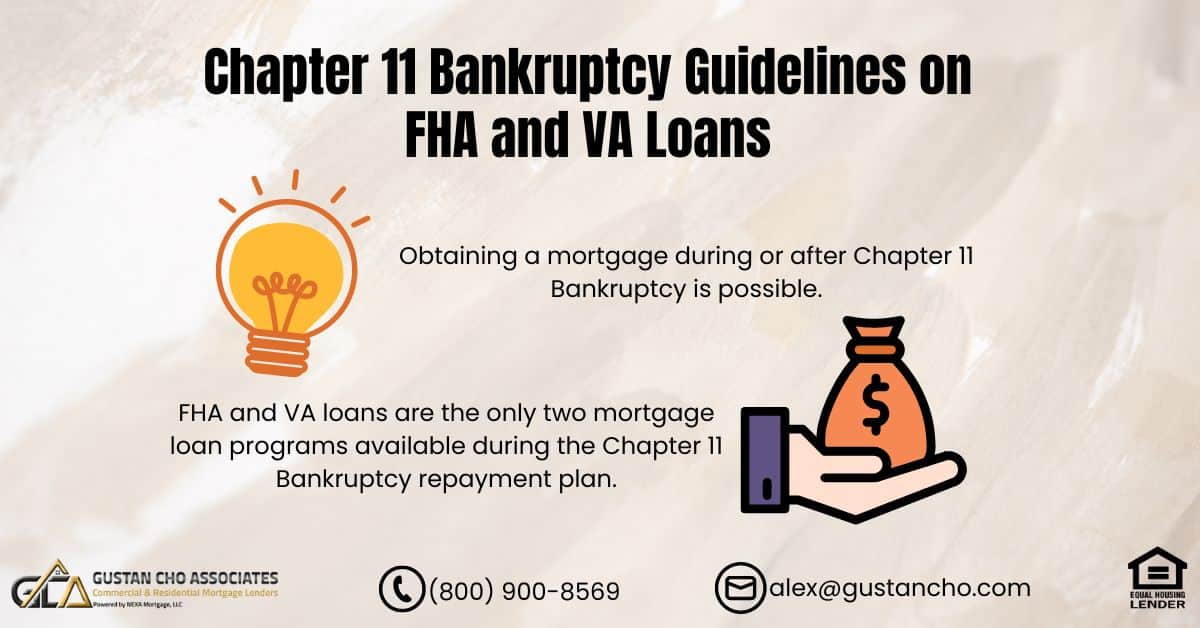
Chapter 11 Bankruptcy and Mortgage Eligibility
There are many conflicting answers regarding when to apply for a mortgage after Chapter 11 Bankruptcy. According to HUD guidelines, there is a two-year waiting period after the Chapter 11 Bankruptcy discharge date to be eligible for an FHA loan.
Other Important Key Points on Mortgage After Chapter 11 Bankruptcy:
Waiting Period: A two-year waiting period after the discharge date is required for FHA loan eligibility.
Repayment Plan Guidelines: The Chapter 11 bankruptcy repayment plan should follow guidelines similar to those of Chapter 13 bankruptcy per HUD.
Seeking Confirmation: Further confirmation will be sought from HUD to clarify the exact guidelines.
HUD Contact: We will contact HUD to confirm the exact guidelines and ensure accurate information is provided.
Additional Information: More details will be shared in the coming days. Stay tuned for updates and detailed information regarding Chapter 11 Bankruptcy and mortgage eligibility. If you have any specific questions or need more information, feel free to ask!
https://gustancho.com/chapter-11-bankruptcy/

gustancho.com
Chapter 11 Bankruptcy Guidelines on FHA and VA Loans
Gustan Cho Associates Mortgage Group are experts in helping borrowers qualify for a mortgage during and after Chapter 11 Bankruptcy.
-
LK1119 2004
MemberJune 21, 2024 at 5:53 pm in reply to: DOWN PAYMENT ASSISTANCE FOR FIRST-TIME HOMEBUYERSDown Payment Assistance for First-Time Homebuyers
Every state in the U.S. has a state housing authority that provides down payment assistance (DPA) programs to help first-time homebuyers with their down payment and closing costs. Depending on the state, county, and city, these programs often have different lending requirements.
Key Points of Down Payment for First-Time Homebuyers:
State Housing Authorities: Each state has a housing authority that offers DPA programs.
Program Variability: Requirements and benefits vary significantly between states, counties, and cities.
Individual State Threads: The individual state threads on the forum will cover detailed information about each state’s DPA programs.
Upcoming Coverage:
We will be covering every state’s down payment assistance program available through their down payment assistance program for first-time homebuyers on the individual state thread of the forum. This will include:
Eligibility Requirements: Income limits, first-time homebuyer status, credit score requirements, and other criteria.
Assistance Details: Amounts available, types of assistance (grants, loans), and repayment terms.
Application Process: How to apply, required documentation, and timelines.
Additional Resources: Links to state housing authorities and other relevant organizations. Stay tuned for comprehensive information on the down payment assistance programs for first-time homebuyers in your state! If you have any specific questions or need information about a particular state, feel free to ask.
https://gustancho.com/down-payment-assistance-mortgage/
gustancho.com
EPM Empowered Down Payment Assistance Mortgage Program
There are recoverable and non-recoverable Down Payment Assistance Mortgage for Homebuyers is offered at Gustan Cho Associates
-
LK1119 2004
MemberJune 21, 2024 at 5:47 pm in reply to: DOWN PAYMENT ASSISTANCE FOR FIRST-TIME HOMEBUYERSDown Payment Assistance for First-Time Homebuyers
Every state in the U.S. has a state housing authority that provides down payment assistance (DPA) programs to help first-time homebuyers with their down payment and closing costs. Depending on the state, county, and city, these programs often have different lending requirements.
Key Points:
- State Housing Authorities: Each state has a housing authority that offers DPA programs.
- Program Variability: Requirements and benefits vary significantly between states, counties, and cities.
- Individual State Threads: The individual state threads on the forum will cover detailed information about each state’s DPA programs.
Upcoming Coverage:
We will be covering every state’s down payment assistance program available through their down payment assistance program for first-time homebuyers on the individual state thread of the forum. This will include:
- Eligibility Requirements: Income limits, first-time homebuyer status, credit score requirements, and other criteria.
- Assistance Details: Amounts available, types of assistance (grants, loans), and repayment terms.
- Application Process: How to apply, required documentation, and timelines.
- Additional Resources: Links to state housing authorities and other relevant organizations.
Stay tuned for comprehensive information on the down payment assistance programs for first-time homebuyers in your state! If you have any specific questions or need information about a particular state, feel free to ask.
https://gustancho.com/down-payment-assistance-mortgage/
gustancho.com
EPM Empowered Down Payment Assistance Mortgage Program
There are recoverable and non-recoverable Down Payment Assistance Mortgage for Homebuyers is offered at Gustan Cho Associates