

 Dually Licensed
 Ollie
Dually LicensedForum Replies Created
-
why is silver price per ounce in China higher than the United States and what are the days and hours CDT trading precious metals.
Silver prices per ounce are higher in China mainly because the Shanghai market is driven by tight physical supply, strong local demand, and capital/transport controls that prevent easy arbitrage with US futures-based prices.
Why China’s silver price is higher – Chinese exchanges (Shanghai Gold Exchange and Shanghai Futures Exchange) are more focused on physical delivery, so prices reflect the cost of actual metal that can be taken out of vaults, not just paper contracts.
– Industrial demand for silver in China (solar panels, electronics, advanced manufacturing) and a cultural preference for **physical** bullion create strong, localized buying pressure.
– When local inventories are relatively tight, prices in Shanghai must rise to balance supply and demand, even if US/Western futures prices do not move as much.
– Moving bullion between the US and China is costly and regulated (shipping, certification, capital controls, import/export rules), so arbitrage cannot fully close the gap, allowing a persistent premium in China.
– Recent reporting notes spreads on the order of roughly 10 USD per ounce between US and Shanghai silver prices, underscoring how Chinese physical demand has decoupled somewhat from Western benchmarks.
Example: An analysis in January 2026 described US silver near 94 USD per ounce while the equivalent Shanghai price (after converting from yuan) was about 104 USD per ounce, with the difference attributed to strong Chinese physical demand and logistical/regulatory frictions.
Main precious metals trading hours (CDT)
Below are the key sessions for a Chicago (Central) time zone trader; note that US listings quote in Central Time (CT), which is the same as CDT outside of winter. Times are approximate regular hours and do not include all overnight/Globex nuances.
COMEX (CME Group) – gold and silver futures
– Floor/regular pit session (gold and silver): roughly 8:20–8:30 a.m. to 1:25–1:30 p.m. Eastern Time, which is about 7:20–7:30 a.m. to 12:25–12:30 p.m. Central Time.
– Electronic Globex session for metals runs from Sunday evening to Friday afternoon, with trading open roughly 5:00 p.m. to 4:00 p.m. Central Time, pausing one hour each weekday from 4:00–5:00 p.m. for maintenance.
### Shanghai precious metals (silver/gold) converted to Central time
Shanghai operates on China Standard Time (CST, UTC+8), which is typically 14 hours ahead of US Central Time.
– Shanghai Gold Exchange day session: 9:00–15:30 CST, roughly 7:00 p.m.–1:30 a.m. Central Time the prior calendar day in Chicago.
– Shanghai Gold Exchange night session: 20:00–2:30 CST, roughly 6:00 a.m.–12:30 p.m. Central Time.
– Reports of Shanghai silver futures reopening around 5:00–7:30 p.m. US Central time fit into this overlap between US evening and Asian morning trading.
These overlapping windows mean Chicago-based traders see active precious metal trading most of the US workday via COMEX, plus significant liquidity in the evening and early morning tied to Shanghai sessions through global spot and futures markets
-
This reply was modified 1 month, 1 week ago by
 Sapna Sharma.
-
This reply was modified 1 month, 1 week ago by
-
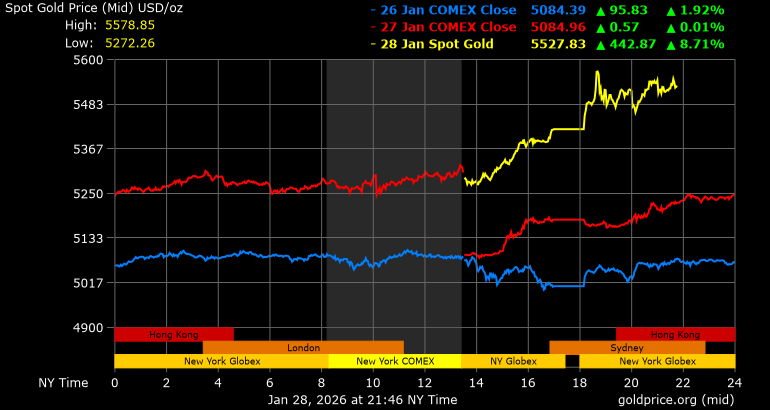
Silver just did the unthinkable: it blew through $100 and closed around $102.50—an all-time record high. Gold is right behind it near $4,980, and Peter Schiff expects the $5,000 level to break soon (possibly Sunday night when global markets open).
This isn’t “good news.” Gold and silver are warning signals. The dollar is breaking down, commodities are turning up, and the move into precious metals and mining stocks is still early. Investors are only starting to reallocate—while Bitcoin continues to lag and lose ground versus real money.
-

Thank you for taking the time to explain all this
I think I will make this move transferring my sponsorship from Loan DeIpot. Not a real estate agent but know many agents. Thank you again
-
Ollie
MemberSeptember 13, 2025 at 6:51 pm in reply to: California Housing Rebound Outpaces the U.S.Using a friendly, yet professional tone, here’s a response you can use:
I love how you broke down California’s market vs the nationwide trade rebound, since that jump in the early part of 2022 was alarming, and scaling the California heights just above 244% compared to the US average of just over 200% is just staggering.
The 36% summer supply growth in California is remarkable. However, the 25% summer supply growth nationwide is weak, and there is a year difference to relieve the 2022 buyer woes.
I would love to undertake the challenge of tracking the spending and movable patterns of the California populace while forecasting how prices will shift in the next decade. What’s your opinion?
How would you like your author to respond to the comment? Ideally, would you prefer the relaxed response of a homebuyer looking for some insights, or would you rather maintain the market-professional tone?
-
Ollie
MemberSeptember 13, 2025 at 6:37 pm in reply to: GCA Forums News Weekend Edition From September 8 through September 13 2005Housing and Mortgage News: September 13, 2025 – GCA Forums News
Sept 13, 2025, housing and mortgage updates from GCA Forums News. Check mortgage rates, market trends, and expert advice for buyers and those refinancing from Gustan Cho Associates.
Welcome to the Saturday, September 13, 2025, GCA Forums News update. Gustan Cho Associates keeps you on top of mortgage and housing market shifts that matter to buyers, lenders, and agents alike. From ticking downward mortgage rates to adjusted lender guidelines, we collect the developments you need for financing decisions and market strategy.
Mortgage Rates Continue to Ease in September 2025
Mortgage rates are gradually declining this September, easing pressure for new homebuyers and homeowners looking to refinance. Recent labor and inflation reports and the Fed’s latest policy stance have reinforced the declining trend.
30-Year Fixed Mortgage Rates Drop
As of today, September 13, 2025, the average 30-year fixed mortgage rate has slipped to 6.1% to 6.3%. This modest drop continues the trend we’ve seen throughout the month, with fixed refinance rates even falling another 11 basis points over the last few days. Analysts link the shift to growing speculation of near-term Federal Reserve rate reductions paired with falling Treasury yields, which together improve borrowing conditions.
Impact on Buyers
Lower rates relieve some of the affordability strain, especially in hot markets. In regions like Florida, where inventory has often lagged behind demand, slightly cheaper borrowing costs and stubborn leasing prices lure more buyers back.
Refinancing Gains
Homeowners still carrying the higher rates in 2021 and 2022 are increasingly looking to refinance. By making the switch now, some are projecting to save tens of thousands over the remaining term of their loans.
Guidance and Predictions
Gustan Cho Associates is, as always, standing by to help clients take advantage of these opportunities, using custom analyses to design the lowest-rate path necessary to achieve their long-term savings goal.
Outlook
Will we go below 6%? Analysts are hopeful yet guarded. The latest update says the 30-year fixed could end the year testing the 6.3% mark, but rates dropping below 6% this month is still, in their words, an outside possibility. The Federal Reserve’s next policy meeting is central to every mortgage-charting model, and lenders will quickly adapt their pricing to any new economic signals.
Housing Market Trends: A Mixed Outlook
The housing market in 2025 is starting to stabilize, but buyers still face challenges in affordability and a lack of supply in some areas.
Regional Market Dynamics: High-Demand Areas
Hot spots like Southern California continue to see strong demand. Families moving to the region and the appeal of coastal living keep buyers in the game, even with rising interest rates and unpredictable state rules. Recent wildfires in Los Angeles have added pressure, making affordable housing even more urgent.
Buyer-Friendly Markets
In contrast, some markets are loosening. More homes are hitting the market, so buyers in these spots have extra choices. Areas with a big supply are turning inviting, especially as interest rates give a bit of slack.
Affordability Concerns Grow
Pew Research shows the worries are real: about 70% of Americans see housing costs as a big worry, a rise from 61% a year earlier. More than one in three households is “cost-burdened,” meaning housing takes over 30% of their paycheck. Programs that offer affordable financing, like USDA, FHA, and VA loans, are a big help. That’s still a focus for Gustan Cho Associates.
Regulatory and Industry Developments
The mortgage world is adapting to new rules. Recent changes shape how lenders and buyers work together, influencing everything from paperwork requirements to interest rate calculations. Keeping up with these shifts is vital for anyone looking to close a deal.
Regulatory Trends Shaping the Market
On September 18, 2025, in an episode of The Big Picture webcast, Mark, a former Consumer Financial Protection Bureau official, will break down the key regulations the mortgage market faces. He’ll explain the biggest compliance headaches for lenders and how the latest rules may tighten or expand access to credit for borrowers. Gustan Cho Associates is constantly studying the changing landscape, so clients can confidently choose lenders who meet every rule while offering the best rates and terms.
Mortgage Technology Innovations
Technical advances in the mortgage sector are moving the needle. During the same webcast, Jennifer McGuinness, president of PIVOT Financial, will showcase the latest developments in structured finance and how they open the secondary market for lenders. Thanks to these tools, nonbank lenders can price, fund, and securitize loans more quickly and accurately, which means clients enjoy swifter approvals and more favorable terms. Gustan Cho Associates uses this same technology to make the mortgage process as smooth and transparent as possible for all its clients.
Global Real Estate Insights
Looking overseas can inform U.S. market expectations, as different countries offer different recovery scripts.
- Australia’s Rebound: Lower rates are already lifting prices, and analysts expect a 5% increase in the Australian market by the end of 2025.
- UK’s Fragile Recovery: The U.K. is seeing modest 3% price gains, helped by falling rates and rising real wages.
- Yet a cautious consumer mood means demand may remain tepid.
These international snapshots remind U.S. borrowers and lenders that housing remains a globally interconnected market.
Commercial Real Estate Struggles
Across the U.S., the national office vacancy rate has reached a striking 20.7%, while tech hubs like San Francisco are even higher at 27.7%. This softness in the market is driving down property values and squeezing local banks that hold these loans.
Those numbers are a loud reminder of how tightly connected real estate markets are. When one sector coughs, others across the ocean usually catch a cold, too, so keeping an eye on global trends is essential.
Tips for Homebuyers and Refinancers
Gustan Cho Associates has a three-point action plan for buyers and current homeowners looking to refinance amid the turmoil.
- Shop Around for Rates: Initial lender offers can be tempting, yet even a small difference in the rate can lead to thousands in extra interest.
- Seek at least three offers to find the winner.
- Check Government-Backed Loans: Programs like USDA, FHA, and VA loans are tailored for first-time buyers and people with credit issues.
- Gustan Cho Associates knows the ins and outs of these options and can guide you through the paperwork.
- Make a Tactical Move: If you see a deal with a low rate now, grab it.
- Rates that could drop further won’t always compensate for the waiting time.
- If you find the right home but the rate looks pricey, pull the trigger.
- Another house won’t necessarily be there when interest is lower.
FAQs About Housing and Mortgage News
Why are mortgage rates dropping in September 2025?
Economic slowdown indicators, expectations that the Federal Reserve will lower interest rates, and a decline in Treasury yields are the big bands the market is listening to.
How will lower rates change the housing market?
Lower mortgage rates typically attract more buyers, pushing housing prices in in-demand cities upward and attracting more affordable housing projects.
What are the Best Loan Options for First-Time Homebuyers?
The top loans for first-time buyers are USDA, FHA, and VA mortgages. They often let you buy a home with little or no money and have friendly credit rules. Please reach out to Gustan Cho Associates for a plan that fits you.
How Can I Stay Updated on Mortgage Trends?
Check the GCA Forums News and talk to the expert team at Gustan Cho Associates to keep up with mortgage changes. They provide concise updates and mortgage options that fit your plans.
Are There Risks to Waiting for Lower Rates?
Hesitating for a lower mortgage rate might cost you. If you wait, the ideal home might sell, and rates that drop could bring more buyers, pushing up home prices. Buying sooner can lock in your choice.
How Does Gustan Cho Associates Help Borrowers?
Gustan Cho Associates guides you with expert knowledge, sharp rates, and a full lineup of loans, from USDA to FHA and VA. The team tailors each mortgage to fit the specifics of your situation.
Ready to explore the best mortgage fit or have questions? Contact Gustan Cho Associates today. You can also catch the GCA Forums News each week for sharp updates on rates and trends anytime.
-
Good morning, America. Today is Saturday, June 21, 2025. President Donald Trump got elected on November 4, 2024. Pam Bondi was nominated as the U.S. Attorney General and was confirmed. With little or no experience as a top law enforcement officer, Kash Patel was nominated and confirmed as the FBI Director. Dan Bongino, a podcaster and former patrolman of the New York City Police Department, and a guard to Barack Obama’s security detail with the United States Secret Service, was appointed the Deputy Director of the Federal Bureau of Investigation with no supervisory experience in a federal law enforcement agency in any capacity.
Why are no indictments, arrests, and trials going on with the Biden-Era people who committed crimes against humanity, conspiracy to overthrow the President of the United States, Treason, Obstruction, and thousands of crimes? Such potential criminals are Joe Biden and the Biden Crime Family, Barack Obama and his supporters, Bill and Hillary Clinton, Bill Barr, Bill Gates, Anthony Fauci, Peter Strzok and his FBI attorney Lisa Paige, Senator Adam Schiff, Congresswoman Nancy Pelosi, Former Governor Andrew Cuomo, New York Attorney General Letitia James, Fulton County Georgia District Attorney Fani Willis and her contractor attorney lover Nathan Wade, Former FBI Director Christopher Wray, and hundreds of local, county, state, and federal employees, elected officials, and third-party contractors.
Does Kash Patel know what he is doing? There is word on the street that FBI Director Kash Patel is still celebrating his dream job appointment and confirmation as Director of the FBI and skipping weekly upper management meetings and taking FBI jets to travel the country, especially to his home in Las Vegas and to Tennessee to visit his American country singer girlfriend. Dan Bongino is too busy as deputy director of the FBI and has not done anything about crime-fighting. Are we going to see any arrests? Did Trump nominate the right people to head the U.S. Attorney General’s Office and the Federal Bureau of Investigation? Or do we have the three stooges without experience to head these high-powered law enforcement positions and offices?
-
What is the latest housing and mortgage news for Monday, June 16, 2025? How did the Israeli-Iranian war affect the housing and mortgage markets? What do you forecast for the interest and mortgage rates? What happens with the volatile stock markets and Gold and Silver prices per ounce?
-
What happens to police officers, their supervisors, the police department, and the village, city, municipality, county, or state agency that employs the police officer in question if they violate a person’s civil rights, such as false arrest, stopping a motorist without reasonable cause, and violating the person’s civil rights?
-
That last flash of news, you saw instant questions hitting your mind, the shake-up rattling markets, economies, and the whole geopolitical deck at once.
Let’s walk through it step by step so you can plug the facts into an update, a client note, or a quick blog post. There is no fluff, just the bullet points.
Context: Israel Bombs Iran
What Were They Thinking? Why Now?
- Israeli planners probably figured certain military or would-be nuclear sites inside Iran were an *imminent danger.
- Iranian officials bankroll groups such as Hezbollah and Hamas that fire rockets or run propaganda straight at Israel.
- The constant connected threat is hard to ignore.
- Israeli leaders also face fierce domestic political heat, public nerves over a security spike after every fresh incident.
- Another read: Jerusalem wanted to hit Iranian weapons flows before they crossed a red line into finished projectiles or tactical gear.
- Some analysts say the attack was also meant to yank U.S. and European eyes back to Tehran, redirecting attention from Ukraine, China, or other hot spots.
Are They Nuts?
- To many Western observers, the raid looks reckless.
- Bombs rarely create calm.
- Yet Israel moves on a wait-and-you-die calculus honed by decades of wars and terror strikes.
- Brief history lesson: Israel once bombed a French-built nuclear plant in Iraq.
- The world complained that Iraq never finished the reactor.
- That tells you how the Israeli mindset works.
- They won’t hug the fence while risking arrows.
- Bombing Iran would probably light a match in the Middle East.
- A wider regional war could spark almost overnight.
- Iran itself might fire back, or it could quietly send its proxies to take swings at U.S. forces or allies.
- The oil market, already nervous, would spiral.
- Pumps could roar louder than any jet.
- Diplomacy could collapse in real time; talking rooms empty before anyone finishes a cup of coffee.
Impact on the Stock Markets
- News breaks, and traders hit sell before reading the headline.
- Defense giants like Raytheon and Lockheed Martin suddenly look like the safest place to park cash.
- Oil explorers and drillers gain ground as crude prices bounce.
- Safer bets, such as U.S. Treasuries and gold glitter, while tech stocks quietly sink.
- The so-called fear gauge, the VIX, jumps because people want insurance on their portfolios.
Impact on the U.S. Economy
- Crude near or over \$100 a barrel becomes a stealth tax for American drivers.
- Jet fuel, trucking diesel, and shipping rates climb, pushing goods prices north.
- Families trim take-out and new sneakers, making retailers feel the pinch.
- Squeezed margins hit earnings reports, and Wall Street cools on high-flying valuations.
Impact on Inflation
- Energy costs jump first, and shipping lanes through the Strait of Hormuz get shaky.
- Higher logistics bills bleed into grocery prices, especially imported staples.
- The Fed faces a messy choice: keep rates high longer or risk inflation that won’t quit.
Impact on Jobs, Bankruptcies, HousingHIRING
- When talk of recession fills the air, many bosses freeze new hires.
- That extra caution won’t reach every corner.
- Energy and defense firms often keep adding workers.
- Hospitality, travel, and a few retail shops usually suffer the most.
BANKRUPTCIES
- Tight credit can push small restaurants, airlines, and gift shops to the brink.
- Many observers think bankruptcy courts will get busy again if loans dry up.
HOUSING MARKET
- Rising interest rates scare off first-time buyers.
- Mortgage applications slide as monthly payments swell.
- Builders notice the drop and slow or shelve new projects.
- Prices still climb in strong towns, but weaker markets may watch values drop.
- Oddly enough, some investors rush cash into U.S. homes when global markets wobble.
- That flight to safety keeps the bigger cities warm even as smaller ones cool.
BOND MARKETS
- Whenever panic strikes, money hops into bonds, yanking yields down.
- Prices climb until investors remember inflation could spoil the party.
- Oil jumps, groceries spike, and suddenly, the long end of the curve ticks up.
- An inverted yield curve- the short rate beating the long one- screams recession fears again.
PRECIOUS METALS
- Wars and skirmishes send people to gold as moths find the flame.
- Prices recently nudged $2,500 per ounce and may climb higher if conflict spreads.
- Silver usually trails gold but then overreacts in the other direction.
- Some traders call crypto the new digital gold; others warn it flickers just as much.
Mortgage Markets, Interest Rates, Mortgage Rates
- Mortgage rates are mostly tamed by where Treasury yields are headed.
- A quick dash to safe bonds has pushed those yields lower.
- That means, for a moment, we might see mortgage rates slip.
- Inflation refuses to stay tamed, though.
- If the price indexes jump one more time, lenders will have to raise mortgage quotes again.
- The ride won’t be smooth.
- Daily market mood swings force brokers to quote wider spreads to stay covered.
- With that extra padding, some shops pause jumbo and non-QM deals to catch their breath.
Recession Risks
- People are waking up to the likelihood of a much heavier recession load.
- Fresh supply-chain hiccups and sky-high energy bills are flirting with stagflation again.
- When that squeeze hits wallets, shoppers pull back, and sooner or later, companies take notice.
- Earnings slide, and layoffs follow.
- A growing chorus of economists warns that if the Israel-Iran clash worsens, we could tumble into a global downturn on par with 2008 or worse.
Real Estate and Mortgage Industry
- Higher borrowing costs are already chilling home sales.
- Investors from overseas are hitting pause, and everyday buyers may back off when layoffs appear in the news.
- Home loans are drying up, and the mood in the mortgage space is jittery at best.
- Non-QM lenders are slashing risk buckets, and hard-money crews are slowing the flow to keep cash on hand.
- Most shops prefer to sit on liquidity rather than chase one last closing in a shaky market.
Impact on the Trump Administration, Republicans, Democrats, and the Nation
- Trump could seize on a new crisis, saying it proves Biden waivers on Iran and that America needs a firmer hand.
- Many Republicans are already sounding alarms, calling for beefed-up military aid to Israel and a harsher warning for Tehran.
- Inside the Democratic caucus, no one agrees to progress against Israel’s tactics.
- At the same time, centrists insist Tel Aviv has every right to protect itself.
- Voters in the middle who worry mostly about safety and gas prices might drift toward the GOP as the 2024 campaign heats up.
- On a broader canvas, partisan lines are likely to deepen.
- If fighting escalates, public protests could erupt across American cities.
Global Economic, Humanitarian, and Political Well-being
- Casualties among civilians in Iran or Israel won’t stay quiet.
- Social media outrage will spread almost in real time.
- Fighting that spills beyond borders almost always generates a stream of refugees, crowding nearby camps and border towns.
- Ships queued up in the Strait of Hormuz could sit idle for weeks, jacking up prices for everything from electronics to sneakers.
- Start talking embargoes, and you send nervous traders yanking dollars out of markets.
- Oil becomes cheaper, and every other stock gets shaky.
- Persian chessboards are crowded; Riyadh, Moscow, and Beijing all see openings to nudge their agendas forward.
- Diplomatically, the U.N. will sputter with vetoes while Brussels worries that Washington is too busy to listen to its advice.
Final Summary
- When Israel hits Iran, the shock feels like a massive earthquake.
- Every market wakes up a little rattled.
- Stock indexes drop almost overnight.
- Oil prices climb.
- New inflation worry.
- Wall Street whispers about slipping into recession.
- Mortgage lenders get jittery; spreads widen.
- Housing values face fresh pressure.
- Gold and silver catch a safe-haven bid.
- Bonds swing wildly as investors move fast.
- Political chatter heats up around the globe.
- One worst-case sketch mirrors the panic of 2008.
- If fighting cools off quickly, numbers could rebound in days.