
• Lender-Paid vs Borrower-Paid Mortgage Transactions

    Posted by Michelle on June 9, 2026 at 2:01 pm

    Need Help Comparing Mortgage Options?

    Closing costs determine whether lender-paid or borrower-paid options have the better deal. Just because the rate is lower doesn’t mean it’s the better option. Gustan Cho Associates will analyze the deals and help borrowers compare loan options to determine which will actually save the most money.

    Lender-Paid and Borrower-Paid Rules Borrowers Should Know

    No loan selling/steering is allowed. Because of that, there are rules regarding borrower-paid and lender-paid. Borrowers should see disclosures that clearly state the loan’s costs and terms. Loan originators cannot reduce their compensation by changing the loan terms in a way that violates the rules. However, lenders, points, and borrower credits must be properly disclosed.

    The importance of the Loan Estimate and the Closing Disclosure cannot be overstated. They are essential documents that summarize the details of what a borrower will ultimately be paying, what they will be credited, and the final cash to close.

    Analyzing Lender-Paid vs Borrower-Paid

    The easiest way to compare the two options is to request pricing for both. Items to compare include interest rates, monthly payments, total closing costs, lender credits, points, cash to close, and anything else relevant that may come up.

    Also, the borrower should ask about the loan retention period. If the loan will be retained for a short period, the higher closing costs will not be worth it. However, if the closing costs are to be paid over a long period, it will be worth paying a lower interest rate.

    The goal is not to select the option with the most attractive numbers. It is more about the loan structure that aligns with the borrower’s cash, payment, timing, and risk preferences.

    Lender-Paid vs Borrower-Paid for FHA Loans

    FHA borrowers typically focus on the cash required to close, as FHA loans entail mortgage insurance and the establishment of an escrow account. Lender-paid pricing can help reduce closing costs, but the borrower should consider the higher rate and the resulting monthly payment.

    Borrower-paid pricing can be beneficial for a borrower who has the cash and wants a lower payment, which may be necessary if the debt-to-income ratio is tight.

    In addition to the cash payment for loan closing, FHA borrowers should evaluate both pricing methods, as minor payment variations can affect loan approval.

    Lender-Paid vs Borrower-Paid for VA Loans

    Although VA borrowers may be eligible for a loan with no cash down, the loan still has closing costs. VA buyers can pay pre-closed taxes and insurance, as well as title fees, recording fees, and other costs.

    Lender-paid pricing can decrease the cash required for closing. This may be especially beneficial to the borrower who wants to maintain their savings after the home purchase.

    Borrower-paid pricing may be more advantageous for the VA borrower who wants a lower payment and plans to retain the loan for a long time, as well as for those considering the VA funding fee and the loan’s total cost.

    Lender-Paid vs. Borrower-Paid for Conventional Loans

    With Conventional loans, pricing may change based on occupancy, property type, credit score, and loan-to-value ratio. Due to risk-based pricing, lender-paid vs. borrower-paid impacts the loan rate and payment.

    Borrowers with strong credit and large down payments may have more options. However, the impacts of the two different pricing structures may be considerably larger for a borrower with weaker credit and/or a smaller down payment.

    For Conventional loans, Private Mortgage Insurance and other costs should be considered, since interest rates impact the total cost of the loan.

    Lender-Paid vs. Borrower-Paid for Non-QM Loans

    Pricing for Non-QM loans may also differ from government or Conventional loans. When borrowers use bank statement loans, DSCR loans, asset depletion loans, or other Non-QM programs, they must closely evaluate the rates and costs to determine the best option.

    Lender-paid pricing can shift costs down at the expense of a higher rate, while Borrower-paid pricing can improve the rate, but increase costs.

    Because Non-QM loans vary widely across lenders and programs, borrowers should request detailed pricing comparisons before deciding which to use.

    Conclusion for Lender-Paid vs. Borrower-Paid Mortgage Transactions

    Both lender-paid and borrower-paid mortgage transactions are completely acceptable. The better option depends on the borrower’s credit, the loan program they select, the cash to close, the payment they desire, and how long they plan to keep the loan.

    Lender-paid pricing can help lower closing costs, but it comes with a trade-off: a higher interest rate. Alternatively, Borrower-paid pricing can help lower the interest rate, but closing costs will be higher.

    The right answer varies from one borrower to another. A comprehensive mortgage review should detail both options and clearly articulate the short- and long-term costs for each.

    Talk to a Mortgage Professional Before You Choose

    Before deciding on lender-paid or borrower-paid pricing, have a mortgage professional compare the two options and detail the rate, closing costs, lender credits, points, and the resulting monthly payment. Gustan Cho Associates is dedicated to helping borrowers review their loan options and identify the loan structure that best meets their home-purchase or refinance goals.

    Lender-Paid vs Borrower-Paid Mortgage Transaction FAQIs Lender-Paid Mortgage Pricing Free?

    No. Lender-Paid Mortgage Pricing is not free. The Borrower may pay less at loan funding, but the price is built into the interest rate, which may result in a higher monthly payment and a higher overall interest payment if the Borrower is not planning to prepay the loan.

    Why Would a Borrower Want a Higher Rate?

    A Borrower may want a higher rate to achieve lower closing costs. This may make sense if a borrower is looking to preserve cash, refinance in the short term, or pay less of their own cash at closing.

    Can Lender Credits Pay for Closing Costs?

    Lender Credits may cover some closing costs, but may not cover all of them. Lender Credits may be affected by limits on prepaid escrow, taxes, and insurance.

    Are discount points the same as borrower-paid compensation?

    No, they are not the same. Discount points are a way to lower the interest rate, while borrower-paid compensation describes the payment to the mortgage broker or loan originator. While they can both be part of the closing costs, they are different.

    Can a borrower shift from lender-paid to borrower-paid before closing?

    This can be allowed in some situations, but it depends on the time, the disclosures, the lock terms, the lender, and compliance. Borrowers should request the change as early as possible to avoid delays, as changes can be made only within certain time frames.

    Which of the two options is better for first-time homebuyers?

    First-time homebuyers usually consider both options, as cash to close is a major factor. Lender-paid pricing can reduce the cash at closing, while borrower-paid pricing can reduce the loan payment. The best option depends on the buyer’s savings, payment, and how long they plan to stay in the home.

    Does lender-paid pricing impact loan approval?

    Lender Versus Borrower Paid Mortgage Transactions

    It can impact the approval if the higher rate pushes the monthly payment and debt-to-income ratio higher. A borrower near the limit should consider both options before locking the rate.

    Tom Miller replied 1 month, 3 weeks ago 2 Members · 1 Reply
  • 1 Reply
  • Tom Miller

    Member
    August 20, 2026 at 2:25 am

    Borrowers need to understand the distinction between lender-paid and borrower-paid mortgage arrangements. The primary difference concerns how the broker is compensated; however, this does not imply that one party assumes all associated costs.

    What Is Lender-Paid Compensation?

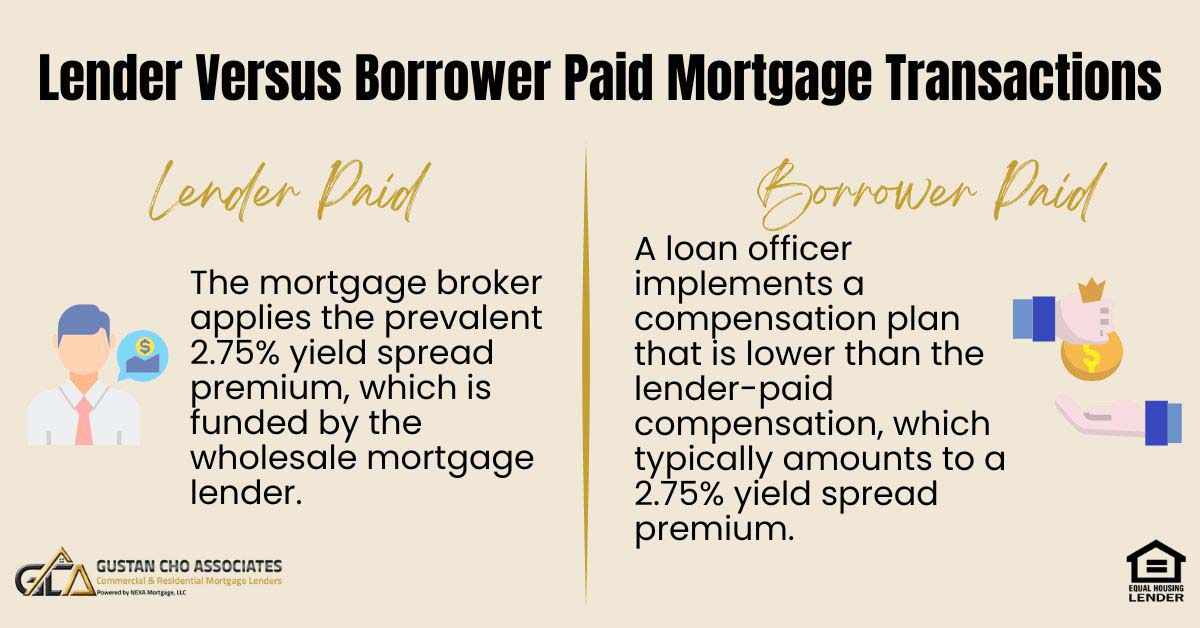
    With lender-paid compensation, the wholesale lender pays the broker’s fee in accordance with their agreement with the brokerage.

    For example, with a $400,000 mortgage and a 2% lender-paid fee, the broker receives $8,000 from the wholesale lender. This fee is incorporated into the lender’s pricing structure, meaning the borrower ultimately bears the cost indirectly.

    In some cases, lender-paid arrangements may offer more favorable pricing, potentially allowing borrowers to allocate funds toward moving or other home-related expenses.

    What is Borrower-Paid Compensation?

    With borrower-paid compensation, the borrower is responsible for paying the broker’s fee directly. For instance, with a $400,000 mortgage and a 2% broker fee, the borrower would pay $8,000 directly to the broker rather than having the lender cover this cost.

    Since the lender does not cover the broker’s fee in this scenario, borrower-paid pricing can occasionally result in more favorable mortgage terms, despite the higher upfront payment required from the borrower.

    Borrower-paid compensation may be advantageous for individuals with sufficient funds who intend to retain their mortgage for an extended period, as it can reduce monthly payments.

    Lender-Paid Compensation and Lender Credits Explained

    Distinguishing between lender-paid broker fees and lender credits can be challenging for many borrowers. Lender-paid broker compensation is the fee the wholesale lender pays the broker for arranging the loan. Lender credits are amounts applied to your mortgage to help cover your closing costs.

    Depending on the selected interest rate and pricing, borrowers may receive both lender-paid broker fees and lender credits to offset closing costs.

    Even when the broker is paid directly by the borrower, the lender may still provide credits to assist with certain closing costs. Federal regulations generally permit the lender to compensate the broker while also offering credits for additional expenses. It is important to recognize that lender credits and broker compensation are distinct and serve different functions.

    Borrower-Paid Compensation Is Different from Discount Points

    Borrower-paid broker fees are not the same as discount points. Broker compensation refers to the fee paid to the mortgage broker for facilitating the loan process. Discount points are additional payments made to obtain a lower interest rate.

    For example, a borrower might pay $6,000 to the broker and $3,000 for discount points. These represent separate costs serving distinct purposes.

    Direct payment to the broker is distinct from purchasing discount points. Discount points do not offset the broker’s fee.

    Can a Loan Officer Benefit More If They Give the Borrower a Higher Rate?

    Federal regulations prohibit mortgage loan officers from receiving increased compensation based on loan characteristics such as interest rates. Loan officers are not permitted to earn higher commissions if a borrower selects a higher rate. Although lenders may offer varying rates, it is unlawful to adjust a loan officer’s compensation according to the borrower’s chosen rate or loan term. Anti-steering laws further prevent loan originators from directing borrowers toward loan terms that would increase their own compensation.

    Example of Lender-Paid vs. Borrower-Paid Compensation

    Let’s say you take out a $400,000 mortgage. These numbers are just examples and do not reflect current rates. With the lender-paid option, the interest rate may be 6.75%, and the lender pays the broker $8,000. The borrower does not pay this fee directly.

    If the borrower pays the broker, the interest rate could be 6.375%. In this scenario, the borrower pays the $8,000 fee rather than the lender.

    Although 6.375% is a lower rate, it is important to consider the time required to recover the additional upfront payment through monthly savings. In this example, paying the extra $8,000 reduces the monthly payment by approximately $150.

    Mortgage Break Even Point

    The break-even point would be reached in about 4 years and 5 months, or 53 months. If the mortgage is sold, paid off, or refinanced before reaching the break-even point, the lender-paid option is generally more advantageous, even with a higher interest rate. However, for borrowers who intend to keep their mortgage for many years, paying the broker’s fee upfront to secure a lower rate may yield greater long-term savings.

    When Borrower-Paid Compensation May Make Sense

    Borrower-paid compensation is beneficial for individuals with sufficient funds for closing who can secure a significantly better interest rate by paying the broker directly. It can also assist borrowers with a high debt-to-income ratio who require a lower monthly payment to qualify for a loan.

    The longer the borrower remains in the home, the more opportunity there is to recoup the upfront cost. Borrower-paid compensation can be particularly attractive when lender pricing allows for a reduced interest rate, potentially resulting in substantial savings over the life of the loan.

    Benefits of Lender Paid vs Borrower Paid Compensation

    Lender-paid compensation may be preferable for borrowers seeking to minimize closing costs, avoid substantial broker payments, and retain cash for emergencies, renovations, moving, or other expenses. Lender-paid compensation is suitable for borrowers intending to sell or refinance in the near future. If the borrower is unable to recover the upfront cost of a lower rate before moving or refinancing, paying additional fees may not be justified.

    When evaluating lender-paid versus borrower-paid compensation, it is important to consider factors beyond the interest rate.

    Broker fees, discounts, lender credits, closing costs, required cash at closing, and monthly payments should all be assessed. In some cases, the mortgage with the lowest overall cost may have a higher interest rate. Some borrowers sell or refinance shortly after paying additional fees to lower their interest rate, which may not result in savings. Retaining a mortgage for 15 or 20 years allows for greater benefit from lower payments. Determining the break-even point is essential.

    Loan Originator Compensation

    Federal Regulation Z requires mortgage loan originators to tell borrowers how much they get paid. The amount can change depending on the loan type. originator cannot receive any additional compensation for the same loan. These rules are meant to prevent loan officers from being paid more for placing borrowers in loans that are not in their best interest.

    Each mortgage lender and brokerage has its own policies regarding compensation, pricing, and compliance that must be followed.

    When comparing lender-paid and borrower-paid arrangements, it should not be assumed that one is universally superior. Lender-paid compensation is generally preferable for those seeking to minimize out-of-pocket expenses. Borrower-paid compensation is more advantageous for borrowers who intend to retain their mortgage long enough to recover the additional upfront cost.

    How to Evaluate the Benefits of Lender-Paid vs Borrower-Paid Compensation on Mortgage Transactions

    The most effective approach to comparing lender-paid and borrower-paid mortgages is to evaluate the entire transaction rather than focusing solely on the interest rate.

    When selecting a mortgage, it is important to consider the interest rate, monthly payment, broker fees, discount points, lender credits, closing costs, required cash at closing, and the time needed to reach the break-even point to determine the most suitable option.

    https://gustancho.com/lender-versus-borrower-paid/

Log in to reply.