
-
Looking to lower your monthly payments or get your finances back on track?
Posted by Bryon Walton on July 22, 2026 at 6:01 amJust wanted to share this because I know a lot of people are feeling the pressure with bills and high interest rates lately.
If you’re paying a lot on credit cards or other debts, or you’ve been thinking about refinancing your mortgage, it might be worth looking into some of the loan options that are available right now. You could potentially lower your monthly payments, consolidate debt, or find a solution that better fits your situation.
It doesn’t hurt to check and see what’s available—you might be surprised by the options.
I’ve attached a link below for anyone who wants to take a look. Hopefully it helps someone.
Sung Kyung replied 1 month, 4 weeks ago 3 Members · 5 Replies -
5 Replies
-

I remember making six figures a year was a high upper-class wage earner. That is so not true. I make over $150,000 per year gross. Net, I probably bring home $90,000. $2,300 monthly mortgage, two vehicle loans: One is $576.00 per month, and the other is $838.00 per month. I have over 30 credit cards with a high credit utilization ratio, so my credit scores are under 580. I have a perfect, timely payment history. Looking to lower your monthly payments or get your finances back on track? Any solutions? Living paycheck to paycheck and need to pay off these super high-interest-rate credit cards.
https://gustancho.com/non-qm-cash-out-debt-consolidation-refinance/

gustancho.com
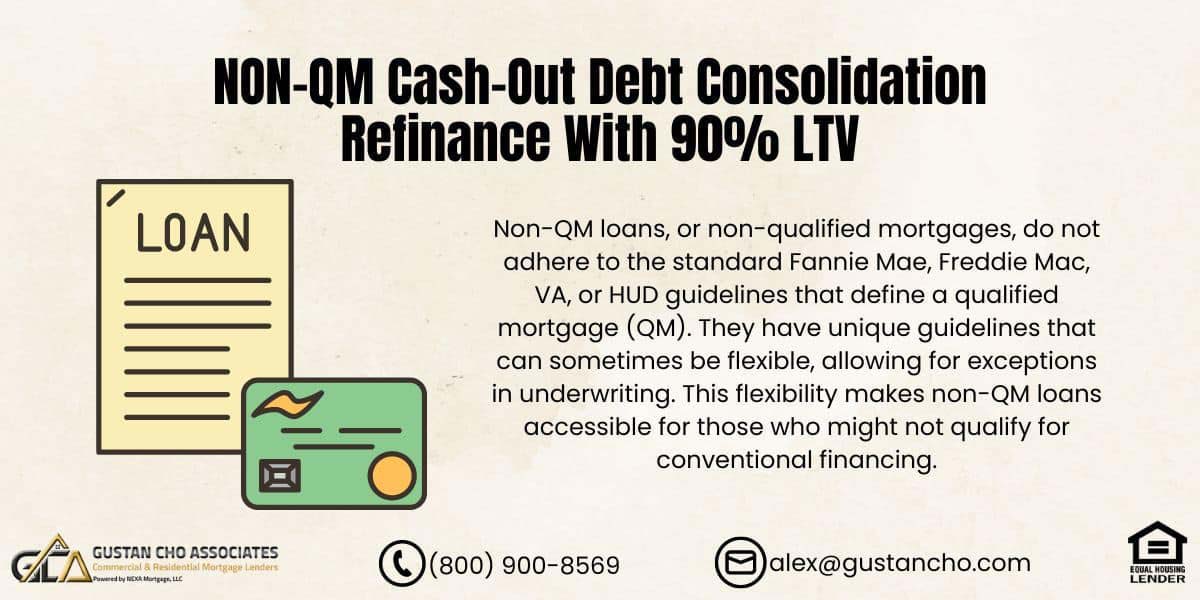
NON-QM Cash-Out Debt Consolidation Refinance With 90% LTV
Gustan Cho Associates offers NON-QM Cash-Out Debt Consolidation Refinance Loans for homeowners with up to 90% LTV.
-
Yes, there are practical ways to lower your payments and manage debt. Given your financial ratios, it’s important to have a careful plan and consider getting professional advice.
- Begin by making a plan to pay down your debt. Focus on paying off the balances with the highest interest rates first. You might also want to look into debt consolidation to lower your monthly payments. Having a clear payoff plan can save you money in the long run.
- Take another look at your housing costs. If you can get a better mortgage rate or loan terms, refinancing could help lower your payments.
- Set up a budget that covers your essentials, debt payments, and some savings for emergencies. Lowering your credit card balances and improving your credit score will also help if you need to borrow in the future.
If you’d like, I can create a step-by-step plan based on your specific numbers and suggest some refinancing or consolidation options.
-
THIS ABSOLUTELY DOES NOT TELL ME ANYTHING. THIS RESPONSE IS ABSOLUTELY WORTHLESS.
-
Managing cash flow and unsecured debt is challenging when your credit score is below 580. Avoid taking out additional loans, as this may worsen your financial situation.
Your Current Cash Flow
Your annual income is approximately $90,000, or $7,500 per month.
Known Monthly Obligation Amount
Mortgage $2,300
Vehicle Loan 1: $576
Vehicle Loan 2 $838
Total Known Fixed Payments: $3,714
- After fixed payments, you have $3,786 remaining each month before accounting for utilities, food, insurance, fuel, credit card bills, and other expenses.
- Nearly half of your monthly income is allocated to credit card payments.
- With over 30 cards near their limits, minimum payments may consume the remaining $3,786 each month.
- Timely bill payments are essential for maintaining a positive credit history.
- To protect your credit, avoid debt settlement companies.
Best Path: Stabilize First
With a credit score below 580 and high credit card balances, obtaining a consolidation loan is difficult. If approved, the interest rate may be high, and lower monthly payments could result in higher total interest over time.
Consider a nonprofit debt management plan (DMP) before seeking additional loans. A DMP counselor will review your debts and income, may negotiate lower interest rates and fees, and help you establish a single monthly payment. You will still owe the full balance; this is not debt settlement.
According to the CFPB, credit card companies often offer hardship programs, and nonprofit counselors can assist with budgeting and repayment plans. DMPs consolidate your debts into one payment and may reduce interest rates and fees, but typically close your accounts to new purchases.
Since most of your 30 credit cards are maxed out, this can help prevent further increases in your balances. Use cash or a debit card for necessities, and avoid using your credit cards. Do not close any accounts or attempt further consolidation at this stage. Prepare a detailed list of all debts, including creditor, balance, credit limit, interest rate, minimum payment, and due date for each card. Also, list all other monthly bills, such as car insurance, utilities, groceries, medical expenses, child support or alimony, taxes, subscriptions, and personal loans.
Contact the Hardship Departments of Each Credit Card Issuer and State the Following:
- State, “I have always made payments on time, but the payments on my revolving debt have become unaffordable.”
- Inquire about hardship programs, lower APRs, fixed payment plans, or other assistance options.
- Obtain all details for any offer, including interest rate, payment amount, plan duration, fees, account status, and credit report impact.
- Schedule meetings with two nonprofit counseling agencies affiliated with the National Foundation for Credit Counseling (NFCC).
- Request a formal written DMP proposal from each, not just an estimate.
- Compare monthly payments, fees, interest rates, repayment terms, and the effect on your credit accounts.
- NFCC-certified counselors will review your budget and may recommend a DMP.
- If these options are not suitable, continue making minimum payments to protect your payment history.
- Avoid for-profit debt settlement programs, as they often advise stopping payments, which can damage your payment history.
- Balances may increase due to additional fees and interest, potentially leading to collections or legal action.
- Forgiven debt may also be taxable.
- The CFPB recommends nonprofit counseling, and the FTC warns against scams and false promises from debt relief companies.
- By law, these companies cannot charge fees until your debt is reduced or paid off.
- If considering refinancing or a home equity line of credit (HELOC) to pay off credit cards, be aware that this converts unsecured debt into debt secured by your home.
- Given your current credit card usage and 580 credit score, loan terms may be unfavorable.
- Only consider this option after receiving a written DMP offer, reviewing all mortgage and closing costs, and understanding the payments and risks.
- Calculate the total cost, payment terms, fees, and APR to ensure all credit card debt is addressed.
- Lower payments over a longer period may result in higher overall costs.
- If DMP payments are unaffordable or the plan exceeds five years, consider consulting a bankruptcy attorney.
- Local attorneys can provide a judgment-free consultation and review your finances.
- Before using home equity or retirement savings, seek legal advice.
- If you have a steady income, a court-supervised repayment plan may offer more flexibility than managing credit card bills on your own.
- Seek legal advice tailored to your state and financial situation.
- A professional can explain your options and help you determine the best course of action.
- To decide your next step, whether it is a hardship program, DMP, consolidation, changing vehicles, refinancing, or bankruptcy, you will need to know your total credit card balances, total minimum monthly payments, and essential monthly expenses, excluding mortgage and car payments.
For example, with $50,000 in credit card debt at a 30% interest rate, you would pay over $1,250 in interest each month before reducing the principal. This demonstrates why minimum payments are often insufficient, even with a high income. Prepare a comprehensive list of your debts and obtain two written proposals for nonprofit DMPs.
-
Yes. Based on what you described, this sounds less like an income problem and more like a cash-flow and high-interest revolving-debt problem. A $150,000+ income can still feel paycheck-to-paycheck when the mortgage, two auto loans, and minimum payments on 30+ highly utilized cards consume most of the monthly take-home pay.
Your situation also has one major positive: perfect payment history. If the sub-580 score is primarily being driven by very high revolving utilization rather than late payments, substantially reducing those balances can help the credit profile as the lower balances report. CFPB specifically notes that scoring models consider how close revolving accounts are to being maxed out and that lower utilization generally helps. (Consumer Financial Protection Bureau)
What I would look at first
Your mortgage and two car payments alone total $3,714 per month. With roughly $90,000 in annual take-home income, that’s almost half of your approximately $7,500 monthly net income before making a single credit-card payment, buying groceries, paying utilities, insurance, gasoline, taxes, or anything else.
The credit cards are therefore probably where the cash-flow problem becomes severe.
1. Find out how much home equity you have. If there is substantial equity, a home-equity loan, HELOC, second mortgage, or cash-out refinance could potentially replace very high-rate revolving debt with a substantially lower payment. A home-equity loan uses the home as collateral, however, so this is not simply moving numbers around—the unsecured credit-card debt becomes debt secured by your house. (Consumer Financial Protection Bureau)
2. Don’t automatically refinance the existing first mortgage. If your current mortgage has a good rate, replacing the entire $2,300 mortgage just to access cash may make little sense. A fixed-rate second mortgage or HELOC could potentially leave the first mortgage untouched. Which is better depends on your current mortgage rate, balance, property value, total card debt, and available second-mortgage pricing.
3. FHA cash-out may be worth investigating if conventional financing isn’t available. FHA cash-out refinances are currently limited to 80% LTV/CLTV. (HUD.gov) A sub-580 score does not mean every possible mortgage solution is automatically off the table, but individual lenders can impose credit-score and underwriting requirements beyond the underlying program rules. The numbers would have to make sense after mortgage insurance, closing costs, the new rate, and the amount of debt actually eliminated.
4. Call every major credit-card issuer before missing a payment. Ask specifically for the hardship department, not just ordinary customer service. Ask whether they can reduce the APR, waive fees, place the balance into a fixed-payment program, or otherwise modify the account. CFPB recommends contacting creditors directly as one of the alternatives to debt-settlement companies. (Consumer Financial Protection Bureau) Your perfect payment history gives you a much better story to tell than someone who is already seriously delinquent.
5. Consider a nonprofit debt-management plan before debt settlement. A legitimate nonprofit credit counselor can sometimes negotiate lower credit-card interest rates and organize multiple cards into one structured monthly payment. That’s very different from a debt-settlement company telling you to stop paying creditors. CFPB specifically distinguishes nonprofit credit counseling from debt settlement and warns consumers to understand the risks of settlement programs. (Consumer Financial Protection Bureau)
I would be very cautious about debt settlement
With perfect payment history, I would not intentionally destroy that history simply because the utilization is high.
Some debt-settlement programs encourage consumers to stop making payments while money accumulates for settlements. That can mean late payments, collections, fees, potential lawsuits, and major credit damage. CFPB warns consumers to consider alternatives before using these companies. (Consumer Financial Protection Bureau)
I’d investigate legitimate consolidation and hardship options before allowing one account to become 30 days late.
Don’t close 30 credit cards just because you pay them off
Once balances come down, don’t automatically close all of the accounts. Closing available revolving credit can increase your utilization percentage and potentially lower your score. (Consumer Financial Protection Bureau)
You can pay a card to zero, stop carrying it in your wallet, remove it from shopping apps, and essentially “freeze” it yourself while keeping the available credit—assuming there isn’t an annual fee or another reason to close it.
The two vehicles deserve a hard look too
You are paying $1,414 every month just for the two vehicle loans.
If both vehicles are necessary, that’s one thing. But if one of them could realistically be sold or replaced with something substantially less expensive without creating a big negative-equity problem, eliminating even the $838 payment would create nearly $10,000 a year of additional cash flow.
That’s the kind of change that can materially alter the situation without touching the house.
The biggest mistake would be consolidating everything and running the cards back up
CFPB makes an important point about consolidation: if the underlying monthly spending remains higher than available income, consolidation by itself doesn’t solve the problem. (Consumer Financial Protection Bureau)
For someone with 30+ cards, I would make any consolidation strategy conditional on one rule:
The paid-off credit cards don’t get used again to finance ordinary living expenses.
Otherwise you can end up with the new mortgage/second mortgage plus another $50,000–$100,000 of credit-card debt several years later.
What I would investigate in your case
In this order:
-
Home equity loan/second mortgage that leaves a favorable first mortgage alone.
-
Cash-out refinance, including FHA possibilities if the numbers and equity support it.
-
Credit-card hardship programs while every account is still current.
-
Nonprofit debt-management plan to substantially reduce card APRs.
-
Strategic utilization paydown to improve the score before applying for better financing.
-
Look seriously at whether the $838 vehicle payment can be eliminated or reduced.
-
Avoid shotgun applications for personal loans and 0% cards while the score is under 580; the pricing and approvals may not solve the problem.
And I completely agree with the larger point you’re making: $150,000 gross income does not automatically mean someone feels wealthy anymore. Income is only half the equation. Debt payments, interest rates, housing, vehicles, insurance, taxes, and revolving debt can make a six-figure household feel broke every payday.
If you give me your estimated home value, mortgage balance and interest rate, total credit-card balances, total minimum card payments, and balances/rates on the two vehicles, I can run through this exact scenario and tell you which approach would likely create the biggest monthly cash-flow improvement—and whether touching the first mortgage makes financial sense at all.
consumerfinance.gov
How do I get and keep a good credit score? | Consumer Financial Protection Bureau
There is no secret formula to building a strong credit score, but there are some guidelines that can help.
-


Log in to reply.