
 Real Estate Professional
Elmoustahyi Abdallah
Real Estate ProfessionalForum Replies Created
-

Elmoustahyi Abdallah
MemberNovember 4, 2026 at 9:12 pm in reply to: How are lenders adjusting DTI requirements for high-tax/insurance states?Thank you both, Lisa and Dustin. This is exactly the kind of technical clarity I was hoping for.
To answer your question, Dustin: I’m primarily looking at Conventional and FHA programs, as those are the most common for first-time buyers in high-tax states. The point about the “ceiling” being different for each program (FHA vs. VA vs. USDA) is crucial, and I think many buyers don’t realize that.
Lisa, your example of the $500 difference in taxes/insurance directly reducing the loan amount by $500 is spot on. This is why it’s so important for buyers to calculate their “True Cost” (PITI + HOA + maintenance) before they even start house hunting.
To help with this, I actually built a free, privacy-first calculator that lets buyers input their exact numbers (including estimated taxes and insurance) to see their real DTI and PITI before talking to a lender. No sign-up required, and it runs 100% in the browser.
If you or your clients want to run the numbers, you can check it out here: https://smartmortgagecalc.space/true-cost
I appreciate you both sharing this expertise. It’s helping a lot of buyers avoid these pitfalls.

smartmortgagecalc.space
True Cost of Homeownership Calculator [2026] — Full PITI, HOA & Taxes
Calculate your true monthly cost of homeownership in 2026. Uncover hidden expenses beyond the mortgage: HOA dues, property taxes, home insurance, and repairs.
-
Elmoustahyi Abdallah
MemberNovember 4, 2026 at 4:18 pm in reply to: The “P&I” Illusion: Why your first mortgage payment will be higher than you thinThis is a fantastic addition. You’re absolutely right—the “P&I Illusion” is exactly why so many first-time buyers get blindsided. They budget for the principal and interest, but forget that property taxes, insurance, and maintenance reserves can add 30-40% to the monthly cost.
Your point about maintenance (1-2% of home value) is spot on. For a $400k home, that’s $333 to $667 per month that most people don’t budget for. This is exactly why I built the “True Cost” calculator—to help buyers see the real number before they commit. It runs 100% in the browser (no sign-up, no data tracking).
You can check it out here if you want to run the numbers for your area: https://smartmortgagecalc.space/true-cost
Thanks for sharing this insight!-
This reply was modified 1 week ago by
 Elmoustahyi Abdallah.
-
This reply was modified 1 week ago by Elmoustahyi Abdallah.
-
This reply was modified 1 week ago by Elmoustahyi Abdallah.
-
This reply was modified 1 week ago by Elmoustahyi Abdallah.
-
This reply was modified 1 week ago by admin.
-
This reply was modified 1 week ago by
-
Elmoustahyi Abdallah
MemberNovember 3, 2026 at 4:34 pm in reply to: Why did the bank reject my mortgage pre-approval even though my salary easily coThis is a masterclass; thank you all. Dustin, your point about “lender overlays” is crucial. Michelle, your breakdown of DTI and the bi-weekly payment strategy is spot on. Ken, your insight on the insurance number being an estimate until the inspection period is exactly the kind of hidden trap that blindsides buyers.
It’s fascinating how the same file can be approved by one lender and denied by another just because of overlays. This is why it’s so important for buyers to understand their true DTI and the real cost of ownership (including insurance and taxes) before they even apply.
To help with this, I actually built a free, privacy-first calculator that lets buyers input their exact numbers (including estimated insurance and taxes) to see their real DTI and PITI before talking to a lender. No sign-up required, and it runs 100% in the browser.
If you or your clients want to run the numbers, you can check it out here: https://smartmortgagecalc.space/true-cost
Thanks again for sharing this invaluable expertise. It’s helping many buyers avoid these pitfalls.
-
This reply was modified 1 week, 1 day ago by Elmoustahyi Abdallah.
-
This reply was modified 1 week, 1 day ago by admin.
smartmortgagecalc.space
True Cost of Homeownership Calculator [2026] — Full PITI, HOA & Taxes
Calculate your true monthly cost of homeownership in 2026. Uncover hidden expenses beyond the mortgage: HOA dues, property taxes, home insurance, and repairs.
-
This reply was modified 1 week, 1 day ago by
-
Elmoustahyi Abdallah
MemberOctober 29, 2026 at 7:57 am in reply to: Why “Cash Offers” are not always better than a Mortgage (The Opportunity Cost)Excellent breakdown, Lisa. You’ve highlighted the exact trade-off: Liquidity vs. Leverage.
The “peace of mind” factor you mentioned is often underestimated. Having $400k tied up in a house means you can’t easily access it for emergencies, and as you said, selling or borrowing against it takes time and costs money.
This is exactly why I built the “Opportunity Cost” calculator on my site. It helps buyers compare the true cost of a cash purchase vs. a mortgage, factoring in the potential investment returns of keeping that cash liquid.
If anyone is running these numbers, you can try the free tool here (no sign-up required): https://smartmortgagecalc.space/compare
What do you think is the biggest mistake cash buyers make when they ignore the opportunity cost?
smartmortgagecalc.space
Mortgage Comparison Calculator — 15 vs 30 Year Comparison [2026]
Compare two mortgage options side-by-side with visual payment breakdowns, lifetime savings, and payoff timeline charts.
-
Elmoustahyi Abdallah
MemberOctober 28, 2026 at 11:51 am in reply to: Mortgage Rates Near 7% Again: Why P&I Calculators Are Misleading Buyers in 2026This is incredibly valuable feedback, Tina. Thank you.
You’ve highlighted a crucial gap in most calculators: the difference between “Market Value” and “Insured Replacement Cost.” A $400k home might cost $500k+ to rebuild in today’s market due to material and labor costs, and buyers need to see that gap.
I love your idea of adding a “Side-by-Side Insurer Quote Comparison” and displaying deductibles in both percentage and dollar amounts. This is exactly what a modern calculator should do.
I’m going to take your suggestions and work on updating my True Cost Calculator to include these features. Your insights are helping me build a better tool for buyers and agents.
Thanks again for the masterclass in insurance transparency!
-
This reply was modified 2 weeks, 1 day ago by Elmoustahyi Abdallah.
-
This reply was modified 2 weeks, 1 day ago by Elmoustahyi Abdallah.
-
This reply was modified 2 weeks, 1 day ago by Elmoustahyi Abdallah.
-
This reply was modified 2 weeks, 1 day ago by Elmoustahyi Abdallah.
-
This reply was modified 2 weeks, 1 day ago by
-
Elmoustahyi Abdallah
MemberOctober 27, 2026 at 11:31 am in reply to: Does making one extra mortgage payment a year really knock years off your loan,Great question, Julio. The math depends heavily on your loan amount and interest rate, but here is the quick breakdown:
1. **Paying twice a month (Semi-Monthly) vs. Monthly:**
Paying half your mortgage on the 1st and half on the 15th does *not* save you interest. It just changes the timing. You are still making 24 half-payments = 12 full payments a year.
2. **Paying every two weeks (Bi-Weekly):**
This is where the magic happens. You make 26 half-payments a year, which equals **13 full payments**. That extra payment goes directly to principal. To calculate the savings, you divide your monthly payment by 12, and add that amount to your monthly payment. For example, if your P&I is $2,400, dividing by 12 gives you $200. Adding $200/month gives you the same effect as one extra payment per year.
3. **How to calculate the exact savings:**
To see how many years you shave off (usually 4-6 years) and how much interest you save, you need to run an amortization schedule.
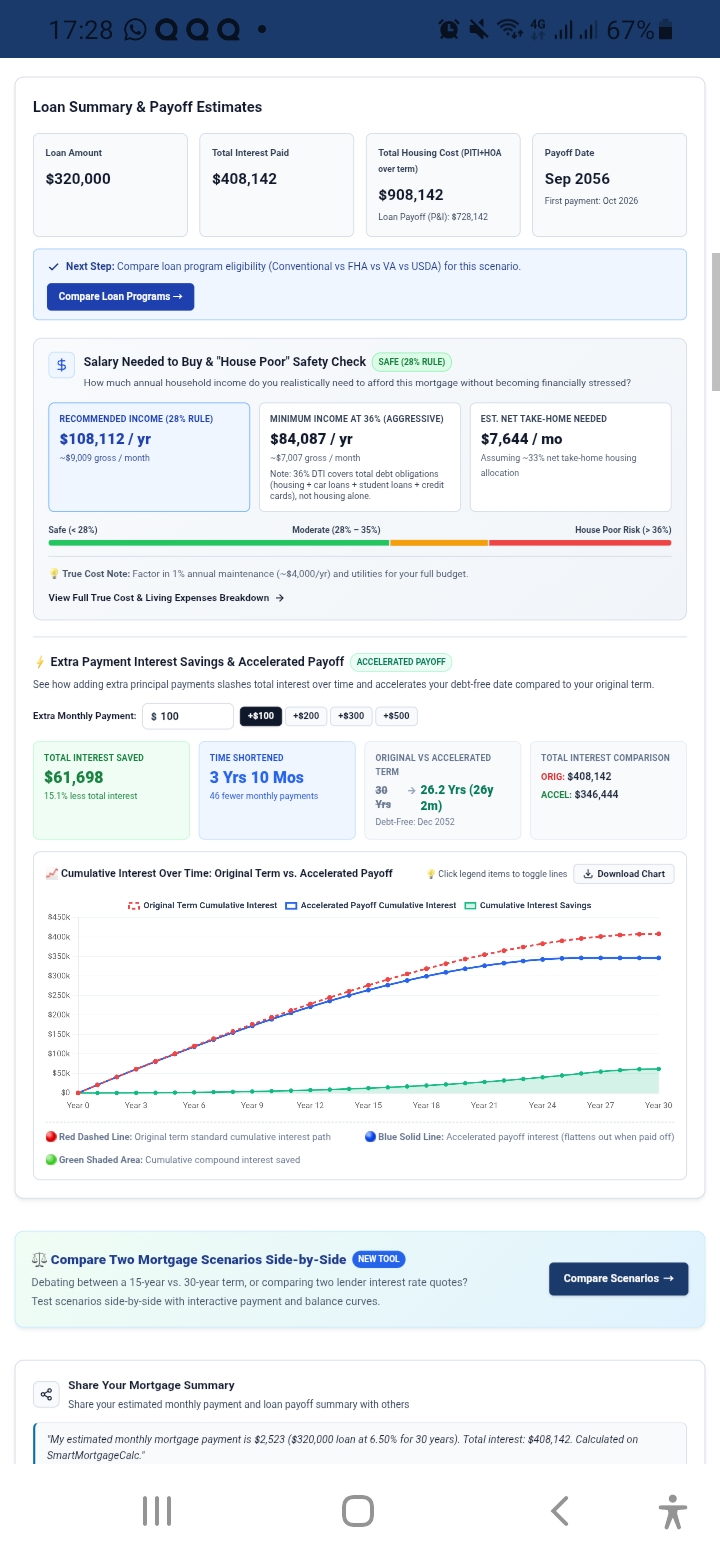
I actually built a free, privacy-first calculator that does exactly this math. You can input your loan amount, rate, and extra monthly payment, and it will show you the exact new payoff date and total interest saved.
You can check it out here (no sign-up required, 100% private): https://smartmortgagecalc.space/extra-payment
Let me know if you have any questions about the results!
smartmortgagecalc.space
Extra Payments Toward Principal Calculator [Save $100k+] | SmartMortgageCalc
Calculate how extra payments toward principal save $100k+ in interest and eliminate years of debt.
-
Elmoustahyi Abdallah
MemberOctober 24, 2026 at 1:17 pm in reply to: GCA Mortgage Forums Saturday and Sunday September 26 and 27 2026Exactly, Gustan. The spread between the 10-year Treasury and 30-year mortgage rates has widened significantly.
Lenders are pricing in higher risk premiums due to inflation volatility and the uncertainty around the Fed’s next moves. Even if Treasuries dip, mortgage rates are sticky because lenders are protecting their margins and managing pipeline risk.
Do you think the spread will normalize in Q4, or should buyers expect these “sticky” rates to remain through the end of the year?
-
Elmoustahyi Abdallah
MemberOctober 23, 2026 at 3:16 pm in reply to: Mortgage Rates Near 7% Again: Why P&I Calculators Are Misleading Buyers in 2026This is gold, Ken. Thank you for this detailed response.
The "Deductible Trap" is something almost every first-time buyer misses. They look at the premium, feel relieved it's within budget, and then get hit with a 2% or 5% wind deductible when a storm hits. Your point about asking the agent specific questions during the inspection period is exactly the kind of practical advice buyers need.
Since you are in the industry, I'd love to ask: Do you think insurance companies will start making deductibles more transparent on the initial quote pages to help buyers compare apples to apples? Or will it remain buried in the fine print?
Also, if you have any suggestions on how to improve the insurance section of my True Cost Calculator (to make it more useful for agents like you), I would genuinely love to hear them.
Thanks again for the invaluable insights.-
This reply was modified 2 weeks, 5 days ago by Elmoustahyi Abdallah.
-
This reply was modified 2 weeks, 5 days ago by Elmoustahyi Abdallah.
-
This reply was modified 2 weeks, 5 days ago by
-
Elmoustahyi Abdallah
MemberOctober 23, 2026 at 9:01 am in reply to: Mortgage Rates Near 7% Again: Why P&I Calculators Are Misleading Buyers in 2026This is a brilliant addition, Ken. Thank you for bringing the insurance agent’s perspective into this.
You are absolutely right about the “quote variance” and the “escrow shock” at renewal. This is exactly the hidden trap that most buyers miss. They budget based on the seller’s old premium or a generic online estimate, and then get hit with a much higher bill in Year 2.To address this, my True Cost Calculator allows users to manually input their own estimated insurance premium and tax reassessment. It was designed specifically to avoid the “built on sand” problem you mentioned.
Since you are in the insurance industry: What is the #1 mistake you see buyers make when estimating their insurance costs for a new property? And is there a specific question they should ask their agent to get the most accurate quote?
Thanks again for sharing this invaluable insight.
-
This reply was modified 2 weeks, 5 days ago by admin.
-
This reply was modified 2 weeks, 5 days ago by